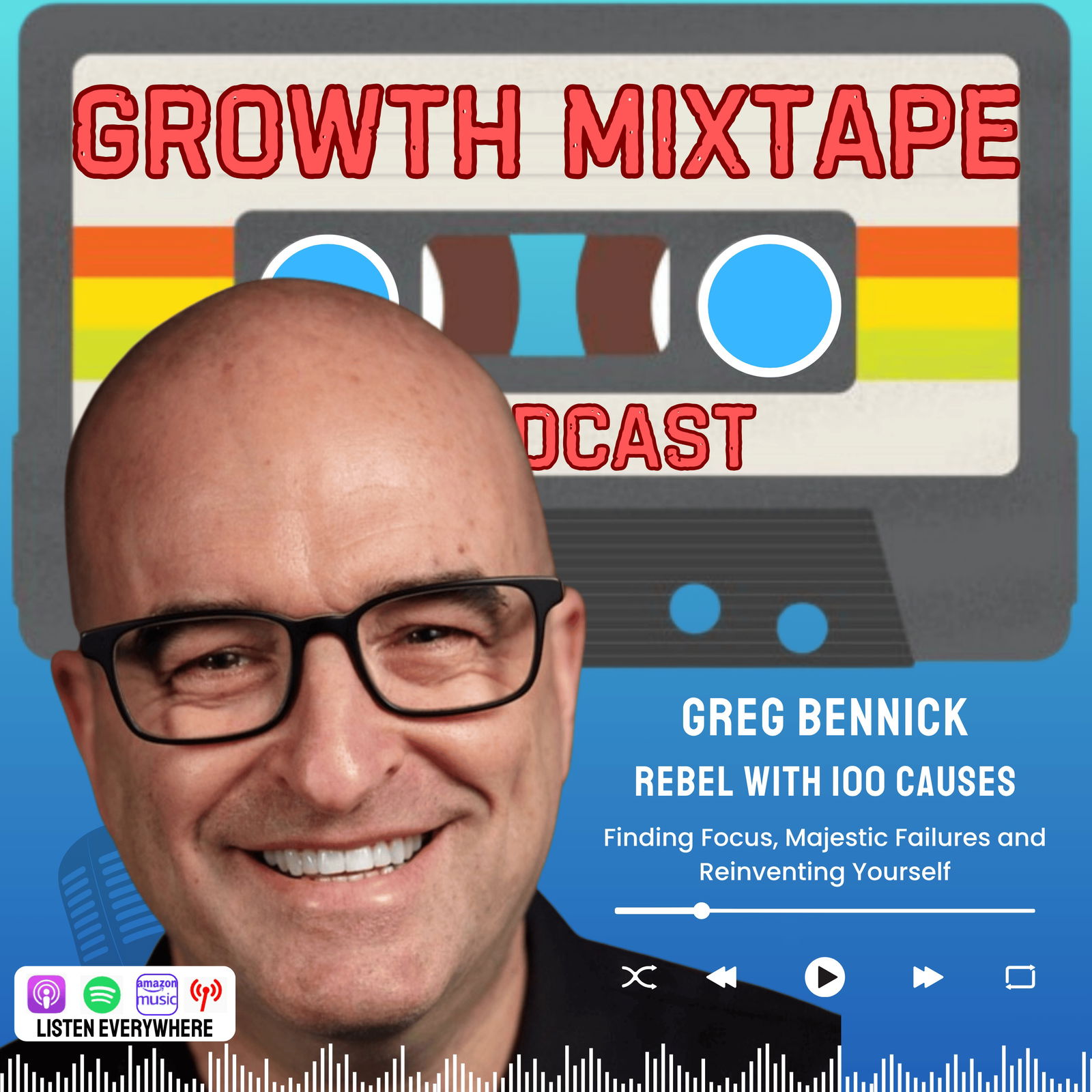
This is a re-release of my original conversation with Greg Bennick from early 2024. It is simply too good not to share again. Greg is a punk rocker, activist, documentary filmmaker, philanthropist, keynote speaker, juggler and expert coin collector. He’s also written a book, “Reclaim the Moment: Seven Strategies to Build a Better Now.”
I could have talked to Greg for an hour about any one of these parts of his life - he’s got a way of making everything that interesting. We talk about Seattle’s teen dance ordinance, a real-life Footloose law that he helped overturn. We talk about how punk music is really just love songs. And we explore the central themes that tie all of his various pursuits together.
If you ever struggle with focusing on what matters, finding your purpose or trying to figure out what makes you special in this world - this conversation is for you.
Please enjoy Greg Bennick.
Key Takeaways:
- Changing the system from within: Greg’s involvement in overturning Seattle’s teen dance ordinance showcases the power of grassroots advocacy and persistence when making changes from within the system..
- Straight edge movement: Explore a subgenre of punk that emphasizes a lifestyle free of alcohol and drugs that is centered around the love of music..
- Majestic failures: Nobody advertises their failures. But behind every best-selling book or successful keynote speech are dozens of failures that paved the way for the success everyone sees.
- Re-inventing yourself throughout your career: Your journey is unique. You have more to offer the world than you think. Deciding what to do next in your career is not about what, but why.
- Focus and Balance: Strategies to maintain focus and balance in a world filled with distractions, as discussed in Greg’s upcoming book, “Reclaim the Moment.”
Resources Mentioned:
Connect with Greg Bennick:
Website
Instagram
LinkedIn
Connect with Bob
LinkedIn
Instagram
Greg
I talk about ways to get back on center that I use when the world has thrown me off track. So, there's a chapter in the book called keep your eyes on the knife. It's a juggling metaphor, basically. And, you know, if I'm juggling and I'm juggling two beanbags and a knife and those are the tasks ahead of me, I need to keep my eyes on the knife because that is the mission critical task upon which everything else rests. If I drop a beanbag on my chest, that's fine. If I drop a knife that I'm juggling through my chest, not as great of an outcome. So what is the mission critical task that I'm focusing on? Bob
Hi. I'm Bob Mathers, and welcome to the Growth Mixtape, a podcast where I talk to the most interesting people you might not have come across yet. I find that these conversations give me new insights and perspectives about topics I didn't know existed. These conversations might not seem to have a lot in common at first. Just like songs and a mix tape, they create something memorable and emotional. Today, we talked to Greg Benick. Now I've had some incredible guests on this show, but goddamn, I love this conversation. So you ready? He's a punk rocker, activist, documentary filmmaker, philanthropist, keynote speaker, juggler, and expert coin collector. He's also written a new book, Reclaim the Moment, Seven Strategies to Build a Better Now. I could have talked to Greg for an hour about any one of these parts of his life. He's got a way of making everything that interesting. We talk about Seattle's Teen Dance Ordinance, a real life Footloose law that he helped overturn. We talk about how punk music is really just love songs, and we explore the central themes that tie all of his various pursuits together. If you ever struggle with focusing on what matters, finding your purpose, or trying to figure out what makes you special in this world, this conversation is for you. Please enjoy Greg Benick. Alright, mister Greg Benick. Welcome to the show, man. I'm, I'm so happy that you've, that you're here. Greg
Me too. I'm I'm overjoyed overjoyed to be here. Bob
That's awesome. So you're in Seattle. Right? Bob
But you're born in New York? Greg
No. Actually, born on the East Coast in Philadelphia, upbringing in Connecticut and then also, Chicago, Illinois, just outside of Chicago, and then moved to Seattle, decades ago to, to go to acting school and study theater. So I've been here, in Seattle for quite a while. Bob
Oh, that's cool. Like, for somebody that travels as much as you do as doing all your speaking, that seems like a out of the way place to get around. Greg
It is. Isn't it? Yeah. Yeah. No. Logistically, this makes no sense. Yeah. Absolutely. In fact, the smartest thing that I ever heard of was many years ago. I had some friends who did a, this kind of like wife and husband couple singing presentation, and they would go around to events and sing with this style in the nineteen fifties. And they had a fifties, like, fifty seven Chevy they would show up in and all this sort of thing. And they started thinking, gosh. Why, you know, why are we living on on the East Coast when what we need to be doing is have easy access to events? And they looked at a map of the United States. They pointed at the center. They went to Claflin, Kansas. They bought a house for probably fifteen thousand dollars, and they lived in Claflin, Kansas and could get to their gigs easier, and they were the smartest people in the world. Yes. I live in the furthest corner of the United States, which is obviously very convenient to to get to nowhere. So, yeah, there you go. Bob
Yeah. I've never been to Seattle, but the Canadian version of that is people that, grow up in Toronto and move to Vancouver, and nobody comes home. Like, once you get a chance to live on the ocean, in the mountains, that's it. You're done. That's Yeah. And, you know, we have friends that, oh, yeah. My kid's going to University of British Columbia. I'm like, yeah. Well, good. You're that's it. They're not it's one way ticket, man. They're coming home at Christmas maybe and yeah. Greg
That's right. That's right. And the thing is, you know, thanks to, shout out to Alaska Airlines, my favorite airline in the world. They fly everywhere, and they're super convenient, and I love their airline dearly. It's almost, you know, it's almost like like a cult of us who are like these frequent flyers with Alaska. We're just nuts about the airlines. But it makes access to anywhere easy, of course. But, yeah, you know, when you get off the plane in Seattle, the air is just different. Or if you're up in Vancouver, you know, from a Canadian perspective, it's just different. And that's no effect. No, no offense intended to the folks from Calgary or Edmonton or anything. But, you know, I'd rather get off a plane in Vancouver. It's just like it's really nice. And, all of a sudden, you you just think to yourself, why would I why would I ever leave? And most people don't. So there you go. Bob
Yeah. You shared something just yesterday, I think, about Seattle, and it was so interesting. I had to, ask you about this. What's the thing about this teen dance ordinance in Seattle? Can you talk a little bit about that? Greg
For sure. For sure. I'm so glad. You know, it's really interesting, and this it speaks I'll speak to one thing first and then get into your question. So the post that I put up about the teen dance ordinance got very little response in terms of likes. And part of my brain went, okay. Well, I guess people don't like what I posted. But then I thought to myself, the story of the teen dance ordinance arguably is one of the most interesting elements, parts of my entire life. And it's okay if people didn't react in terms of likes. It's still awesome and valuable. It was a great lesson for me in my own mind of going, you know what? I'm posting things that are meaningful to me, and who's ever along for the ride is great. What's been fascinating is that I've done, two podcasts since yesterday. Both have asked about the teen dance ordinance, which makes me overjoyed. That tells me that the people who are interested in things that I like are the people I'm connecting with, like you. That's very, very cool, and I'm happy to tell you about it. So back to your question now. The teen dance ordinance was a law in Seattle all the way back to the nineteen eighties, which effectively prevented music and all ages music specifically from happening in the city. Meaning, there was a problem in the city's mind that, young people were attending these immoral dances and putting themselves in immoral situations that the city needed to step in and protect them from, and in doing so, made it essentially illegal for promoters to put on concerts in the city and made it illegal for anyone in the city who is, say, nineteen years old to be in an event where people say twenty two years old were. Well, sure. The city's position was that they wanted to keep, quote, unquote, kids safe. But our position as people who are advocating for access to music, access for the arts, and development of culture, we thought, yes, we wanna keep kids safe too. We wanna keep everybody safe, but we want people to have access to music and access to arts and access to avenues for the development of their own creativity. So we started pushing back against the city, and my post yesterday was about changing the system from within. We often think about protests or changes having to come from outside the system, and we've seen recently a lot of protests in the news along those lines. But what we did with the teen dance ordinance was literally go to the city and start knocking on doors and saying, hey. This this law is ridiculous. It's based on a law from nineteen ten that you revised and created this morality law around music and dance, turning Seattle into Footloose, basically. We want kids to be able to and people to be able to access music, arts, and culture, change the law. And over years of doing that, you know, spoiler alert, but we got the law changed. For those interested in the Team Dance Ordinance, look up a podcast called Let the Kids Dance. A guy named Jonathan Zwickle created a seven part podcast miniseries on the history of Seattle's team dance ordinance and the efforts to overturn it. That is brilliantly done. This was literally like the movie Footloose, and Google it, folks, if you've not heard of it, you know, making dancing and making access to music illegal. And and we thought that that was, utterly ridiculous. The city's argument was, you know, access to music, you know, was was inviting alcohol consumption and whatnot. And our our our position was that this is a liquor and control board issue. Like, this is not a music issue. Don't don't conflate, I think, is the right word. Don't combine the two into one. And we approached it from that perspective for years, from the perspective of no. Kids shouldn't be drinking alcohol. I don't drink alcohol. I haven't had a drink since I was seventeen. I think access to music, arts, and culture is essential for a community to thrive. So we basically pushed forward for a law to be enacted around that end. And now the city in Seattle not only supports arts and music, but at Seattle Center, metaphorically and literally the center of the city, there is a city, conjoined run venue, a city run venue, basically. City supported and run venue is a better way to say it. Why did they back it? Well, because a group of us decided we wanted the world to look different and wanted our world to look different, and, we made it Bob
happen. You know, that is man, I'm I'm so glad I got a chance to ask you about that, Greg. You know, when I was when I was doing some research and digging into what we could cover on today, you know, we you're a keynote speaker. I knew you're coming out with a book. I'm like, okay. There's a couple of boxes that make for a good guest. He's got something to say. He's got some good ideas. He's a storyteller. I didn't know you were a documentary filmmaker, a philanthropist, a musician. I didn't know about this teen ordinance. And so I was like, shit. Like, what am I gonna how I could have an hour conversation on any one of these topics with them that I'm genuinely really interested in. How am I gonna pick one? And now five minutes in the podcast, you just added another thing that I'm that, we're not gonna be able to cover in, enough depth. I want to touch on, music. Like, what is it about music that's been such a big big part of your life? Greg
Yeah. I think, you know, when when I started getting interested in music, it was, you know, friends introducing me as for many of us, you know, to records and whatnot and songs when I was in in high school and various songs back in the day. But then, you know, I started to realize that there was the ability for me to engage with music, and I started forming bands with friends in high school and whatnot. And I was interested in punk rock. I happened to be coming up at a time in in Connecticut on the East Coast when the punk rock scene, specifically something called the straight edge scene, which was a non drinking, no drugs, no drinking subculture within punk, was exploding and just really catching on. So all of a sudden, I went from being this teenager who was, you know, drinking and having fun with my friends to realizing two things. One, I didn't have to drink to have fun with my friends. And two, is that the music that I was enjoying was accessible to me to create. Like, I could form a band and be a part of this thing and be generative in terms of my creativity. So that's where that started. And then over the course of my life, rather than do the thing that many people do, which is to say that was fun, now I'm in college. Now I'm going to go get a job. Now I'll continue the rest of my life and eventually shuffle off this mortal coil and die. I said, you know what? I'm gonna keep doing this. I'm gonna keep playing in bands. And I ended up traveling around the world and, playing and and singing in bands. And then, you know, after, you know, the bands weren't touring as actively speaking regularly and and being, you know, in in front of audiences and whatnot and speaking. So and and doing that in the context of music, meaning I I traveled all over the planet speaking to the same audiences the band would have seen, but instead, I was just speaking without the band. I did the first ever spoken word tour of all of Russia, twenty one dates across Russia and Ukraine. And I was speaking to, some nights, the same punk audiences that I would have played to with the band. On other nights, speaking at a museum somewhere in the middle of Russia to a handful of maybe punk music related people who had set up the event, but the entire audience is, local communities. It was amazing. Bob
God. That's amazing. Yeah. I had never heard of the straight edge kinda subculture. Actually, I think it was I was listening to a podcast where you were a guest in preparation for this, and you you dropped the turn. I'm like and I was actually with some of my friends last night. I'm like, have you ever guys ever heard of this? And they're like, oh, yeah. You know, some of them are pretty, you know, know a lot about music. I was like, oh, shit. So that's really interesting. I didn't I had never heard of that. Like, if you see punk scene, like, I just imagine, people in a mosh pit slamming around, and that still happens just without the alcohol piece, I guess. Greg
And and but with with a different mindset. Right? So, you know, punk punk has often been equated with nihilism, right, and destroy this and smash that. And I was always, really quick to tell people in terms of my band and our record that if people were interpreting it as anger, rage or nihilism, that they'd missed the point entirely. These were essentially all love songs, not love like, you know, I love you, then you left me, our hearts are broken, you know, woe is us. But rather, these were all love songs rooted in passion and a desire for a better reality, a better life, better connections. And if people had misinterpreted them as anger songs, then then that was on them and please relisten. But, you know, punk, went the same way in that it was about nihilism. And some people realized, wait a minute. We don't want this to be the case. We can do better. And, it was in Washington, DC. People started, as as the as the mythology and the truth of it goes, there were clubs where you get an x on the back of your hand if you were underage to signify that you couldn't drink. And there was a group of individuals who started to come to these shows having drawn x's on the backs of their hands to say, we don't need your little x saying that we can't drink. We are defiantly placing a giant x on the back of our hands coming to these punk shows saying we won't be drinking. And then it became this sort of movement of of positivity and this movement of, because it it spread. Evidently, it was like the right idea for the right time, and people really latched on to that. So that's that's really cool that that that people latched on to the right idea at the right time and just ran with it. So pretty fascinating. Pretty cool socially and culturally that that happened. Bob
Just a personal aside, about two years ago, I got sober and stopped drinking. Good. And when I started reflecting on that, I've realized that it was a habit that I created. Like, you mentioned seventeen. I basically created this habit where I wasn't smart enough or funny enough or cool enough, and so I needed this crutch to go out and talk to girls and be, you know, the the cool kid. And it kinda did that for a while. But because I never took a break from it my whole adult life, you know, I wouldn't go to a party without having two or three drinks or, you know, any kind of social setting. And it just made me realize, yeah, I had this habit that I started at seventeen, and, you know, it worked for seventeen. But I stopped and was like, I don't need a drink to go be funny or social, and I can be charming, and I can be funny. And, anyway, it was just really interesting when you mentioned that. That triggered that it was, like, you know, if I had gotten in involved in that scene where I could still let out some of that aggression and be part of a community without needing a few drinks that maybe I wouldn't have had carried this habit around with me for thirty five years before one day realizing I didn't need it anymore. Greg
Yeah. May may maybe I'm just I'm just glad that you finally reached that point, whether the pathway was by way of punk rock, which might have led to you having constant ringing in your ears and being generally disgruntled because your band didn't get signed to a label or whatever it could have been. Maybe you would have end up woefully disappointed instead, but the path you're on led led to this, and that's that's great. I'm just happy that, that you're in that in that zone of, sobriety. That's a great place to be. Bob
Hey. It's Bob, and I'm taking the growth mixtape on the road in a series of keynote speeches inspired by the stories of my amazing guests. At their core, these signature talks are about how to get you and your teams off autopilot and stop settling for small incremental improvements. This isn't gonna come from spewing business advice. My podcast is full of people that have done incredible things, and every one of them struggles with self doubt, imposter syndrome, and the crippling fear of judgment that holds so many of us back. They've also found ways through it by rediscovering their creativity, their curiosity, and the confidence to do scary things. Imagine the power of bringing these vulnerable stories to life live and on stage to help you and your teams hit your targets, find your voice, and be the rock stars you are. Book me for your next event at bob mathers dot c a. Now back to the show. So a few different things that, I I've just been making some notes here I wanna circle back on, but I did want to come back to something else. You know, I rhymed off a bunch of the things that you've done and, you know, not just a documentary filmmaker, but of some acclaim. You've won awards. You're you're a a speaker. So you've been successful at a lot of different things. And I'm curious maybe there's a couple of questions in here. What that common thread is? Because I talk to people that are in their late twenties that have been in a career for five or six years and are looking to do something different. I also talk to people that have been doing the same job for thirty five years and are eyeing retirement and are trying to think, like, I've been doing the same thing for thirty five years. Like, who's gonna care about selling, you know, rivets for thirty five years? Like, what am I supposed to do? And I think the common thread is that sometimes we can't see how versatile and how valuable and how many different ways we can take this bundle of strengths that we've got and point them in a different direction. You don't seem to have that problem. Like, how do you jump from or take on challenges and do different things all the time? Greg
Okay. So let's let's normalize, me for one second because if we set me up as being the guy who's been successful at all these different things, listeners will immediately do what I hope they would do is to say, I'm not listening to this anymore. I'm not perfect. So let me just say let me just say it's the beginning of my answer. I've also failed majestically at so many things. Right? And the list of things that's left on my resume are not all the things that I've been immensely successful at. We could just as easily argue that I haven't been successful at some of the things that are on my resume. Yes. I've spoken in twenty seven countries. Yes. I did the spoken word tour of Ukraine and Russia. But did I do, three more? Did I go to other places? Did I you know? Yes. I did. Sure. But did I go to as many as I could have? I could argue also that I didn't do enough. Right? So, I think it's important that us that we all recognize that, hopefully, we're doing the best we can. Right? And, hopefully, we're doing, as much as we can in the time that we do have, and, hopefully, we find some measure of success at those things. Let's jump now to the person who's been selling rivets for thirty five years. The person who's been selling rivets for thirty five years is on a path that has worked for them for some reason. It's helped them buy a house and a car and, start a family and all those sorts of things. And as they're eyeing retirement and thinking to themselves, gosh, what could I do with this? Who's gonna care that I sold rivets for thirty five years? Years? Well, there's tons of people who are gonna care that you sold rivets for thirty five years. I mean, how many people in the world have a career path that looks like this? Learned how to juggle, got deeply involved in coin collecting, went and spoke across Russia and Ukraine, ended up as a keynote speaker who does development work in Haiti. I don't know. One? You're talking to him. How many people have led a life where they've thought, you know what? I've been in sales. I can equate sales with other elements of my life. I just don't know exactly know how to do that. All of a sudden, boom. Thirty five, year rivet expert comes along saying, I've been selling rivets for thirty five years. Let me tell you how to take selling rivets for thirty five years and use it as a metaphor for how you connect using the rivet metaphor, different elements of your life. All of a sudden, that person is entering into retirement writing a book on rivets and how rivets are an amazing connective tool and a metaphor for how we have relationships with with one another. Rivet people, I just gave you a million dollar idea. I don't want you to talk to me. Commission basis. The point is is that there's an an immense amount of value in all the paths that we might take through through life. And and what might seem like success to somebody, somebody else is not necessarily our success. And we can we can build off the things we do have and make them successful. So there's lots of potential there. Bob
Yeah. Well, I really do have a friend that's been selling rivets for thirty five years, and he's one of my best friends. But I don't think he listens to this podcast, so I'm not gonna say anything. And in one day, if I never hear anything, I'll know he never he didn't listen to this episode. So Greg
Well and if he does, I want ten percent of the proceeds for the million dollar idea, then I'm stuck. I don't know how to do any of this. Bob
Absolutely. This guy could sell You guys could sell anything. And I'm like, man, you don't realize, like, there are so you could it's it's not a matter of will anybody care. It's like, just decide what group of millions of people would care and go after that. It's amazing opportunity. So and everybody's got that. Everybody's journey is completely unique. Yeah. Yeah. Greg
And that's that's my point. How many people out there have my resume? Like, one. Right? How many people out there have a a sales background or millions. There's millions of people out there. So okay. So with that that said, there's there's ways to benefit those people on a very human level that that are actually, you know, interesting and authentic and not necessarily teaching them how to sell, but how the process of relationships in sales enhances human experience. That's one thing I write about in my book is, like, let's establish relationships, not because they benefit the bottom line, but that profit can take a lot of different forms. Sure. It means maybe a bank account full of money, but, also, it can be very profitable to have a conversation like the one we're having right now. I profit from this. I benefit from this. I get more than the sum of its parts. And that's something I think that's really important for people to remember. Bob
God. I love that. So that's a perfect segue. I do wanna talk about your new book because I I'm genuinely interested in, what you've got to say. But it turns out you're writing two books, and I'd love to just touch on the other one. Who is Ernest Becker, and why did you decide that you needed to write a book about Greg
him? Absolutely. So Ernest Becker is a cultural anthropologist and, brilliant human being who, died in the early seventies, and he is most well known for a book he won the Pulitzer Prize for called The Denial of Death. The Denial of Death was about our, fear on a subconscious level of our mortality and how we manifest responses to that fear day to day in our human interactions culturally, socially, independently. But Becker was also writing about why it is that we behave the way we do, and what is it that that leads us to acting these ways? Why where do we put our power? Where do we, transfer our power from where and to where? Becker was fascinated by this. He was fascinated by the idea that an entire he was writing mainly in the sixties. Why is it that an entire culture of people who are not inclined necessarily to tear each other apart are continually engaging in war and continually engaging in the the sort of systematic churning through of human beings through through, industry and through the military and whatnot. He was fascinated. Like, what is it about us that leads to us giving our lives and our power away like that? And he was writing academically, but he was a fascinating guy, and I've been interested in him for a very long time. A friend of mine named John Wilson, who is the, smartest person that no one's ever heard of, gave me a copy of three books that changed my life. Ernest Becker's Denial of Death, Otto Ronk Art and Artist, and Viktor Frankl Man's Search for Meaning. And I read these three books, and they each, in different ways, transformed me. And, Becker's work really struck me because I've often thought about what is our relationship to to the powers that be or to power or to authority, or why is it that we transfer power away? And then in terms of death and and mortality, what is it that we fear, and why do we fear it? And on a subconscious level, what's going on there? What motivates me to do what I do? So if I say something, say, that, is, you know, lashing out at something, what motivated that? Is it really that thing? Was it really that important for me to lash out, or is it some inner fear that's causing me to react in a certain way? So getting to the core of why I behave, why I do, or why humans behave, why they do, that's what interested me most about Becker's work. Bob
Yeah. And I don't know much about it. I had hadn't heard of him, until I was, listening to you talk on a previous podcast. Like, we're here for, what, eighty, ninety years. Shouldn't we just be engaged in the pursuit of joy and trying to make the most of those eighty or ninety years instead of the default setting seems to be to beat the shit out of each other if we're not clearly intentional and put a lot of focus on being good people? Shouldn't we just shouldn't we just be good people by by by default? Greg
One hundred percent. Or be good people with the, with the caveat that it's not always gonna be easy to be. Yeah. Not because we're jerks, not because we're mean, but because you're trying to get through life as best you possibly can. I'm trying to get through life as best as I possibly can. And one of the things that Becker's work leads us to is what if the truth of your reality and the truth of mine collide? What if you believe, for example, in in one religious path, and I believe in another religious path, and, and we're both trying to get through life, yet we disagree? The question becomes exactly what you just asked. Is there a way that we can have psychological calm and balance amidst a situation where we're not always gonna agree with one another without defaulting to the animalistic tendencies of tearing each other's throats out that we, as rationally thinking intelligent creatures, can transcend? Meaning, if you and I creatures, can transcend. Meaning, if you and I get in a disagreement, there's a couple different ways to go. One is that I throw a brick, you know, through your house window and steal your television. The other way is that I knock on your front door and say, hey. Listen. Is it possible to turn the TV down? I'm trying to work on this book on a cultural anthropologist over here. And you say, yeah. Sure. You want some lemonade? And I say, fantastic. Cool. We smile. We're friends. Pollyanna ish? Maybe. But realistic? Absolutely That we, as a rational, intelligent creatures, can transcend our impulses to say and do things which are harmful to other people. Do we say and do things that are harmful to other people? We absolutely do. I do. You do. We all do. We are inherently harm causing creatures all the time. We can always work to do better and learn more about ourselves in the process. And, I've been working on this biography for for quite some time, and it'll be, it'll be finished this year. I've just, you know, finished this other book for Wiley that we'll talk about in a minute, and then, diving back into the Becker book for sure. Bob
So yeah. Great segue. So that's super interesting. I appreciate you, giving me a high level view of that, Aaron Specker stuff. I I love that cultural anthropology stuff, and I feel that's a rabbit hole I need to go down because that's super, super interesting. So tell me about so I and, again, I'm what I'm trying to put together, it's this seemingly eclectic mix of different things you've done. You've talked about coin collecting and juggling and drama, and your latest thing is a book. And I'm wondering how all of that work, not necessarily in a straight line, but how all of that you could have written about fifty different things. How do you decide to write about the strategies to, as you say, build a better now? And tell me about that. Greg
Yeah. Okay. So I'll give you the backstory. It's a it's a great story. So I do a a mastermind group with a friend of mine, and that's an over dramaticized way of saying a good friend of mine who's in the speaking industry and I get on Zoom every handful of months and talk about what's going right in our careers, what's going wrong, what do we wanna change, what do we wanna build on, what are the trends, where are we headed, That sort of thing. Well, he's a futurist, and futurism, of course, looks at the future of, say, work, the future of cities, the future of technology. And at one point in conversation with him, I sort of exasperatedly said, I don't wanna be a futurist. I just wanna build a better now. The second I said it, he looked at me. He said, have you trademarked that? And I said, not yet. And he said, you should trademark that. I'm like, okay. So then that became the sort of mission to figure out, okay. I just said this thing which resonated and sounds cool. What is it? So I started exploring, what is it? And I started, you know, putting together ideas around it and speaking a little bit about it and then speaking a bit more about it and then was approached by a publisher, Wiley, who, asked me if I would write a book on that topic. So that book became the book that I just submitted that'll come out August twentieth twenty twenty four, which is called Reclaim the Moment, Seven Strategies to Build a Better Now. And in the book, I talk about ways to get back on center that I use when the world has thrown me off track. So I think that, focus is nearly impossible in a world where there are distractions at every turn. And, also, our sense of who we are is thrown off base by the things that we are to like and click on, illuminated rectangles, which drive us out of our minds, or enhance our lives and make our lives better. Regardless, it's easy to lose ourselves amidst that. So what are the techniques and strategies I use? What are the things I think about the perspective shifts to get back on track when I felt thrown off by the world. So I talked about seven of them. You know, one of the first ones is believe in the possibility of kindness. We are all inherently harm causing creatures. We often default to saying things and doing things that are harsh, unnecessarily so. Unnecessarily so. And if four years of the pandemic taught us anything, it is ways that we can help each other through a convoluted existence, which is often challenging, difficult, or sometimes deadly. What can we do to make each other's lives better? Believe in the possibility of kindness as an option. There's a a chapter in the book called keep your eyes on the knife. It's a juggling metaphor, basically. And, you know, if I'm juggling and I'm juggling two beanbags and a knife and those are the tasks ahead of me, I need to keep my eyes on the knife because that is the mission critical task upon which everything else rests. If I drop a beanbag, on my chest, that's fine. If I drop a knife that I'm juggling through my chest, not as great of an outcome. So what is the mission critical task that I'm focusing on? Those are some things that I think about. So there's seven such strategies, perspective shifts in the book that I explore, and I talk about my background, tell some fun stories, and, it's it's a good time. Bob
So this this book kinda culminated in some it came out of some speed or some keynotes, I guess, that you were delivering. You deliver these keynotes to, you know, business leaders, big companies, etcetera, some impressive logos in your So how do people take those seven strategies and apply them to that business world? Like, what do you hear from your audience, you know, at the side of the stage when they come up and talk to you after? Like, oh my god, Greg. That was amazing. Like, what are you hearing from them in in terms of the problems that helps them solve? Greg
Yeah. Awesome. So so what I typically will do is say to a client, here's seven strategies in my book. Is any one of these relevant to where you're at in terms of the problems you're facing with your group? And sometimes people will say, yeah. You know, we've been unnecessarily unnecessarily harsh with one another. We love the idea of believing the possibility of kindness. Cool. I can craft a keynote around that. Or, many people will say, yeah. Focus is an issue. Great. Let's talk about focus. And then I craft something around focus. Sometimes I end up doing breakout sessions with with organizations. I did one in Iowa last week where I'm interacting and actually teaching people how to juggle, literally teaching them how to juggle, not just as a fun circus trick, but rather as a metaphor for finding focus. Let's practice, literally practice working on our focus right here and now so that the next time we are in a situation that requires focus, we return back to this situation and go, okay. I remember what it was like to focus in that juggling environment. I can apply this level of focus to the work or the task list task list I'm facing today. I think that the work involved with implementing these strategies or perspective shifts is pretty wide ranging, and people are connecting with it really well. Bob
It was so funny. I think, maybe I'm just easily excitable. I'm I'm so grateful that I decided to, launch this podcast with the help of, Amy, my producer Amy. You know, I've talked to a comp composer and music producer on creativity. I've talked to professional athletes on confidence. I've talked to emotional intelligence on curiosity. And I'm just like, after every one of these, I'm like, yes. Confidence. That's it. I imposter syndrome. Oh my god. I that's something I need to fix. Oh, creativity. Oh my god. If I could just harness more creativity, how many more problems it would solve in my day? And when I read the a bit about your book, I'm like, focus. Oh my god. Focus is what I need. Like, my god, Greg. Solve my focus problem. Like, I just every one of these things is so amazing. And so, I know that's a big issue for a lot of people, for me along with just added to list of other things that kind of get in my way of doing things. But what do you can you tell me a little bit more about this focus and sort of tips and tricks that people can obviously get out of your book? But, like, what is it about I mean, what is it about focus that makes it so hard, and what are some things that we can do to get better at it? Greg
Well, everything's alluring. Everything is alluring. The world is set up to be alluring and to look alluring, and we have invited ourselves into a world where we help promote that as well. Now I use social media. Okay? I like it. I enjoy it. I keep in touch with lots of friends that way. It's a lot of fun to do. That's fantastic. And we've all agreed that when we like something, that we are giving information about what we like to people who will then put in front of us ideas and images that are alluring, specifically crafted to the things that we like. I like scuba diving. I often like scuba diving posts. So when I like scuba diving posts, all of a sudden, more scuba diving distractions appear to me of things that I could buy, things that I could do, places I can go. My gosh, I don't even have time to talk to you right now because I should be planning my next scuba diving trip to Thailand, which came up just a few minutes ago in my social media feed. Why is it there? I put it there. I liked things. So we have created a world in which the distractions are curated to us and for us, and we have done that intentionally, willfully. We've given our permission for it. So it shouldn't be any surprise that we are entirely distracted. We invited this entire situation into reality. Reality. So with that in mind, what can we do in the midst of it? And to answer your question, that idea of keeping our eyes on the knife, at least for me, is essential. You know, when when I'm juggling, it's not just a trick. I always tell audiences these are not tricks. They're metaphors for life lessons. How can we compartmentalize and make sure that we're going after the mission critical knife that's flying in front of us? That's the one that if it fails, everything else fails. I think that, prioritization is very important and also getting away sometimes, I talk about this in the book, getting away from illuminated rectangles. Like, the irony of speaking to you across one right now, notwithstanding, I think it's really important to get out, breathe air, see the sun, connect with a tree every once in a while. And that isn't some Luddite approach which says technology is bad, but rather that we are out of balance with how we use it. So I think it's really important for us to remember that, you know, the the world we've created that is immersed in like culture does things to us psychologically, economically, and spiritually that we need to be aware of, all of which will help us focus on what's important to us more. Bob
Yeah. One of the best books that I read this year, Dopamine Nation, And among other things, it just reinforces the fact that this is not a fair fight. Like, these social media companies are using our hardwired instincts against us to keep us engaged. You know, I was at a cottage in the fall, and I was getting out of the boat. I had my phone in my top pocket. I got out of the boat. Phone drops out, bloop. And it was October, man. It was or November. I don't know. It was cold. So I went in after it. Couldn't find it, of course, because it was dark and murky. And it was a really I'm I know lots of people have had this happen, but it was a re a really, uncomfortable, I would say, four or five hours. Like, I felt naked. I felt like I had an arm missing. But then after that, it was amazing. And everybody else on the island had still had their phones. So I'm all I'm super aware, of course, of how connected everybody else is, which I probably would have been myself if I hadn't been a dumbass and dropped my phone in. It it doesn't take long for that, you know, that withdrawal or that, you know, that anxiety to go away and how freeing it is. And I see it when I when we go on a canoe trip with my kids, especially my youngest one who's really attached to his device, how anxiety how full of anxiety he is when he doesn't have it with him. We we have to force ourselves to go to a place that has no connectivity or leave it at home, and we all know it's bad for us. We all know we should do it more often. It's a long winded way of saying, yeah. I agree. Greg
So when I'm feeling flustered or convoluted or when you're thinking to yourself, oh my gosh, I I I I don't like this. Well, you created it. You created it. Okay. So we need to make other choices and step away even for a moment from it, which isn't to demonize social media, isn't to demonize technology or the companies connected to it necessarily, but more importantly, primarily our role in it. It's an important one, as you said, to step away from from time to time just to breathe. Like I mentioned, see the sun, talk to a tree, or sit on a rock. Just do that for five minutes, and then go back in and like three hundred posts so that people offer you scuba gear and scuba trips. Have at it. You know? But just be sure to breathe the air every once in a while. Bob
One thing I wanted to just circle back on, you were talking about the post around the, the ordinance in Seattle. It didn't seem to resonate, right, or at least you didn't generate any engagement on social media, but it was really important to you. And I'm just wondering how in your keynotes or this book, how do you figure out that content, that stuff that's super engaging to you? And I'm gonna put it out there, and I don't give a shit if anybody reads it. But I feel really great about it as opposed to the stuff that you to make a living, you kinda need people to care about. Like, I think that's a a a line that I try to walk all the time too. I find that sometimes I write things that I'm really passionate about and nobody else seems to care. But just like you, I do find that people will approach me, oh my god. I love that you, you know, talk to me. So there's the people that engage in social media aren't necessarily the people that really care as much and the people that you're trying to connect to. I don't know. There's a lot there. Greg
I'm I'm all about what you're asking. In fact, I find myself leaning forward with excitement because I'm about to, start, posting and creating content about things that I like and care about. That's a huge revelatory, revolutionary statement for myself because I spend too much time wondering, thinking, what should I be writing? Not that I do, but what should I be writing? Shouldn't I write a a post or a blog about leadership? Neat. The world needs a lot more of that. It really, really does. So I'm gonna be posting about things that I care about. The Teen Dance Ordinance post, amazing example. Right? Amazing example. We didn't have a back and forth about the Teen Dance Ordinance post. We didn't have a back and forth about a podcast I was on that mentioned straight edge. You happen to find those things, interpret and appreciate them, and get in touch, and we talked about them. That's way more interesting than getting x number of likes on my post about teamwork. You know, I'd I'm happily posting on the happily post about leadership and or teamwork. However, let's do these things from a more authentic and organic perspective. Otto Rank wrote in a letter to a friend in nineteen thirty three that he was taking time off from writing because, as he said, the world suffered from an overabundance of truth, and he suggested that it could not all possibly be consumed. In nineteen thirty three, he was talking about books. There were too many books he couldn't possibly read through the books. What would Otto Ronk say about all the posts and all the blogs and all the things we create, the content that we are filling the world with? Literally, the guy spinning like a dynamo in his grave, I'm sure. The point is is that let us not create more drivel. Let's just create things that are more authentically interesting. Like, I would much rather you start posting about your passionate love for earthworms and their life cycles and have me not care than you posting about things which are obviously just derivative and have me go, I don't care. I'd much rather read that than read, you know, just something that's just rehashed, basically. You know what I'm saying? So, like, let's let's, create more vital content. I think I think that sounds like a really fun thing for us all to be doing. Bob
Yeah. So do I. I purposely didn't ask you much about coin collecting because I do have a feeling that that is absolutely a a, at least an hour long conversation, and I'd love to get into that because I know nothing about it. But when you post something about that on LinkedIn, I'm really looking forward it'll show up in my feed, and I'll be all over it. And maybe it's you and I and a a couple of other people coming out of the woodwork. But, yeah, that's a great point. Just like just this what happens when you put out content that's that's not there for any other reason other than for you to share something, and you click post, and you feel amazing about it? Because that's really healthy. Because I find myself doing that, and I'm like, I don't care whether anybody engages with it. And, yeah, I do like, I don't wanna care. I don't wanna admit that I care, but I do care. And so maybe what I need to do is post some stuff that nobody could possibly care about and be and kind of build up that muscle for for being okay with putting something out there. Greg
I love it. I would love and have thought for years about creating content around coins. I've thought for years about creating coin content. I've thought about creating a a a keynote around the types of coins I create and how we what we can learn from them. Can we approach teamwork and leadership from a perspective that is actually genuinely authentic and interesting. Mhmm. So, you know, maybe there's a coin metaphor there. In fact, my maybe is more like definitely there's coin metaphor there, and we could talk about coins for the next six hours. And I'll never repeat myself, and you'll lose all your listeners. But the ones that hang on, they're the ones I wanna be friends with. Right.
Bob
That is so good. Just one last thing. So what are you most excited about now?
Greg
I would say, the book, seeing where the book goes, seeing where the book leads. And when I say seeing where the book leads, sure, it'd be really nice if people have me come speak. What I also really excited about in terms of where the book leads is the conversations that are gonna come from it and hearing from people what they create as a result of reframing perspectives or reclaiming their moments from a world which has thrown them off center. What happens? What happens in that world? That's what I wanna see. You know, I mean, our conversation is one of those things. Right? Writing the book led me to being at an event where you and I met, and as a result, we're having this conversation. This conversation will lead to others. That sounds like a really cool, as I talk about in the book, reverberation effect, rather than a ripple effect, which is where a stone drops in a pond and the ripples, slowly fade as they get outside to the edges of pond. Everyone loves the ripple effect idea. I talk about the reverberation effect where I share an idea with you, and rather than that idea fading over time, you take it, you hear it, you run with it, create something new. You feed it back to me, and I go, wow. That. Yes. And then it's a series of amplifying one another's ideas. That's what I wanna hear about, from the book and what comes from the book. I'm fascinated by the idea of what will reverberate as a result.
Bob
Yeah. I love that idea. And I really do I when you when I read about the book and around focus, I I was serious. I was like, yeah. That sounds really compelling, super interesting. You talked about, you know, kindness kindness and and laughter. So I'm I'm looking forward to digging into those seven strategies. And you're absolutely right. I'll tell you, the most the hardest part of doing this podcast is the forty eight hours after I have a conversation, particularly like this one. Because I'm like, oh my god. How did I not ask that? Oh, shit. Oh my god. How did he leave that thread just dangling there? I would have loved to follow-up on that. This conversation is gonna have lots of those. So I'm very serious. I would love to have a, a second episode.
Greg
Absolutely. Of course. Like, I live for this. Like, I would absolutely love it. I would absolutely love it.
Bob
You mentioned that, event that we were at. We sat down for lunch. We had a brief conversation. You were just very generous, and I really appreciate you making the time today, Greg. When I originally envisioned this podcast, I had you on a list. I built up the, courage to ask you. You didn't hesitate. We booked it, and you've been just so generous with your time. This has been amazing. I can't thank you enough.
Greg
Oh, thank you. I mean, for the opportunity to share ideas and connect with you. I love it. I'm always happy. Podcast anywhere, anytime. I love having conversations like this. So this has been tremendous, and you've been a gracious host. And I I appreciate you very much. Thank you.
Bob
This is, to be continued, I would say. The Growth Mix Day podcast with Bob Mathers is produced by Bespoke Projects, music by Jean Michel Walter Cronkite. If you enjoyed this episode, please take a moment to follow and rate us. When you do this, it helps to raise our podcast profile so that more people can find us. If you wanna connect, you can find me on LinkedIn using the link in the show notes.