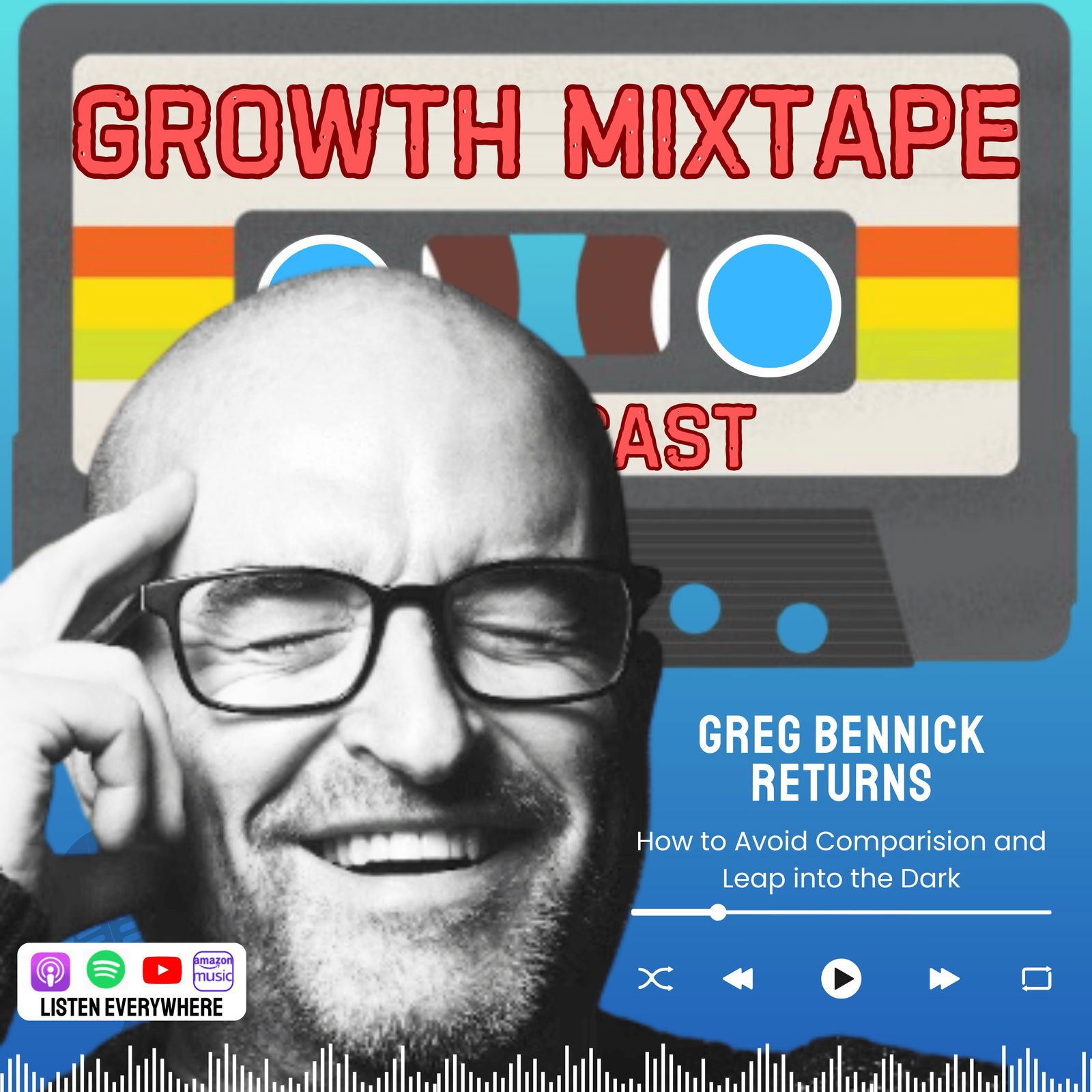
Today we talk to Greg Bennick—writer, speaker, punk rocker, coin collector, juggler, and the first ever returning guest on the podcast.
Greg is one of those people whose passion is contagious. He can make anything interesting—coins, kindness, counterstamped nickels from 1860—and somehow ties it all back to living a life that actually means something. Our first conversation was the episode I recommended most when people asked what this podcast is all about, and this one might be even better.
We talk about the terrifying beauty of taking creative risks, the unexpected power of noodles in a hotel lobby, and why staying in the game—whatever your game is—might be the most important decision you ever make. He also shares what it’s been like to release his first book into the world, and why the chapter he almost left out might be the one that changes everything.
This conversation is about passion, purpose, and possibility.
Please enjoy, Greg Bennick.
Key Takeaways
- “Do it your way.” Greg shares how skipping the networking events at a major speaker conference—and eating Pad Thai alone in the hotel lobby—led to the most authentic connections of his career.
- Writing his first book taught him that vulnerability is part of the process—and that success often starts with just staying in the game.
- The chapter he almost didn’t include—on kindness—became the one readers connected with most. Sometimes others see the heart of your work more clearly than you do.
- Creativity isn’t magic—it’s a muscle. The breakthrough moments come after you’ve put in the reps, not before.
- Greg’s obsession with rare coins isn’t really about the coins—it’s about history, relationships, and finding connection in unlikely places.
- Comparison will kill you. We all assume everyone else has it figured out, but the truth is most of us are just doing our best to stay curious and keep going.
- Greg’s advice for anyone looking to start something new: Leap into the dark—not to fear failure, but to embrace the possibility of success.
- Purpose doesn’t have to be some grand external mission. Sometimes it’s sitting quietly in the lobby with a bowl of noodles, choosing to live a life that’s yours.
Connect with Bob Mathers
Website
LinkedIn
Instagram
The Restless Leader Newsletter on Substack: https://bobmathers.substack.com/
Links & Resources
Greg’s website: https://www.gregbennick.com/
Greg on LinkedIn: https://www.linkedin.com/in/gregbennick
Greg on Instagram: https://www.instagram.com/gregbennick
Speaker 0
When you say, do I have it figured out? I'm not quite sure anybody ever really has it figured out except what's his name? Oh, yeah. Buddha. Okay. You get the point. Right? You're the exception of, like, Buddha and Mohammed and these sorts of folks. Right? Jesus seemed to have it have it figured out. You know? Okay. That's three. Right? Three out of billions. The rest of us are left to, you know, grovel and figure out what we're doing. Speaker 1
Welcome to the Growth Mixtape podcast, and I'm your host, Bob Mathers. Now before we get started, I'd love to ask a quick favor. If you like what we're doing here, please follow the podcast wherever you listen. It helps you find new episodes quickly in your feed, and it helps promote our profile so we can continue bringing you awesome guests like this one. Please share this episode with anyone you think needs to hear it. And if you want more of this awesomeness we're serving up, join my one hundred percent free substack at substack dot bob mathers dot com or get the link in the show notes. So today, we welcome back Greg Benick to the pod, our very first returning guest from season one. When people would hear about the podcast in the early days, they would inevitably ask which episode they should listen to. Without hesitation, I pointed them to Greg's. I don't think I've ever laughed so much. So when I wanted to try my first returning guest, there was only one person I called. And believe it or not, I think we did it again. We talk about how to avoid comparisons, finding your passions, and leaping into the dark for the possibility of success. But that's not what makes this conversation so special. It's how Greg brings so much passion to every topic, including his incredibly nerdy hobbies. You can't help but lean in and want more. Please enjoy Greg Benick. Alright. Welcome back, Greg Benick. This is gonna be a lot of fun. Speaker 0
I'm excited. I'm very happy to be back. As I understand it, you don't often have people back, so this is really cool. Speaker 1
Well, so you're my first returning guest, and I'm about fifty episodes in. And I was thinking, okay. I feel like it's time to have a guest back. And quick story, when I started this podcast, you were in the first, you know, maybe dozen or twenty, guests that I had on. And when people would ask me, okay. Interesting, Bob. If I was gonna listen to one episode to figure out what this thing is all about, which one should I listen to? And I gave them your name because it was the episode that I heard consistently from people that they enjoyed the most. But then people would ask me, okay, Bob. I'll do that. What's it about? And I'll be like, well, we talked about juggling, and we talked about the Seattle Teen Dance Ordinance. And we talked a little bit about his speaking, and I'm like, shit. I think we were supposed to promote his book. I don't think we talked about it. And I said, but it was also sort of the the gold standard for conversations that weren't really about anything, but were also about everything all at once. Speaker 0
Awesome. I would much, much rather do that than promote my book. If at the end of people hearing us talk, they wanna read my book, which is basically more stories and exciting things, and I could tell you all about it, then great. But let's let's just have an awesome conversation and prioritize that. That sounds a lot more appealing to me. Speaker 1
Yeah. Now I have been following you on Instagram, and you have been everywhere. Just even in the last, what, months, six weeks? Pennsylvania, Arkansas, Nebraska, Colorado, Texas, New York, Iowa, Oklahoma. Speaker 0
Yeah. I I I just just just the other day, I landed in Seattle. I looked at my schedule. I realized that I I I don't have to be back on a plane. I texted my girlfriend. I said, I don't have to be on a plane for nine days. This is unprecedented in the last half a year. I'm so happy about it. So yeah. So this is great. I've been I've been all over the place. And, you know, I split my time doing a number of things, but, you know, they're all, connection based and speaking based, sure. But, you know, I'm sure we'll dive in, but I I do a lot with, research and writing about rare coins, travel around the country speaking as a writer and, historian, consultant, educator about rare coins. So I do a lot with that too. So, yeah, I'm always in motion, and and I I like it. But it's really nice to be not in motion today and be able to talk to you. Speaker 1
Well, I do have questions about writing and specifically about taking your book out into the world. Because last time we talked, your book wasn't out yet. Speaker 0
Oh, yeah. That's right. That's Speaker 1
right. But before we do that, yeah, what what do you spend a lot of time doing that I wouldn't know based on your Instagram? Speaker 0
Okay. So, my Instagram has coins on it, more or less. I mean, there's there's coin stuff. I mean, I spent a lot of time studying coins. So here's here's the the five cent version, no pun intended. What I collect and what I research and what I know about a lot about are two things. Error coins, meaning coins that were made accidentally by mistake, imperfectly, struck twice by accident, struck off center. This is super nerd stuff. This is like nerd, like stratospheric level stuff. And then also counter stamped coins. In the eighteen hundreds, before the age of Instagram and Facebook, merchants would advertise by stamping their name, their business name, their location, or what they did into the face or reverse of coins. So you and I are walking around Omaha, Nebraska. It's eighteen sixty. We don't know where to get a haircut. And all of a sudden, we get a half dollar and change that says JF Higgins Barber, Omaha. We go, oh, wow. Let's go to JF Higgins. Okay? I they're called counter stamps, merchant counter stamps. I know a lot about merchant counter stamps. And and when I'm not booking keynotes or working with clients on keynote speeches, all of which is great and I love, my spare time, is is coin related. I write for four different coin magazines and sit on the board of two different coin organizations. And if anybody's still listening, congratulations. It's really wonderful. Speaker 1
Yeah. Well, that is one topic that was sort of dangling from our last episode. And I'm like, okay. I know this is risky. I know Greg could talk about this shit for six hours, but I gotta get into it. I did find an article about you. I don't think it was written by you. And here is the here is the the subtitle of the article. Greg Benick has discovered a mated pair of uncirculated eighteen sixty seven shield nickels under described in auction at a as a lesser error type. And I'm imagining that to the right audience, that is like, wow. Holy shit. I can't wait to dive into that. Like, I need a language translator for that. So I know you to be a deeply, deeply thoughtful person. And so whenever I come across somebody like that that is so passionate about something that I know absolutely nothing about, it's usually a signal that I'm missing something. So what am I missing, and why does this matter so much to you? Speaker 0
Be because I think it's important to have something that you love, that you believe in, that you connect to, that gives your life a sense of meaning and gives your relationships deeper meaning. That's what the coins are about at Speaker 1
the end of the day. Speaker 0
Like, it could have been something else. When my dad was a kid, he started collecting coins. When I was born, I caught the bug and started, you know, collecting coins. He could have been a dart thrower. He could have been a horseback rider. He could have been a, you know, the best French fry maker in the in the in the galaxy. Who knows? Right? It was coins, and I connected with it. What that means is I've got a better relationship with my dad. I've got a better relationship with my friends who also share these bizarre interests, of which there's thousands of us. It's unbelievable how how widespread it is. So I get a sense of connection and a sense of meaning with other people. But I also delve into history, right, which I love, and I I delve into details, which I love. So I learn more. I challenge my brain. It's not just me staring at a glowing rectangle expecting to get smarter as a result, you know, all day long. I'm really diving in and studying and learning and growing as a result. So it's interactive and introspective at the same time. And, you know, that article that, you know, you read the the title of, I could give you all the details on that. And at the end of the day, I promise you'll have less listeners. You're gonna have one person who's like, oh my gosh. I love coins. This rules. But at the end of the day, I I did discover something that hadn't been discovered before. And as a result, made new friendships, made new relationships, had better connections. That's really, at the end of the day, what it's about. Like, people ask me, you know, hey. What's that thing worth? Who Who cares? It's a that's a number in dollars. I'm sure we all like dollars and numbers associated with them. But I would much rather have connections and friends and deeper meaning in my life, and that's what coins bring me brings me. Speaker 1
For somebody like me that knows so little about that world, what's the most, I guess, misunderstood thing about coin collecting? Or what do you think people would be most surprised to learn? Maybe that's a better question. Speaker 0
Yeah. You know? Okay. So it's it's you know, I used to joke, back in the single days that I had no hope of, finding a partner because the two things I love most in life are juggling and coin collecting. I mean, come on. Like, who's got that on on their bingo card? Right? Like, I I need to find a man. I need to find somebody with a shaved head who's really into coins and juggling. That's never ever been said. Like, in in in all combinations of language, in all the languages of the world, there is no woman alive who's ever said, I need to find a coin collecting juggler. The the point is is that the the idea, the image that we have in our mind is all these, like, nerdy kids who, you know, are are collecting coins. And in part, it's kinda true, but it's also not. Meaning, there's a lot of camaraderie and a lot of fun and a lot of history and a lot of knowledge and a lot of, exploration and a lot of wonder and and also an extraordinary amount of value, yes, to coin collecting. Value just in terms of the quality of life and quality of relationships, but also in terms of dollars. The amount of dollars that gets spent on rare coins in this country, astronomical. Like, if you told me that you heard a coin sell for a hundred thousand dollars, it wouldn't even phase me. Wouldn't even would not even phase me. That's that's, that's every day. So, you know, every couple days or whatever. The point is is that, what people don't realize is that there's a depth to this that's really wonderful. And the people involved, you know what? A lot of us are, like, nerdy women and men who, you know, just just, like, loved this special weird little thing, but were but there's also a lot of depth to the scholarship and the exploration behind it too. Speaker 1
I've gotta believe too that there's a lot of closet numismatists out there. And by the way, I had to look that up and even have YouTube pronounce it. So, hopefully, I did okay with that. You did okay. But I also suspect that it's one of those things where people don't it's not that they are, you know, embarrassed by it, but they just don't talk about it necessarily in, in certain circles because they don't think anybody would care. And if you just floated it out there, you would probably find all kinds of people that have at least some sort of knowledge or fascination with this. It's just one of those things that I think a lot of people do it, and they talk about it in certain circles, but I bet it's more common than I think. Speaker 0
And or they have some coins that a grandfather or grandmother left them, and they don't know what to do with them, but they like them. And the reason they like them, that's the operative moment. Right? There's no reason to like round discs of metal. What they like is the connection to their ancestor who gave them the round discs of metal. Now the round discs of metal have meaning. The point though is is that there's lots of people who have a coin or coins in their house that were given to them at some point. They won something. They were confirmed. They had a bar mitzvah. They're grandma and grandpa, whatever it might be. Those those are people who I I always love talking to because I just love hearing, like, why just save these things? Like, tell me why. Tell me what they mean to you. That's where the, I think, the real value often is. Speaker 1
I appreciate how you're not going too deep into this because I know how much you'd love to talk about this for three or four hours, because you're so passionate about it. I do there's but you hit on something that's really interesting that I wanna circle back to. And I had a guest on, and she's actually become a friend of mine. Her name's Alex Parks. And we're talking about, you know, my speaking, the book I wanna write, the coaching that I do, etcetera. And she's all about trying to get people to bring more of their passions into their work. So we don't have Bob the musician and Bob the coach and Bob the speaker and Bob the author, and you bring in you bring all of that on the stage. And I wonder if I went to see one of your keynotes, have you found or do you feel the need to fold in the love of coin collecting, your love of punk music, all of this into one genuine Greg Bennett on stage, or do you still compartmentalize things? Speaker 0
No. It's all part of it. I mean, here's the thing. I made the joke before about, Tinder and Bumble dating, and no one's looking for a coin collecting juggler. Let me reframe that without the joke. What if I said, I am so completely passionate about the things that I love, and I am so devoted to them that nothing could break that devotion. And in fact, I am committed to the things that I love for my life. I'm committed to the things that I love so deeply that nothing could distract me. That sounds like somebody I would go out on a date with. That sounds cool to me. You know what I mean? So it just reframing it that way changes the changes the vibe. What that means is, in terms of the keynotes, is that I don't need to walk out on stage and say, hi, everybody. I like counter stamped coins. Let me tell you about juggling. But rather, they get the sense that I'm passionate about the things that I believe in. And if I make a reference or an allusion to or tell the story of a connection to coin collecting, which I often do, it's quick because that's not the point. The point is the passion. The point is the consistency. The point is the focus on something that you believe in. Now we're talking about things that are relatable. And that way, the person in the audience who really likes haberdashery I have no idea where that word came from in my mind. No one said that since eighteen thirty. The point is is that whatever it might be that your odd hobby is knitting, who knows what, you'll connect to the person on stage when you see they're passionate about something. Even if it's the corporate topic of the day, even if it's the idea about human resources or teamwork dynamics of the day. When you realize the person on stage is committed and passionate in general, you're gonna listen to them talk about the thing that they're talking about. But, yes, I do hint on some of those things at times, and it's just to kind of add a little bit of here is who I am to the audience. But they get that. They get the passionate side, regardless of how deep I go into details about what what type of metal discs I collect. Speaker 1
Yeah. That's one of the things that I heard, from listeners based on our first conversations. Like, god. That guy, Greg, he can make anything sound interesting because he's so passionate about the things he talks about. I was like, yes. That's a great way to put it. Speaker 0
Well, I love that. I love that. It's it's true, though. You know what I mean? Like and you joke about, you know, Greg, you wanna talk about coins for three or four hours. Like, last summer, I did a two night mini seminar on counterstamp coins at a at a coin education event, and I spoke for six hours about them. Literally, six it was a six hour deal. Right? So that's not necessary, though. What's necessary for your listeners is that we talk about what we're passionate about, and and we've got the coin basis already because people will relate based on what they're passionate about too, and that's exciting to me. Speaker 1
Yes. It's really around the passion and bringing different parts of those things together. So I don't have to leave parts of me off the stage. It just doesn't mean I need to be up there juggling and collecting coins. Speaker 0
Yeah. And if you walked out on stage with the guitar and played one chord and had it sound really good and let it ring out for ten seconds and then put the guitar down and say, it all started with that, that sound, the purity, the finger placement on the fretboard, the way that I strum, just that one chord. It all started from there. You could build a whole keynote off of that. Yeah. Just one chord. You don't have to play you don't have to play Proud Mary. You don't have to play whatever it is. You know what I mean? You know, at the end of the day. Speaker 1
I I did think about just bringing the guitar up and setting it there. Just having it there and not touching it, not not referencing it, not saying a word about it, just doing the keynote beginning to end and just be an interesting experiment. Theatrically awesome. Speaker 0
Because the audience would would wonder the entire time, especially if at the end of the keynote, you made some reference to it somehow that wove it through as people kinda reflected on what you said. We could talk about that offline. I love that idea. Speaker 1
So you did I there's a couple of things I did wanna ask you about the book again because it hadn't even been out yet. And when I asked you at the end of our last conversation what you were most excited about, you said, I'm excited to take this book on the road, to have people react to it, to have conversations about it. I'm wondering what that process was like for you working, agonizing over this book, every word, every phrase, every page, then releasing it out into the world, not knowing people love it, people hate it. What was that what's that process been like? Speaker 0
It's it was mind boggling, and it continues to be. And and I'll I'll I'll place that continues to be first, and and then I'll tell you about it being mind boggling. It continues to be because it was so intense to write the book that when the book came out, I didn't do the traditional, like, let's post about it every five seconds and hammered over, you know, everybody's head nonstop. I just let people know about it and consistently let people know about it. And that's still ongoing. Right? And the reason that I did it that way is because after pouring heart and soul into it and stripping out the things which were insincere in it, it felt then insincere to go, hey, everybody, I've got a book and you should care and here's why. That's not me. You know, note that I did not say to your listeners, you should all collect coins. Write me for my four page brochure on how to get no. Likewise, read my book or don't. I would love for you to read my book. I would love for you to contact me, but you don't have to read my book. I mean, it's filled with stories and filled with things that I think are interesting and ways to get back on track when we've been thrown off track by the world, all reminders to myself about how to do that. That's why I wrote it. So with with this in mind, the process of writing and creating the book and getting it out was extraordinary. It was so challenging. It's it's incredible how much work goes into it. And now that it exists, it's really interesting. It's split between a couple different types of people. One type of person bought the book, put it on them their shelf, and haven't read it yet. I could show you hundreds of books for which that's true for me, that I've bought and put on shelves and haven't read yet. That's okay. I mean, the love is there. I just haven't had and made the time to read them. Then there's people who have read it who are excited, freaking out about it. I had a friend of mine who I haven't seen in a year grab me and hug me recently. She's like, I love your book so much, and that's really great. And then there are people who have read it and said, oh, hey. I really like that story, or they're mentioning something very specific about it, like a story that I told that was fun in it because it's filled with stories, of global travel and interacting with people and that sort sort of thing. It's an ongoing process, and I've recently thought I'm gonna start going through the book and and creating content based on lines or ideas in and throughout the book that I can get behind and believe in. And I just want to put put out that content not so that people buy the book because I think it'll make my life and my interactions in the world a better place if I do. I mean, that might be a tall order to say, oh, yeah. Me creating content is gonna make the world a better place. But I do think that there's ideas in the book which are relevant and vital and valuable to people that could make people's lives better. So we'll see how that goes. Speaker 1
And when you write a book that's full of so many personal stories, and again, you kind of wrote it for yourself. Right? The seven strategies to get yourself back on track when you've been knocked off course. So it's it's a pretty personal deeply personal book. Were there ever points in that final process or any part of the process where you were afraid that it was gonna flop? And how did you deal with that? Speaker 0
Oh, yeah. Well, totally. I mean, you know, in in the book, I you know, I there's different stories about, about, different parts of my life that then relate to the reader's life. Right? There's no stories in the book that are just like, I did this, and then the reader goes, okay. But what about me? It's all tying back into the reader. Right? But at some point, I had to do I had to do a lot of editing along the way. Way. That's the one of the hardest parts of writing the book is figuring out what goes in between the two hard covers, right, and what gets left behind. Those thousands and thousands and thousands of words that got left behind. I mean, eight thousand words or something got left behind got just got cut. I mean, that's weeks of work that just got cut deleted, that sort of thing. And some of that was because, oh, that story, it's not that it's too personal, but maybe it just doesn't relate. It doesn't land. When I read it, I can't imagine Bob reading the story going, oh, man. I relate to that in the message Greg drew from it in the book here. I just you know? So I I would cut those things out. But, yeah, always afraid. I mean, we are I mentioned this probably in the first, interview that we did. We are all insecure, frightened, terrified creatures. We're hurtling towards an uncertain end. We're hoping that the interactions we have with other people are meaningful and that our contribution to this unbelievable maelstrom of a life actually ends up mattering to somebody else. And in the midst of that, we're constantly afraid of failing. And there's a chapter in the book, you know, leap into the dark to embrace the possibility of success, about how we're also afraid of succeeding. You know, we we're we're we're up against we're up against a lot as humans. We really are. But that said, what I chose to do with the book, and this is the way that it's an example of me writing it for myself, is rather than write that chapter and have it be leap into the dark because you might fail, but let's see what happened. No. Leap into the dark to embrace the possibility of success. What happens if we succeed? That's terrifying. All of a sudden I'm in a new place. The parameters are different. The walls are different. What am I gonna do with this newfound space I've created with my success or the thing that I didn't think I could do? Now what? I made those choices about what to include and what not to include based on, you know what? Let's throw it out there. Let's see what happens. And any story that had relevance to the reader, a message for the reader, and also was authentically personal to me at the same time, those are the ones that made it in. Speaker 1
Are there I'm wondering if the book has the meaning of the book or the parts of it that mean the most to you has changed over time as you've talked to people about it. Because it occurs to me even coming back to our original conversation, I would talk to people and they'd be like, oh, I love when Greg shared this story about, you know, juggling or this metaphor about this or when he talked about the the team dance ordinance. And I guess I realized that what people take away from the content that we put out there has as much to do with them as it does with us. And so we agonize over this thing that we put it out there, and then we we learn that, oh, I never occurred to me that people would take a, b, c, d, and e away from the away from it. And I wonder if that's having those conversations has maybe changed what it means to you. Speaker 0
Oh, one hundred percent. In fact, when I started writing the book, there wasn't even gonna be a chapter that is the the first strategy in the book for people who are unaware. Believe in the possibility of kindness to escape the trap of pessimism. And the idea is that if I approach the interactions in my life from the perspective of the person I'm interacting with might be kind and have good intentions. This might lead somewhere positive. This could lead to something good. Well, then we've created possibility rather than saying, this person's gonna screw me over. This is not gonna go the way I expect. I don't know if I ever get what I want out of interactions with other people. I the last time didn't work. This time's not gonna work either. That pessimism destroys possibility. Okay? So it's a reminder to myself to stay in that space of believing in the possibility of kindness. I can be kind. Other people can be kind. Let's see where that leads us. That wasn't even gonna be in the book. That's something that I speak to a very specific subgroup of audiences about. And it was a friend of mine that said, how come the kindness stuff isn't in your book? And I went, oh my gosh. Oh my gosh. Okay. It's the first chapter now. Like, it all of a sudden I realized, oh my gosh. That's huge. Speaker 1
It was almost the title. Speaker 0
One hundred percent. Like, absolutely, that's where that landed, and it's become a huge central part of it. And it was that other person kind of giving you that reaffirmation and or that refocus that really shifted the tone of some of these chapters and prioritize them in different ways. So some of the things that I thought would land and be like the main thing, like there's a chapter engage with laughter to connect amidst the weight of the world. You know, the world's a heavy place. We need to connect with laughter with one another. I figured that would, like, catapult to the forefront. People would be like, Yeah. Let's talk about laughing. Nope. They wanna talk about kindness, keeping your eyes on the knife. Focus. Who knew? Wow. Speaker 1
Well, and something else you mentioned earlier, Greg, I wanted to come back to this. This idea of, I well, you didn't say it, but purpose. Because one of the things we talked about last time was Viktor Frankl's book, A Man's Search for Meaning. So I read it, and I think I texted you after I read it. Of course, not surprising, just an incredibly powerful book. Little embarrassed that I hadn't really known much about it before you and I talked because I realized, oh, this is, like, one of the greatest literary achievements of the last hundred years. I probably should have known about it. But anyway, better late than never. But one of the one of the quotes that he's most famous for is a man who knows his why can tolerate just about anyhow. I'm sure it's his is much more eloquent than that. But I do talk to people all the time that are really struggling with this, you know, you talked about it, your why. That's what Viktor Frankl talks about too. It's like, fuck, I'm fifty five. I don't know my purpose. I feel like I'm supposed to know my purpose. Everybody around me knows their purpose. I'm running out of time to figure out what my purpose is. How do you think about that? And have you found would you say you think you found your purpose? Speaker 0
I'll tell you I'm gonna tell you a story in a moment. But first, let me just say the operative part of what you said and the thing I hope everyone takes away from this conversation is the moment where you said everybody else is finding their purpose. Like, what about me? Everybody else is dot dot dot dot When I was twenty two, I did a keynote for the boeing corporation did a presentation and I was working with some really high power folks at boeing at the time rana strovsky ed renoir. They were responsible for the seven four seven seven six seven and triple seven program. There's no reason I should have been in the room. And instead, I was right. It was amazing. And I'm about to go on stage and my client, whispers to me off to the side of the stage. What do you want them to remember after they've forgotten what you said? And I was like, what? She's like, what do you want them to remember after they've forgotten what you said? I tell this story in my keynotes. I was like, they're gonna remember everything I've said. She's like, no. No. No. They're gonna forget everything. What do you want them to remember? And I never ever ever forgot that. Listeners, that moment when Bob said, everybody else has found their purpose. What about me? Let's please deconstruct that in our lives. Let's please get away from that. The comparison game will kill us. Whether we're fifty five, ninety five, five, or however many years old, the comparison game will be the end of us, and it's everywhere. It's what drives sales in the world. It makes lots of people rich. It makes lots of people feel terrible about themselves. Let's get away from it. Here's the story I wanted to tell. I'm a member of National Speakers Association. So, yeah, as if I need another nerdy accolade, group of people who get together every year and talk about talking. It's like, okay. Hi. I'm the coin collecting, juggling speaker guy. Point is every year, there's a convention called influence for the National Speakers Association. All professional speakers or many professional speakers end up at influence. Thousand people, twelve hundred people, whatever it is. For years, I went and I did what you said in your quote just now, because we all do it. I do it. You do it. Gosh. Everyone else seems to have their career figured out. Everyone else is getting booked doing keynotes. Everyone else's keynotes are more lucrative than mine. Everyone else has a topic. Everyone else has, mind boggling. This last year, I went to influence, and my commitment to myself was to go on my own terms. So each night, when everyone would get together and they would go to not get together. Everyone would be on-site, and they would go to after parties and networking events and the bar to buy drinks for each other, and you you see where I'm going. Right? You know what I mean? That kind of stuff. First night of the event, I sat in the lobby of the lobby of the hotel, and I ordered DoorDash, Pad Thai, and I ate noodles. And I sat there for two hours eating my noodles, and they were delicious. And people would walk by me asking if I was going to the networking event. I'd be like, no. I'm just I'm eating these I'm eating these noodles. And I meant it. I'm eating these. That's exactly what I was doing, eating these noodles. The second night, people are walking by going, weren't you here last night? You had noodles last night. I'm like, uh-huh. And they're like, oh, oh, okay. And I'm just eating my noodles. And at the end of the night, couple people walked by and they're like, you're still here? I'm like, yeah. I'm just finishing my noodles. Anyway, the long story short is that by the third night, people were asking if they could join me. And they were bringing their own noodles. A couple guys brought ice cream, so we called it noodles and ice cream. And all of a sudden, we've got this group of people sitting around eating noodles, talking about, noodles and ice cream, talking about authenticity, doing it your own way, not going to the networking event to buy drinks for the right person at the right time, the after party because that's what I'm supposed to do, that's what everyone else is doing, but rather I really like Pad Thai, and I like sitting eating noodles. Doing that instead led to some genuinely awesome connections. Okay. That said, when you say, do I have it figured out? I'm not quite sure anybody ever really has it figured out except, what's his name? Oh, yeah. Buddha. Okay. You get the point. Right? You're the exception of, like, Buddha and Mohammed and these sorts of folks. Right? Jesus seemed to have it figured out. You know? Okay. That's three. Right? Three out of billions. The rest of us are left to, you know, gravel and figure out what we're doing. Right? The point is is, and sincerely, the point is is that the Noodles taught me so much and shifted the way that I do business, shifted the way that I approach keynotes, shifted the way that I market myself. Do it your way. Viktor Frankl, I would think, far be it from me, but I think is cheering from beyond the grave at our conversation. Because Frankl's point one of Frankl's points in in Man's Search for Meaning is that having a reason to be is a driving force that literally saves lives and gives you a sense of of of purpose and meaning that drives you through when I mean, in his case, there are things literally threatening your life. Like, you know, he he survived multiple concentration camps and did so in part and found that other people did in part because they had something to live for, something to believe in, that something that was unfinished, something that was meaningful to them. And that was a driving force behind why they could survive and continue. Now granted, there were people who died as a result of random deaths in in this situation. But for those who weren't randomly made un alive, they were surviving because they had a sense of meaning and something to connect to and something to look forward to. When we find that on our own terms, the person we love and doesn't matter that everybody else doesn't love them We love them or the thing that we really enjoy coin collecting, for example, doesn't matter that everybody else doesn't love it I love it and we sink into that noodles metaphor, right? I'm just gonna sit in the lobby and eat my noodles. Let the world go on around me. That's something that I have figured out for myself that I think is deeply, deeply meaningful, really, really meaningful, and it's changed the way that I approach my life. Speaker 1
And there's something really, I don't know, profound about the noodles in the lobby because presumably, the couple people that met you on night two or night three had been in the lobby bar like we've all been, you know, dozens or hundreds of times before and walked by and said, what is that? I don't know what that weirdo is doing, but, man, that looks like so much more fun than listening to these people drone on in the around the lobby bar. And and so you attracted people to you because they were just they just sensed that somebody didn't seem to care about all that other stuff that they got sucked into, and there's something really amazing about that. Speaker 0
Yeah. And you know what? The the people in the lobby bar, bless their hearts. You know what? I hope they made great connections. I hope it was very profitable economically. I hope it was profitable personally. But given a choice between meeting a a small group of people and doing it in a way which was authentic and sincere, calm and grounded, or trying to meet people who could further I would rather not do that latter thing. I would rather sit around with my noodles and ice cream crew. And, we had a phone conversation yesterday, actually. Yep. Noodles and ice cream is fantastic. It led to it led to it led to some brand new friendships. I loved it. Speaker 1
Before I forget, I just think about noodles and ice cream. That would be a great name for a podcast. Have you ever thought about I mean, I know you are a guest on a lot of podcasts of all the things that you're doing. You're speaking, you're writing. No podcast yet? Is that is that on the list? Speaker 0
Not yet. But you know what? Why not? Why wouldn't the podcast be about finding your purpose or or not trying to find it? Finding the things in your life which are already purposeful and meaningful. Right? The things that are effortless. That's that'd be an interesting podcast idea. But if you have other ideas or if listeners do, I'd love to hear about it. Maybe you have ideas for guests even. We can do a podcast. I would love to do a podcast at some point. Speaker 1
Yeah. Well, you've always yeah. That I do like that idea. Stop looking for purpose and just look for purpose in the things that you already love. It's probably right in front of you while you're spending all your time agonizing over looking for this new thing. Speaker 0
Noodles and ice cream, man. Speaker 1
Hey. It's Bob, and I'm taking the growth mixtape on the road in a series of live podcast episodes. Imagine a podcast tailored specifically for your company recorded in front of a live audience that would be released as its own episode. These are thoughtful, emotional conversations that help teams who have lost their spark rediscover their curiosity and creativity so they can love work again. Sure. You could do a typical keynote or panel discussion, or you could give your team something they'll never forget. Book me at your next event at bob mathers dot c a. Now back to the show. You've always been a creative person. You've always been a a musician, an author. Your keynotes, I'm guessing, are, you know, very creatively inspired. And so I've I'm reading this book right now called Big Magic by, Elizabeth Gilbert. And this idea that and I've heard musicians talk about this. I've heard Keith Richards and John Lennon talk about this process of songwriting where these ideas are just flowing around, and it's nothing our only job is to be open and to be ready to grab them and to build on them when they show up. And it's such a romantic notion, and I have had ideas and inspiration strike me out of the blue where I'm just scrambling for something to write on. But it is completely random. I seem to have no control over it. And so I'm wondering, how have you been able to how has your creative process changed maybe over the years, and how have how are you able to harness it when you need it? Speaker 0
It's good. Okay. So harness it those are two separate things. I'll take harness it when you need it first, then we'll go back to how things have changed. Harness it when you need it is a result of, continuing to try. Okay? So this here's a gift to listeners. A gift to listeners is to stay in it. Stay in your process. Stay in the thing that you like to do. Stay in if it's drawing, if it's, helping out in the community. Whatever however creativity manifests in your universe, stay in it and keep doing it. Because when you need that creative thrust drive moment, it will be there for you if you're well rehearsed. Same is true with your guitar. If you picked up your guitar at age six and didn't practice until age fifty, and then you try to go play Eruption by by Van Halen, probably not gonna work. Okay? But if you've been practicing every day and all of a sudden somebody says, hey, play guitar for five minutes. I just really wanna hear someone play guitar. You're ready. So be ready for the creative moment because you have practiced, not just because you want it, but because you put in the time. The other side of what you asked about how has this changed over the years is that I have become more comfortable with things not working while in the midst of process. And here's what I mean. Let's say I'm working on a piece of writing. If I'm working on that piece of writing and it's not coming to me and not coming to me and not coming to me, and I try to write and I try to get away from it and I try to come back to it and I try to think about it from another angle and I talk to somebody else about it, and I'm hoping I find my way and it's still not working, Greg one point o would think to himself, oh my gosh. I'm terrible at this. I have no idea what I'm doing. Greg two point o realizes, stay in it. Because what ends up happening is that your subconscious, I assume, is working on it. You're thinking about it when you're mowing the lawn, driving down the street, or eating granola in the morning. And then all of a sudden, lo and behold, six months later, after frustration and, you know, bashing your proverbial head into proverbial walls, all of a sudden you go, oh, that's the lyric I wanted to write. There you go. It's of course. And you just write the whole song or you write that verse or you write that line. These two answers that I've given you tie together. Stay in it. Because what I've learned and how it's changed over the years is now when I'm in that moment of, gosh, I just can't get this. That's part of it. That is part of it. I write about it in my book, you know, the sine wave of creativity. You know, there's sometimes you're at the top of the the wave of a sine wave. Imagine it going up and down. Sometimes you're at the crest of a sine wave. You feel like that you're the champion of the entire world. Other times you're in the trough at the low point. You're like, oh my gosh. Why am I even doing this anymore? I'm such a moron. I can't even believe it. You know? But if you stay in it, you're gonna get to where you're going. And the consistency the consistency consistency of staying in it is what makes those seeming breakthroughs happen. The breakthroughs aren't like moments of brilliance. They're the result of practice and staying in it all the while. Speaker 1
Yeah. And the beautiful thing about that, Greg, is that it's just it's one of these things that you have to go through. It's not like you can jump from Greg zero point o to Greg three point o. You sort of have to go through the one point o so that you can go back and realize, oh, yeah. Right. This is the way it's supposed to feel. This is how it's supposed to work. Yeah. And I love this idea that, you know, if creativity is sort of how we come to a better understanding of ourselves, curiosity is how we come to a better understanding of the world around us. And I've been playing with those two things. And I'm wondering, are there things that you're deeply curious about today that you're sort of chasing down? Speaker 0
That's really great. Yes. I am deeply curious about human dynamics as it relates to, social issues, politics, followership, and leadership, especially in today's world. I'm fascinated by how humans follow along and how we look to others for guidance, leadership, authority. The relationship between authority and power fascinates me. The difference between, somebody, imposing their will and their way on us versus, making suggestions. Why do we respond to those suggestions? Why do we respond to power in the way that we do? And how do we do that individually versus collectively? I mean, I basically just described a sociology PhD probably that I've I haven't gotten or, you know, haven't started the process of. Those things fascinate me. Absolutely fascinate me. Like, why is it why is it that we do things the way we do? I mean, I study the work of a cultural anthropologist. We talked about Ernest Becker, and Becker was trying to figure out why it is that humans behave the way they do, in regards to other people given our own deeply rooted insecurities about our own mortality. I mean, I'm not gonna be alive in a hundred years. I want to be, but I'm not going to be. As a result, I should probably be screaming, running through the streets right now like, oh my gosh, everybody. What do I do? Instead, I'm having a very polite, wonderful, entertaining, and enthralling conversation with you about philosophy of being. Does that make sense? Sure. It does. This is this is what we should we should be doing, but I'm fascinated with why we behave the way we do given the parameters of self society, insecurity in the world. Again, individually and socially, we are fascinating creatures, and watching it all play out in this political realm that we're in is mind boggling to me. So, yes, very curious about that. Speaker 1
When we talked last, you said, I think, you were in the process of writing two books, one about Ernest Becker and the one that you released. Speaker 1
So is the Ernest Becker one still in process? Speaker 0
Still in process. Yeah. Yeah. For sure. And I love that I just said process like you do because you're Canadian and it's awesome. I mean, I that was kinda like process. I mean, that's how I said it. Right? You know, I was because I live so close to the border. I don't know how to say process process. The point is is, yes. It is. That's gonna be a huge undertaking. And I recently said to some people very close to me that I need to restructure some things in order to put more mental energy into that because it really requires some depth. Yeah. It really does. You know, when we're talking about Ernest Becker, Viktor Frankl, and Otto Rank, and some of these thinkers and whatnot, these were not slouches. These were, intellectual powerhouses. And I don't wanna be, as a good friend of mine once said, a second rate interpreter of first rate ideas. So I'm doing my best to, to to restructure a bit to be able to dive into those Speaker 1
things. Yeah. I imagine, you know, if I was to undertake something like that, I think I would feel almost overwhelmed with this idea that, again, because you're talking about some very serious deep thinkers, like, what do I have to offer this conversation? And overcoming that and figuring out what it is that, you know, one unique perspective I could have to offer that would would offer that would probably be a little bit crippling for me. Speaker 0
Okay. Gift gift to listeners number two. Ernest Becker, cultural anthropologist, researcher, writer, who wrote a book that won him a Pulitzer Prize. Let's stop there. I know enough about him to recite his entire biography to. And if I could just type it out, I'd have my book, which is gonna be a biography of of Becker. The point is is that, Becker, pre Pulitzer Prize, often was questioning what it was that he was doing and trying to figure it out. And he didn't often say that explicitly. It's not like we have pages of notes from Becker going, what am I doing? I don't know what I'm doing. But he's writing books that aren't right, that aren't it. He's written quite a few books that weren't it. And by it, what he eventually landed on that he wrote about, another topic for another time, certainly isn't what's in his, what I call, the middle canon of books that he wrote. He's figuring it out. So if he's doing that, then I have to wonder why is it that it's, in in your words, crippling to each of us to say, what do I have to contribute? Well, you got everything to contribute. You're a human being. You're a sentient creature walking around the world and this your one and only life. Why would you not, instead of thinking, I have nothing to contribute, think, okay. Let's just put pen to paper and see what comes. Let's see what happens when I talk to that person, make that connection. Whatever it might be, why would we put ourselves in a position where we diminish ourselves instead of going, wow. Okay. Limited time. Let's get to work. Let's go. I I I believe in anyone who comes to me and says, you know what? I have an idea. I'm like, cool. What is it? Tell me about it. Let's talk about it. Let's see how we can make it happen. That's way more interesting than I have an idea. Oh, really? Do you? No way. Let's let's talk about possibility. That's what my book's about. That's what you know? And I have to again, it's reminders to myself. I have to remind myself this too all the time. It's important to stay on top of it. Speaker 1
Is there another book in you? Speaker 0
Oh, yeah. My gosh. Absolutely. Yeah. It's called Noodles and Ice Cream. It's about no. I wanna write a book based on the first chapter of, of my book that believe in the possibility of kindness You know, I don't know if I mentioned it in the last in the last conversation But you know you started out by listing these cities I've been to recently and I've been doing these, keynotes for associations and corporate groups I love doing those those events right the association type events, corporate events, that kind of thing, conferences. When I'm not doing those, I am, a, sure, working on coin collecting and booking more of those, but I often speak to young people about kindness and inspired by that chapter in the book, believing in the possibility of kindness. And I've thought about writing a book based on that idea, but kindness, because I think the world needs it. The reason that I speak to young people is that I'm convinced that the world would be a better place if, young people and students and whatnot grow up thinking about kindness as a possibility rather than selfishness, you know, getting what we want at the expense of other people and so forth. But I think that a a book on kindness would be would be valuable, I think, in the world. So yeah. So that's something I've been thinking about for sure. Speaker 1
Well, one of the things I love about that other than just the idea alone is that if you were crippled with the anxiety of putting something of yourself out into the world and worried about whether anybody would like it when you wrote the book, then the book wouldn't exist, and that chapter wouldn't exist, and all those conversations would never have happened, and you wouldn't now be embarking on this other thing. So it's just, like you said, just keep at it and keep putting these things out there because it's impossible to know where they're gonna lead. And I think that maybe your Pulitzer Prize book is out there somewhere. And as great as your book is, people might look back at that first book and go, wow. He was really still trying to figure it out, man. There's a lot of I don't know where he was going with that. Five books later, and he's got Speaker 0
Love Love it. And he found his way. Okay. So that speaks to that chapter I talked about. Right? You know, leap into the dark to embrace the possibility of success. If I give up because maybe the next book isn't gonna be any good, well, then you're I'm right. Okay. Then it's not gonna be any good because it won't exist. But if I try, if I at least try, and that's, again, gift for listeners. You know, I hope that there's a listener who has always wanted to try something new. I hope there's a listener who has always wanted to you know what? I'm gonna text that person, ask them if they wanna have coffee with me. I hope there's a listener who's who said, you know what? I wanna take on that new role at work because I know that they need it. They made the offer. I'm gonna accept. What happens if we succeed and the thing you wanted to try turns out to be a new passion? Oh, gosh. That's intimidating. What are you gonna do with all the other passions you have in life? Now you're doing this one that you really love. What happens if the coffee leads to a relationship? I literally have goosebumps right now talking about this. What if the coffee leads to a relationship? Oh my gosh. Where does that place me? Dunno. That's intimidating. Right? What happens if you take on the new role at work and all of a sudden you're catapulted? Oh my goodness. What do I do with this new role and this new success? But if we don't try, we are nowhere. We have to create possibility by saying yes to these opportunities and by putting ourselves in situations which might feel slightly uncomfortable, but at the same time, which propel us forward. And, again, this isn't me as a guru telling you Gregsplaining what you should do. These are reminders to myself. When I hang up this call, I need to do these things too. We all need these constant reminders all the time in my opinion. Speaker 1
Man, I love that. You know, I coming into this conversation, Greg, I was I went back and listened to our original episode, and I was thinking about all of the conversations that spun out of that from, in conversation with other people that I've met. And I was like, okay. I love this idea having Greg back. But coming back to that original one of the original topics we talked about this this comparison being the thief of joy. I'm like, holy shit. I I would never gonna recreate the magic of whatever happened a year and a half ago in that first conversation. People it's never gonna be as good. I cannot tell you how much this conversation means to me, and I think it might be better than the last one. It's just been chocked full of insights, amazing stories. I mean, god, I could do this another half a dozen times. Speaker 0
We can do it. We can do that. Because in the last year and a half, I've done lots and lots and lots and lots of podcasts. And some of them are great, and some of them not so great. And the ones that are not so great are the ones that are like, so tell me about your book. And I go, well, the book's about this. Then they go, tell me about the like, there's no conversation. It's just a list of questions followed by, you know what I'm saying? You and I always have great deep conversations to the point where, like, in between podcasts, in between the year and a half, we should probably hang out and talk about, like, life, right, and guitars and coins and stuff. That sounds good to me. So I I hope that your listeners get that as well, that that we enjoy this. And and, also, just as an invite to listeners, I said it last time, and it's true. You know, I would love to hear from people anytime. So if people wanna be in touch, you know, greg bennett dot com is my website, but there's a contact form there. Get in touch. Hey. I heard you on, you know, Bob's podcast, and it inspired me to do this. Or I heard you on Bob's podcast, and I'm struggling with my desire to do this, and I'm afraid to. I'd I'd love to hear from people about this sort of thing and have conversations about it. Speaker 1
Yeah. I would love to. And, yes, we are gonna find a way to hang out, Greg, because we met, of course, in person for the first time two or three years ago. It's culminated into a couple of amazing conversations, and I think it's time to take this, relationship to the next level.
Speaker 0
I like that. Sounds good to me.
Speaker 1
This has been so awesome. Thanks again, man.
Speaker 0
Of course. Anytime. Absolutely anytime.
Speaker 1
The Growth Mixtape podcast with Bob Mathers is produced by Bespoke Projects, music by Joe Mappel Walter Cronkite. If you enjoyed this episode, please take a moment to follow and rate us. When you do this, it helps to raise our podcast profile so that more people can find us. If you wanna connect, you can find me on LinkedIn using the link in the show notes.