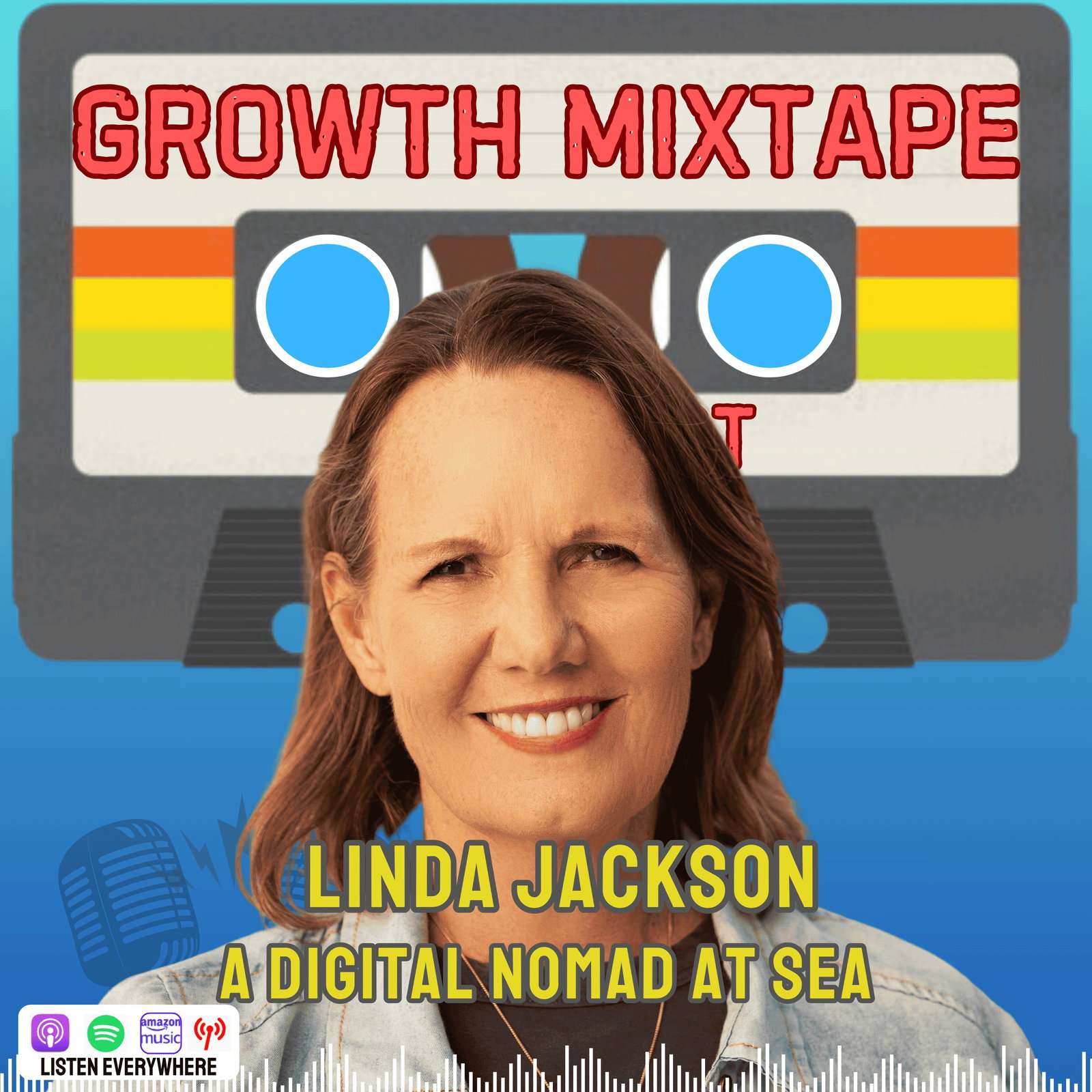
Today we talk to Linda Jackson, a self-described OG digital nomad who’s been living and working from a sailboat for over a decade… and not just weekend sailing either — we’re talking about crossing oceans, navigating cyclones, and building a life completely untethered from land.
Linda is calling in from Fiji — yes, actually on an 80-foot sailing yacht — and what struck me right away is that this isn’t just a story about travel or adventure. It’s about designing a life on your own terms. Selling everything, letting go of the “stuff,” and figuring out how to blend work, curiosity, and freedom into something that actually feels like living.
We get into what it really takes to live this way, the mindset required to handle uncertainty, and why most of us talk ourselves out of things long before we ever give them a shot.
This conversation left me thinking a lot about the stories we tell ourselves… and what might be possible if we challenged a few of them.
Please enjoy, Linda Jackson.
Key Takeaways:
- You don’t have to go “all in” to try something new — most big lifestyle changes can start as experiments rather than permanent decisions.
- Letting go of physical “stuff” can feel surprisingly freeing — and often reveals how little of it actually matters.
- The digital nomad lifestyle isn’t just about travel — it’s about designing work in a way that supports how you want to live.
- Nature doesn’t care about your plans — Linda’s approach to sailing is a powerful reminder to respect reality, adapt quickly, and never get complacent.
- “Head in boat” syndrome — being so focused on what’s right in front of you that you miss the bigger picture — applies just as much to life and business as it does to sailing.
- Fear and perceived obstacles stop most people long before reality does — the barriers are often more mental than practical.
- A shared vision matters — whether it’s a relationship or a business, alignment on the bigger goal is what makes long-term success sustainable.
- You can blend work, adventure, and life together — it doesn’t have to be neatly separated into boxes like we’ve been taught.
Connect with Bob Mathers
Website
LinkedIn
Instagram
The Restless Leader Newsletter on Substack: https://bobmathers.substack.com/
Links & Resources
Linda on LinkedIn: https://www.linkedin.com/in/eljay/
Shellphone Chronicles on Substack: https://shellphonechronicles.substack.com/
Speaker 0
There's always gonna be times when you're out there and you run into the unexpected and, you know, you've just gotta know what to do and there's no shame in reducing sail and turning around. Like, if the if the weather is against you where you're trying to go, fall off, you know? If you get there a few days later, who cares? Let the storm pass, you know? Don't try and beat your way into it. Just run with it and let it run itself out and then turn around and go where you're trying to go. But, you know, we we don't try and... We don't mess with mother nature. She doesn't like to be messed with. Speaker 1
Alright. Welcome to the Growth Mixtape podcast, and I'm your host, Bob Mathers. Now just a reminder, if you know someone that needs to hear this episode, please share it with them. And if you like what we're doing here, join my one hundred percent free Substack at substack dot bob mathers dot com or get the link in the show notes. Today, I talked to Linda Jackson, the self proclaimed OG digital nomad. If that's a new term to you, you're not alone. I had never heard of it until recently either. A digital nomad is someone that lives and works while traveling the world. What makes Linda's nomad lifestyle different is that she's doing it aboard an eighty foot sailboat with her husband. That's right. They sold everything they own, their house, their cars, and everything else they couldn't fit aboard and hit the open seas. And that was fourteen years ago. When I talked to Linda, she was holed up in Fiji in the South Pacific waiting out cyclone season. Linda is living the life I thought I'd be living by now. If you've ever thought about traveling the world while working, what it takes to get started, and how to live with zero regrets, you'll love this conversation as much as I did. Please enjoy Linda Jackson. Welcome, Linda, to the show. Speaker 0
Oh, thanks, Bob, for having me. It's really a pleasure to be here. Speaker 1
So let's just set the stage here. Where are you calling from? Where on the globe are you? Speaker 0
I am in Fiji, which you probably know is an island nation just kind of north of New Zealand and west of Tonga and east of Papua, New Guinea. So it's kinda out there in the middle of the Southern Ocean. And, we're on... I'm on a sailboat. I'm on a sailing yacht that's eighty feet long and we're anchored in the port of Suva on the main island, Vitilavu of Fiji. Speaker 1
So I've I've always heard it pronounced Fiji, but I guess Fiji is how the locals say it? Speaker 0
Fiji is it. Yeah. I learned that pretty quickly when we got here. Nobody says Fiji. Right. It's Fiji. Yeah. Speaker 1
Now are you... Is it, like, cyclone season or something? Was there a cyclone going through there recently? Speaker 0
Yeah. Actually, yesterday. Well, not... Yeah. The night before last was a big night here. There was a tropical cyclone that came down through Vanuatu, between Vanuatu and Fiji, and it came pretty close. It was a couple of hundred miles offshore. So we just caught the edge of it and we are in a very sheltered port. So we're behind a big range of mountains that knocks everything down and it... It's known for its shelter. That's why the port of Suva is here. So we're anchored in a pretty sheltered place. We had big wind. We had a lot of rain but we didn't have much sea which was great. And we stayed up late the night before last just making sure everything was okay but we weren't really in any danger. We didn't feel threatened at all. And it's gone now. It's... It... We woke up to a beautiful sunny day. So it's all over. Speaker 1
And what is the difference between a cyclone and a hurricane? Speaker 0
Well, the main thing is they rotate in different directions. Cyclones go in a clockwise direction and hurricanes go in a counterclockwise direction. They're north and south of the equator, so different magnetic pull. But that is one difference. The other difference is that we learned as we started spending time in Fiji, we had noticed that they report a lot of cyclone activity here, but they actually measure cyclones different than hurricanes. So coming from the northern hemisphere, we're used to having a hurricane on the scale of one to five, you know, category one to category five being the most severe. It's a different scale. And here, they use a lower wind speed to measure cyclones. So what we would consider to be a good afternoon blow is actually a category two cyclone here. So it's a little different. But, that said, you know, they're still serious and you still take them seriously. But that's one of the biggest... Two of the biggest differences. Speaker 1
One last question about Fiji. I've had... You're my second sailor that I've had on the podcast. A couple of years ago, I talked to a guy named Drew Smith who sailed his thirty two foot sailboat from California to, to off the West Coast of Australia. And he spent some time in Fiji. Is it a place... Like, is it a haven for people that are going through the South Pacific maybe because it's sheltered? Or is it a common spot for people to spend time? Speaker 0
Yeah. It it is a common spot to stop. You you might wanna stop and reprovision or get shelter, but it's also just a really interesting place to come. It's a it's a beautiful island group. The people here are great. There's lots of good stuff to do. So a lot of people come here to do, you know, surfing, snorkeling. There's a lot of islands out on the west side of the archipelago that are really conducive to that. This is where they film Survivor, and this is where Cast Away was filmed. So it's kind of known for the deserted island kind of thing, and, a lot of people come because of that. Speaker 1
It sounds amazing. You did mention the boat. So just one last thing as we're setting the stage here. Can you tell me a little bit more about the boat? Speaker 0
Sure. It's an eighty foot sailing yacht. It was designed by John Alden, who is a famous American boat designer. And it was custom built in a shipyard in Denmark for an American client. They provisioned... They commissioned it and a family commissioned it and had it built over the course of two years at a smallish kind of shipyard, but a very talented shipyard. They were known for a lot of their work in aluminum welding and this is an all aluminum hull. So they... Hull and superstructure. So they built the boat right from scratch and did all the interior finishings and everything in beautiful Danish teak. It's all hand built, custom built. So it's really beautiful. And it's an aluminum boat. So that's that's also kind of a a class of boat that is built for the high latitudes. So it was really made to go into the Arctic and the Antarctic. And in fact, it was the first American flagged vessel, private vessel, to sail north of the Arctic Circle when it was built. So it's thirty years old. It was built in, nineteen eighty nine. Speaker 1
Yeah. Wow. That just sounds beautiful. And before this, you did send me some pictures of it. It's gorgeous. For... Unless people had spent time on boats or yachts, they might not realize, at least from my perspective compared to the boats that I grew up on, eighty eighty feet is really big, and there's a ton of room in it. So when you say you're living on a sailboat, like, it's a it's as much... It's got more room than a lot of cottages I've stayed in. Speaker 0
It it does. It it has more room than your average New York apartment Right. Actually. Because, you know, it does have separate staterooms. We have two guest staterooms that are double bunks, with their own head, which is the the bathroom on a boat. It's called a head. And, they have their own head and shower and, you know, on suite facilities. And then there's a master cabinet cabinet at the aft of the boat that is big double queen bed and, its own head and shower as well. So it's got a lot of space. Speaker 1
Yeah. Well, it's just gorgeous. Okay. So now we've got the stage set. I... You are... You call yourself the OG digital nomad. Now I must admit that I didn't... I had never heard the term digital nomad until maybe as recent as, like, a couple of months ago. But you've been living this lifestyle for years, and I've stumbled into this really interesting kind of community of people. So for people that don't know much about that, tell me what that digital nomad lifestyle means to you. Speaker 0
Yeah. I probably have a little bit of different interpretation. I think in the in the true meaning of the world... Word, digital nomad is one who moves around but still earns a living. So in a digital way, you are able to work remotely whether you're working for yourself or working for a company as a remote worker. You can move around and you can still get a paycheck. So that's kind of what the meaning of digital nomad is. But for me, it's a little different because I do live on a sailboat. Most digital nomads... I mean, it could be somebody who just goes and works in a coffee shop every day and doesn't go to an office. It doesn't necessarily mean you're a traveler. But I'm also a full time traveler. So that makes it a little different. And I travel by sea. So that's even more different than the norm. Speaker 1
Yeah. The the one thing, we came across each other on Substack, and I was Yep. And I was reading a bit about you. And I'm like, okay. Digital Nomad, that appeals to me a little bit. But somebody doing this from a sailboat, that that just... You're kind of living my dream life and that if you asked me... If if you asked a twenty year old Bob Mathers what he'd be doing when he was fifty, I'd be like, oh, I'm... We're living on this. I'm living on a boat. I was a power boater, but I don't know if I'd be able to afford the fuel. So I probably would have graduated to sailing by now. And that's what I had always envisioned I'd be doing. It didn't exactly work out, but it's not too late. So I wanna get into that later. But how long have you been doing this for? Speaker 0
We first moved aboard a boat full time. And and in that... By that, I mean, we we sold our house. We sold our furniture. We got rid of our cars. We don't even have a... Didn't even have a storage unit. And that happened in twenty eleven. So it's been going on fifteen years now. And, actually, twenty twelve, we moved aboard. Twenty eleven, we bought that boat. So it's fourteen years. But it's been, a series of boats. We we first started on a fifty footer and then we found this boat kind of by circumstance. And we were already in the South Pacific on our last boat. We were sitting in Tahiti in French Polynesia and we found this boat and we thought it was worth taking a look at. And we went to Florida to just get our eyes on it and it was located in Fort Lauderdale. And we knew that this was probably the only chance we would ever have to get a boat like this. So we took it. And so that meant we had two boats. We had to put our boat in Fiji up... Or in Tahiti up for sale. And, it luckily sold, even during the pandemic. It was right at that time. But we went to Florida in twenty nineteen and we picked this boat up and we sailed in December of that year from Florida to Panama nonstop was our shakedown cruise. And then we went through the Panama Canal and then spent a couple of years up and down the coast of Mexico and Southern California just getting this boat ready for the next phase. Then last year, we were ready to... Enough. And we left from Mexico and started back through the South Pacific again. So we're now further west than we've ever been. And each time we move, now we're going to uncharted territory for us. Speaker 1
Yeah. I mean, having having seen pictures of the boat, I've gotta believe, like, what... As soon as you walked down into the cabin, did you know, oh, yeah. This is home. Speaker 0
Well, yeah. I was... We were trying really hard to keep our reactions in check because, you know, the last thing you want to do is show the yacht broker how excited you are. So we just we just looked around and couldn't really believe it. I mean, they had the boat staged, and it was just looking beautiful. And, you know, there were some things about it that were tired. We have replaced all of the upholstery, interior, and all of that. The soft surfaces were a little tired. The boat had gone through ten years of very, what we'll call neglected maintenance, And it needed quite a few things. And it had been for sale for quite a while, nobody else was brave enough to take it on. But we knew that we could do it. It wasn't, you know, it's not... It wasn't for the faint of heart or people like us who are do it yourself yachters. We do everything ourselves mostly. Many people aren't equipped to do that, and I think it would have been very expensive for somebody who had to pay someone to do the repairs that we've done. But we've done most of them ourselves, so that's why we can afford this. Speaker 1
So you mentioned the decision to do this and to basically diversify yourself of all, you know, of cars and properties and stuff. What's going on in your life that makes you decide to do that? Speaker 0
Well, we were living in the Bay Area. We were in Marin County just north of San Francisco. And we had a really comfortable life there. We had a beautiful place that was on the water in San Rafael on one of the canals. And we we wanted to stay in a waterfront place. We we were looking around. We were looking for other property. And things were just getting out of control there with property prices and such and taxes and everything else. And we just decided that, you know, we can have a waterfront property full time and we can have one that we can move around and change our view when we want. So why don't we look for a boat that we could live on? And we knew it was something that was suited for us. We had done extensive sailing on the boat that we had at that time. We we had been, you know, a lot of different places. We'd taken a one year sabbatical in Mexico for one year. We knew that we were well suited to living aboard and being being on a boat full time. So we look for something that would be big enough for us to be on and for me to work on because I was already working remotely from my home office. So all I had to do is have a space that I can work in on the boat, and that's how it happened. Speaker 1
And you sold everything. Because I imagine people doing this, there's different stages of commitment. Like, I guess they could've, you know, probably sell their cars, but they could've got a storage locker and put a bunch of stuff in it. And it was always kind of their safety net in case this didn't work out. You just went all in. Speaker 0
Well, remember I I mentioned that we had done a one year sabbatical. So when we got back from that trip, that was a one year trip to Mexico. Zihuataneu and it was on a much smaller boat than we eventually, moved on to. But we came back from that trip and we had put all of our stuff in storage and we had moved. So we moved into a new condo. And the movers came and they dumped all our stuff in the living room. And I just looked at all those boxes and went, what the heck do we need all this stuff for? So I knew then that we had too many things and things weren't really very important to me. And on a boat, everything is always with you. So you don't, you know, we we made a rule when we moved aboard that we only wanted to have the things that we needed with us. We didn't wanna have all that other stuff. So I digitized all our documents and photographs. I didn't... I made it so that we didn't have to keep anything anywhere because I knew it was just a piece of baggage that would that would weigh us down. And we literally felt lighter each time we divested of something. You know, you sell the couches and the dining room set and you just go, oh, wow, that's a load off. And we didn't actually... It's funny, we didn't actually sell our cars right away. We had a truck. My my husband had a pickup truck and I had a nice little BMW convertible. And we actually kept those for a while. We had the truck as our kind of support vehicle. Even when we went first to Mexico, we would take it, you know, we would sail the boat and then we'd go back and drive down and have our truck because we were still doing a whole lot of work on that first boat. And we we needed the truck to go back and forth to buy solar panels and all that kind of stuff. So we kept that. And my BMW, I moved it down as far as San Diego just in stages as we went down the coast the first time. And then, I ended up selling it to a friend of ours in San Diego, and he still has it. I still get to drive it when we go back there. He still calls it our car, so it's kind of fun that he kept that. So... And and, you know, the really funny thing too is it was color, a BMW color called Mireya green. And I had never been to Marea when I bought that car. I had no idea. But when we got to Marea on our boat, which is in French Polynesia, that... The island of Marea, the lagoon is that green. And I went, oh, now I know why that color was called this color. And I took a picture of it and sent it to Joe. It was kind of fun. Speaker 1
Yeah. That's amazing. I mean, when I think of... When I... Because I've given this some thought and I think about, okay. How would this process go? One of the first things that I think about is, oh, yeah. My god. What would I do with all this shit? I mean, we lived in this house for thirty years. It's been amassing stuff for thirty years. What was the hardest part of that for you? Speaker 0
Yeah. That's a really good question. You know, there wasn't anything that was particularly hard because we we moved a lot even before we moved aboard a boat. We we moved a lot. We lived in a lot of different places and a lot of different cities in both Canada and the US. So I was used to moving, and I was used to leaving things behind. So things don't really mean that much to me. I I... You can always get more things. Things are easy to get. So there wasn't really anything that... You know, I guess maybe some of my cookware. You know, I had a really great set of, you know, stainless steel pots and pans. But you know what I ended up doing with those is I sent them to one of my best friends. And she's she's cooking with them today. And whenever I go visit her, we cook together on them. And the the rule is that, you know, eventually, when I get back to a a land based dwelling someday, I might ask for them back. And she's cool with that. Speaker 1
So that was one of the one of the Speaker 0
hard things, I guess. My cookware. Speaker 1
Yeah. My crew set Dutch ovens. Speaker 0
They were just too heavy to pack. Speaker 1
So... Yeah. That's right. Hey. It's Bob, and I'm taking the growth mixtape on the road in a series of keynote speeches inspired by the stories of my amazing guests. At their core, these signature talks are about how to get you and your teams off autopilot and stop settling for small incremental improvements. This isn't gonna come from spewing business advice. My podcast is full of people that have done incredible things, and every one of them struggles with self doubt, imposter syndrome, and the crippling fear of judgment that holds so many of us back. They've also found ways through it by rediscovering their creativity, their curiosity, and the confidence to do scary things. Imagine the power of bringing these vulnerable stories to life live and on stage to help you and your teams hit your targets, find your voice, and be the rock stars you are. Book me for your next event at bob mathers dot c a. Now back to the show. What's the longest passage that you've been on? Like, in... You don't see land. Speaker 0
It was four thousand miles. So the first time we crossed the Pacific, we sailed from San Diego to the Marquesas. That was three thousand miles. And then this one was from Puerto Vallarta to Tahiti because we didn't stop in any of the other islands in French Polynesia. We went straight to Tahiti, and that was four thousand miles. So that was our longest stretch. And the Pacific is the biggest ocean, so that's where you get the biggest distances. After this, things are shorter after this. Speaker 1
Yeah. Yeah. So how long were you out there? Speaker 0
Twenty four days. Twenty two loaves of bread. Speaker 1
What are the biggest seas you've been caught in? Speaker 0
It's funny, you know, that the biggest seas we've sailed in, the captain and I in our sailing career together, were actually on a much smaller boat up on the northwest coast of Vancouver Island. That was the biggest sea I've ever been in. That was probably, I don't know, twenty five or thirty foot wind... Wave and swell combined. You know, it's not a wave that tall. It's swell and wave. But we didn't even know what we're doing in those days. We were so crazy and naive, but we were we were too dumb to be scared. But now, probably some of the biggest seas we've been in are, you know, three and four meters. But we try not to go out in anything bigger than that. You know, we we plan our passages pretty carefully to optimize for wind and wave because it's often the waves that get you. It's not so much the wind. You could always reduce sail, but the relentless waves are what can really wear you down. So we try and go at a time that's good. When when we did our passage from, Wallace and Fatuna down to Fiji at the end of the year last year, that was a pretty big voyage. But it was only seventy two hours, so we knew that, you know, we weren't gonna be out there for a really long time. But we knew it was gonna be big. And it was a bit of a beam sea, a bit more beamy than we thought it was gonna be. We thought we'd be getting it more on the stern quarter, which is better, but it was very beamy. So we were we were going over pretty good. And it was it was four meters for most of the trip and probably twenty five to gusting to thirty knots of wind, but we were reefed down. We had a very small main and just a staysail, and this boat just flew. She just rode it so nice. It was unbelievable. And after a while, you just kinda get used to it. You know, it's like that frog in the hot water. It starts to boil and he doesn't even realize it. You kinda get like that as you're out there. You're thinking, okay. Well, we handled that one. We're gonna handle the next one. After a while, it just just feels normal. So but that was a big sail. It was a really big one. Speaker 1
And when you say a beam sea, that means the waves are coming from the side? Speaker 0
That's correct. Yeah. So your your boat is not just going up and down in a forward motion. It's going side to side. Whenever the wave hits you, you gotta ride up over that wave sideways. And usually, it means you you tip over pretty far. Yeah. So... Speaker 0
Yeah. There's nothing like looking down at the water. Speaker 1
Yeah. You also mentioned swell and wave. What's... I've never I've never understood that distinction. Speaker 0
Yeah. So the swell is the natural movement of the ocean. The ocean always has a swell, a rise and a fall. And when the wind builds, it adds wave height to those swells. So that... That's the combination. So the wind waves might be, you know, three or four feet, and then the swell height could be a couple of meters. So that just adds to that that motion. Speaker 1
Okay. Yeah. Interesting. The, when you talk about planning, you know, carefully paying attention to the the waves and the wind, I've gotta believe that the biggest risk is complacency. And I'm wondering how you feel about that. Right? Like, because I think whenever we're trying something new or we're putting ourselves in, you know, what some might consider to be risky situations, at first, we're super careful. But then we do it a bunch of times, and we we, you know, we we just keep pushing the limits. And usually, whenever something bad happens, you read about a sailor getting caught out in the weather, for example, that they should never should have been in, they just got complacent complacent because they had done it so many times before. How do you protect against that? Speaker 0
Don't get complacent. And and we don't, Bob. We don't. We take it very seriously. Mother nature is relentless, and she will always win. So, you know, don't mess with her. And we don't. We we pay very close attention to the weather and our routing. My husband is a very talented weather router and he usually can pick a good window for us. And we have very... You know, the tools today are so accurate with weather prediction capabilities and we have a satellite connection at all times. So, you know, we're... We try and pick our windows, but there's always gonna be times when you're out there and you run into the unexpected. And, you know, you've just gotta know what to do. And there's no shame in reducing sail and turning around. Like, if the if the weather is against you where you're trying to go, fall off, you know. If you get there a few days later, who cares? Let the storm pass, You know? Don't try and beat your way into it. Just run with it and let it run itself out and then turn around and go where you're trying to go. But, you know, we we don't try and... We don't mess with mother nature. She doesn't like to be messed with. Speaker 1
Sounds like there's some valuable lessons in there that I'm guessing you share with some of your clients about business and pivots and, you know, and resistance and all. Yeah. It's interesting. Speaker 0
There's so many things that you learn as a sailor that are applicable to real life no matter business or what. But, you know, the ability to change course and the willingness to change course. If something's not working, don't fight it. You can change course. You can always go back and, you know, there's no there's no shame in that. And the other really interesting thing that I think is really valuable for anyone is to look around and see what's going on outside. We call it the head in the boat syndrome, and it's something that you learn in in when you sail. But will you... I don't know. Did you tell me that you used to race? No. Maybe not. Speaker 1
I've been on a few... I've crewed on a couple of sailboats. Yeah. Speaker 0
Yes. So when you're sailboat racing, often, there's a syndrome that we call head in boat where everybody is so focused on what's going on on their own boat that they don't look around to see that they're gonna crash into someone else or that they're overrunning the buoy or whatever. But you've gotta have... Make sure that at least somebody on board is responsible for raising their head up and looking around once in a while to see what's on the horizon, see what's coming at you. And I think that's an analogy that applies to many facets of our life, not just running a sailboat, but looking around to see what's happening to make sure that what you're doing isn't ignoring what's going on outside. Speaker 1
Yeah. Wow. I love that. In your travels, you must meet other people that are doing what you're doing. Speaker 0
Yeah. Yeah. There's quite a few of us out here, actually. We don't often get together or anything, but we run into people. And and sometimes we run into people over time Mhmm. Multiple times, which is always really fun when you see someone again that you've met years before and you meet up in another anchorage, that's always joyous. But, yeah, there's there's quite a few people that are doing what we're doing. I'm not sure how many people are also still running businesses, but I think that's becoming more common too is for people to still have business going on while they're sailing. But, yeah, there's there's quite a few of us out here on the ocean. Speaker 1
What would you say you have in common with the people that you've... That have adopted this kind of lifestyle? Speaker 0
Boy, I think it... It's kind of the love of adventure and freedom, you know. We we love to be out here kind of on the edge of things and with not a lot of rules. We don't we don't have to put up with a lot of constraints or constrictions even though, country that you're visiting and you have to respect those, you know, their laws and customs. But people mostly leave you alone for the most part. We don't have a lot of hassle and we don't have to deal with a lot of regulations and, you know, all of the stuff, the stoplights and the and the one way streets and all that stuff that happen when you're on land. We just don't have that kind of restriction. And you mentioned before that you you you observe that we probably don't go into marinas very frequently, and we don't. You know, for one thing, it it costs a lot of money to to buy dock space for an eighty foot boat. So we try and avoid that because we're we're pretty frugal sailors. But, we like to be at anchor because it provides another level of freedom. You know, we don't have to put up with the other boats being close to us and all that kind of thing. We like the anchoring idea. Speaker 1
What do you think... Because I'm listening to this and I'm just thinking, like, it sounds like paradise. What do you think holds people back from doing something like that? Speaker 0
Well, it does take a lot of preparation and planning. I mean, you can't just decide one day. Well, you know what though? You can. I know somebody that did. Just decide one day that they were gonna go buy a sailboat and they bought an old sailboat and they started fixing it up and now they're living on it and sailing it. So it does happen. But I think for most people, it requires a level of preparation and commitment that doesn't just come at a whim. You know, it's not something you do on a whim. You usually have to plan for this kind of life. And I think that a lot of people... You know, there's a lot of things that hold people back, Bob, and I think a lot of it is just fear of the unknown. You know, there's a lot of uncertainty that you have to be comfortable with, a level of uncertainty that's probably too much for most people. Like so many of my friends, they say, oh, I could never do what you do and all I can do is agree that they couldn't. They, you know, they couldn't do what I do. They appreciate it, and they love it, and they like to come to visit when they can, but they couldn't do this. It's not it's not possible for many people. But it's not to say that anybody couldn't learn it if you really wanted to. Speaker 1
Yeah. It's amazing the things that we tell ourselves we can't do. Mhmm. All of it's none none of it's insurmountable. I mean, you're an example of that. And I'm sure... Yes. I'm sitting here, I don't know, three thousand miles from the closest ocean in a house full of stuff that's taken me thirty years to collect. All I see is, oh my god. What would I do with this? And what would I do with that? And all I see is obstacles. And I think we're really good at throwing up obstacles in front of the things that kinda make us nervous. But if you want it bad enough, if it's something you wanna try bad enough Speaker 1
There's nothing you can't figure out. Speaker 0
And and you can always do things on a trial basis. You know? Everybody always assumes that when you do something, it has to be all or nothing. But it really doesn't, you know, you could try it. You could put all of your things, Bob, in a storage unit. You could grab that guitar from the wall behind you, and you could go on a boat and just try it. And if you didn't like it, you could say, this is not for me. I tried it and go back and get another house. You know, there's... It's not like you can't change your mind later as well. So I think if people just give themselves the courage to give things a try, then it's it's not so hard to do. Speaker 1
I do love that because I think, you know, I've I've often said marrying my wife is the... Hands down, the best thing I've ever done. I grew up on kind of on boats. So when I say boats, I mean, like, a thirty foot cabin crew... Cruiser on the Great Lakes, not, not your level of boating, but it's a start. And I always loved it, and I'm never quite as relaxed and content as I am when I'm on the water. But she didn't grow up on boats, and she doesn't have that draw to it like I do. So I've just sort of said, okay. Maybe I'm not gonna live on an eighty foot boat, you know, when I'm fifty years old. But I I I do have this suspicion that if I don't try it or at least find a way to scratch that itch, even on a trial basis, Mhmm. Then I'm gonna be lying in my bed at ninety years old saying, shit. I wish I would have tried it. Speaker 0
Well, one of the things that that we're gonna start doing, probably toward the end of next year is we're gonna start hosting some adventure cruises for people that do wanna try what it's like and see what it's like. So maybe we'll we'll get you onboard Duende, and you can check it out here. Speaker 1
Oh, man. I knew there was a reason the universe brought us together, Linda. That is... That sounds amazing. I I did wanna ask you. You mentioned family and friends. So how do you stay connected to them? How often do you get visitors, or is it just a lot of Zoom calls? Speaker 0
It it is a lot of Zoom calls and, you know, WhatsApp and that kind of thing. But, we had last had our... The last visitors we had were friends of ours, longtime friends of ours that came for a couple weeks while we were in French Polynesia last year. And that was great. It was joyous. We had such a good time. And we actually took them on an overnight sail from Moorea up to Wahine, and then they flew back to Tahiti from there. And we carried on on our voyage. But it was a wonderful visit, and it was really fun. But that's the last visitors we've had. We've been in increasingly remote and faraway places since then, so it's not easy to get here. Yeah. It's a long flight. And not that it's not direct or anything, but it's just a long flight and it's costly. So, you know, it's hard for people to make this commitment. And my family hasn't been to visit us since we've left Mexico. So it's it's just tough. But, you know, I stay connected. I'm okay with that. It's it's... I miss not seeing people in person, but I have to make up for it, and and this has become a good proxy. So I'm okay with it. We keep in touch. Speaker 1
Yeah. The, yeah, that's interesting. One of the things I was gonna ask you about is... Because it sounds like... I mean, it sounds like, like I said, it sounds like paradise. Mhmm. Some of it sounds like, oh, god. That must cost cost a fortune. But on the other hand, when I think about what I pay for groceries and what I pay in taxes and mortgage and everything, you know, I think I I I read something that you wrote or maybe it was the captain that wrote it about... You know, you could go and... You could go to Bora Bora and pay, you know, four thousand dollars a night in one of those stilted cottages, or you can sit on your boat two hundred meters off that boat and be surrounded by that ocean in three hundred and sixty degrees. Like, that's a really interesting way of thinking about it. You just take your floating For free. Cottage. Yeah. For... Yeah. Right. For free. Speaker 0
Yeah. I mean, that's that's when we say we are the view because those people are all looking at us. Speaker 0
But, yeah, it's really interesting because after you've got the boat, if you own the boat outright, that's it. You know? We're we're no longer paying any kind of state or country tax because we don't... We don't... We're not a resident of those countries anymore. And where we are a resident, like, we do have to pay for visas and such, but we don't have any mortgage or property tax or car payments. I mean, all... Literally, all we pay for is diesel to run our generator and our engine and food to run us. So that's pretty minimal, really. And and then, you know, the everyday living expenses and, you know, the things we have to buy for the boat and all that. Like, right now, we're having our generator rebuilt. So there's some... You know, there's cost of maintenance, but it pales in comparison to what we were paying to live our life in San Rafael, California. I mean, that was expensive. This is nothing compared to that. Speaker 1
Yeah. Now I can't believe it's taken me this long to ask about this, but you've said we a bunch of times. Speaker 1
So you are with your husband. And, again, I think back to my wife who's the best thing to ever happen to me, but she would be the first one to tell you there's no way she could live with me, you know, in a space like that for any period of time. So how does that work? I mean, I... It it... Like I said, it's a pretty big space, but that's a lot of together time, Linda. Speaker 0
It is. But you learn to put up different types of barriers. You know, when I'm working, I'm working. And that's, you know, what... And I work probably, I don't know, maybe twenty hours a week or so. But that's that's, you know, my time. That's alone time. And I'm really good at blocking things out that are going on around me, so I just ignore everything that's happening and do my work. And we have things that we we do separately. I get off the boat a lot and go exploring, go walking around town, and meeting crazy people to write about on Substack and, you know, having fun doing that. And, the captain, he focuses mostly on the boat, but we get out together and, you know, take walks and exercise and do things. But we just have learned to not let the little things get to us and get over things quickly. I mean, there's never... It's never perfect. It's a relationship. So there's volatile moments, but we just get over it and move on. And on a boat, there's also a hierarchy. You know, he is the captain. And when we're sailing, it's the captain and not... At that point, he's not really my husband. He's the captain. And there's a reason that, you know, he has responsibility for the boat and all of the souls on board. So you've got to respect that and, you know, and that's the way it works when you're sailing. But now, things mostly work out pretty good and and we have a good life. And we we know we have a good life. We appreciate that life. And we appreciate each other that we share this dream. I mean, we've met a lot of sailing couples who have to end their trip time on their boat because it wasn't a shared dream, you know. And eventually, it comes out that, oh, well, I don't really like this, and I miss the grandkids too much, and we've gotta go back. And then everything has to come to an end, and luckily, that's not us. Speaker 1
Yeah. The, god, as you were talking, that just... So you call him the captain. What does he call you? Speaker 0
You don't wanna know. No. Yeah. Just Linda, usually. Speaker 0
Yeah. I just... I I don't like to put too much about our life. It's bad enough that I'm writing on Substack now. I never used to write anything public about what we do, so I decided not to use names and photos and stuff. It's it's it's just better that way. Speaker 1
Tell me about writing on Substack. Because, again, that's how we met. If it wasn't for Substack, we wouldn't have, come across each other. And tell me how long you've been there, what that's like for you, how you're enjoying it, just what that experience has been like. Speaker 0
Yeah. I started last August, so it's not even been a year yet. And I started it because I'd actually set up a Substack for a client. And in the course of doing that, I learned a little bit about the platform and I discovered there was some pretty interesting writing going on on that platform and started reading some of the, you know, people that I admire had substack publications, and I started reading some of that. And then one of my friends told me... He said, you know, Linda, you've got the best stories of anybody that I know. Why don't you have a substack? And I started thinking about it, and I've always journaled. Like, I I have what I call, you know... Sorry, reaching for the camera here. But, you know, I call my publications Shell Phone Chronicles. Well, I always have a hard version of that. And for all the years of our sailing life, I've written my my daily kind of, you know, what goes on. It's like a log, but it's kinda more storytelling. And it's just the things that are happening and what the weather was like and what I did that day. But, it's it's also just a way for me to to keep my memories intact. And so I decided I'd expand on that a little bit and start to tell some of these things in more story form. And so I started with the origin story. So my first four posts were the origin of Duende, how we got Duende, how we made the decision to move from our last boat, which was a perfectly good boat, to this boat, which was much bigger and a bigger project and needed a lot more work. And why we made that decision and then about that first few years, and then I kinda fast forwarded to... And here we are in Tahiti back on our second, go round. And I started writing it last August and I've written some pretty good stories. I think I'm on post number forty nine this week. It's my forty ninth essay. I've been pretty consistent pretty much every week. I think I've only missed two weeks out of the time. And, I'm loving it. I I just like to tell unusual stories. Like last week was another connection. It was an incredible connection where I met a guy whose name is Owen Kelly. He runs a publication called Slave to the Stitch. And he is a very talented hand embroidery artist. He does the most amazing embroidery work you will ever see in your life. And I got fascinated with his stuff because I also do embroidery as one of my art forms. I usually combine it with my watercolor painting and I do embroidery embellished watercolors. And I got in touch with Owen and I just said, you know, I just love your work so much. And I sent him a copy of this little book that I've just published that I thought he would like and he loved it. And I told him that I wanna, you know, turn some of that artwork in that book into embroidered and he helped me with some ideas for how I might do that. And then he he published a story that somebody else had written for him on one of the one of his pieces of artwork. He's doing this big quilt project right now that he calls the Quantum Quilt, and it's a hundred panels. And one of the panels this guy wrote a story about, and I loved it. And so I wrote to Owen and I said, if you ever want anybody else to do a story for you, I'm I'm your girl, you know. So he sent me this image of what he had imagined to be a tropical lagoon. And he said, I've never been in a tropical lagoon. I would love to know what it's like to be in a tropical lagoon. You should write this story. So I did and that published last weekend and I called it The Wait of a Hundred Years. And I wrote it from the point of view of an old sea turtle who is, like, in the lagoon and telling about the surroundings and what's going on. And it was really fun. It was just so fun to do and it was so out there for me because it was poetic kind of writing that I don't normally do. Usually, I'm talking more about what's going on around me that rather than putting myself in that kind of a voice. And I actually even read the story and recorded it as an audio and embedded it in my post, so that was really different for me. So Substack is allowing me to explore a creative side that I've always had. I'm... I feel like I'm an artist in a lot of ways. I draw and I paint and I make things and I love making things. But this has been an outlet for me that has been really rewarding. And it's introduced me to so many great people. I met you. I've met so many friends and so many people that are living the nomad life. You know, there's kind of a little group of us now on Substack that are the nomads and we're... We get together, we do calls, and we help each other. And we, you know, we even sometimes get together in person, which is pretty amazing. So it's fun. It's just a fun place to be and I hope it stays that way. I have my worries, you know. I think it's gonna become like all other social media because it's heading in that direction very quickly, you know. Very quickly. You know, they're adding all these features that are all about the algorithm. And I'm not sure how great I feel about that. But for now, I'm just doing my thing on it. I'm not looking to monetize or anything. And I did put up a paid version, and I had some very kind friends and family subscribe to my paid thing. But I'm almost thinking about giving them a refund and taking that paid part down because honestly, I just don't I don't want it to be a job, and I don't want anybody to feel obligated. And I just wanna do it for fun. So I don't put anything behind a paywall. I... Everything is always gonna be free. So why bother with that other part? I don't know. It just seems a little weird. But I'm I'm doing it for fun, and it is fun right now. It's a lot of fun.
Speaker 1
Yeah. Yeah. Nothing will suck the joy out of something you love faster than turning it into a job. Right? And all of a sudden, you feel a pressure because people are paying fifteen dollars a month, and now you've gotta deliver something even if you don't have anything to say or you're stuck with no Wi Fi somewhere. And it's just... Yeah. And I feel the same way about Substack. I don't wanna overly romanticize it because I know it does... People are on there for growth. But, I mean, I... I'm in... I'm still on LinkedIn quite a bit. And I came to Substack so I could just explore things that I would never talk about on LinkedIn.
Speaker 1
I think, you know, it's... We're protective of it. Like, I wanna I wanna grow there because I want more people to see my stuff. I don't have any ambitions for monetizing either necessarily. But, yeah, we're kind of protective of it. Like, no. No. Keep your LinkedIn shit out of here. We don't. And... But it's kind of feels inevitable. And I guess Yeah. We'll enjoy it while it lasts, and then something else will spring up, and we'll jump there, and cycle continues.
Speaker 0
Well, the good thing about the platform is they still give you access to your audience. So you can... You know, I I religiously download my email list on a pretty much regular basis. Because if it ever comes a day when I wanna leave, I'll still have Right. That audience. And I think that's important. So, you know, I wanna keep writing. I don't know where it's gonna go. There might be a book there someday, but I'm not real focused on that right now. It's just essays for now. This this weekend's essay is gonna be fun. It's all about the crazy buses in Suva because they are like... The bus drivers here are maniacs. They just drive like there's no tomorrow, and they have no regard for pedestrians or speed limits or anything. And they're... The buses are all in a varying degree of maintenance. You know, some of them look like they... They're just gonna fall apart any minute now, and they don't have... Most of them don't have windows. They're just wide open. They're just... They are crazy. So I'm gonna have a fun time writing about the bus drivers and the and the bus... Buses in Suva.
Speaker 1
I really enjoy your posts on Substack, the shelf... The Shell Phone Chronicles. Right? And I'd Right. Really encourage people to check that out. It's, yeah. I do... You know, sometimes I get a little bit of imposter syndrome. I'm like, oh my god. Like, if I was living your life, I'm sitting here in my home office staring into a camera, talking to people, trying to come up with interesting things to say. I mean, your life is a, like, endless, you know, source of amazing stories from these places you've seen and the people you've met. And one book, my god, it sounds like five books to me.
Speaker 0
Well, you're very kind to say that, Bob. Thank you. I I forget sometimes that it... How unique it is, and sometimes I need to be reminded. But, yeah, we're doing some pretty unusual things. And it is fun to tell the stories, you know. I I like to say that how I tell tall tales from the high seas. So that's still my my modus operandi in this whole thing. And I might even do another sea shanty one of these days. If you look back through my archive on my substack, there's a post that's a sea shanty that I wrote where I got inspired by listening to a couple of sea shanties. And I thought, I need a sea shanty for Duende. So I wrote one and then I sang it and recorded it. It's too crazy. That was a really crazy moment. But if you're ever inspired to look at that...
Speaker 1
I am absolutely......
Speaker 0
Want a good laugh.
Speaker 1
I am gonna go back and look at that. That's amazing. Linda, I can't tell you how much I've enjoyed this. I know this is one of these... One of those conversations that's gonna sit with me for a while. I'm just so grateful that our paths have crossed for this conversation. I'm one hundred percent serious. I would be, you know, just the thrill of a lifetime to, get a chance to come aboard someday and show me around some, island... Tiny island nations. And I'll even get my wife to come on board, or maybe she'll find her own thing for those few weeks. That's,
Speaker 0
Well, we're gonna be up in... You know, eventually, we'll be in in Southeast Asia, which will be much easier for people to travel to. And it's a great place to do some shorter, you know, excursions into some really nice places. So maybe when that time comes, we'll we'll be able to. But I'm really happy to have met you too, Bob. And I do hope that this conversation adds to your your theme of of growth. And in some ways, we touched on it. I don't think we really got that deep on it, but maybe we can do a sequel one time and...
Speaker 1
All.... Think it... Yeah. Yeah. I just love the idea of, you know, just taking on that adventure and blending the adventure with work, and we don't have to have these walls between, okay. We're gonna work, and then we're gonna travel here, and then we're gonna do this. It's like, no. We could... Peep... There are people that are mashing all this stuff up and doing it all at the same time every day and blending all of these things. I think that's what I've taken away more than anything. I love that.
Speaker 0
It is it is a mash up. And I'm gonna keep mashing for as long as I can.
Speaker 1
For people that, have loved this conversation as much as I have, Linda, where can they find you?
Speaker 0
I think probably Substack is the best place. I do have a profile on LinkedIn. You can find me there. But I'd... I'm not been posting there very regularly anymore. LinkedIn has changed for me. I I feel like it's very algo driven right now, and I'm not real thrilled with most of the stuff that I read there. So I've kinda left it in a lot of ways. Substack is kind of the only social platform I really do anymore. I I have an Instagram channel, but again, I'm kinda over it. And Yeah. I don't I don't really look at it anymore. So I think Substack is it. And if they wanna connect, they can always DM me or, you know, they can see my email address there and get in touch with me if they wanna connect directly. I'd love that.
Speaker 1
Well, I'm excited to continue, following you, chatting and DMing on Substack, staying connected. And... Yeah, this has just been absolutely amazing, Linda. I can't thank you enough for this. This has been Yeah. So good.
Speaker 0
Thank you, Bob. I really enjoyed it as well, and let's keep in touch. Okay?
Speaker 1
Alright. Awesome.
Speaker 1
The Growth Mixtape podcast with Bob Mathers is produced by Bespoke Projects, music by Jean Appel Walter Cronkite. If you enjoyed this episode, please take a moment to follow and rate us. When you do this, it helps to raise our podcast profile so that more people can find us. If you wanna connect, you can find me on LinkedIn using the link in the show notes.