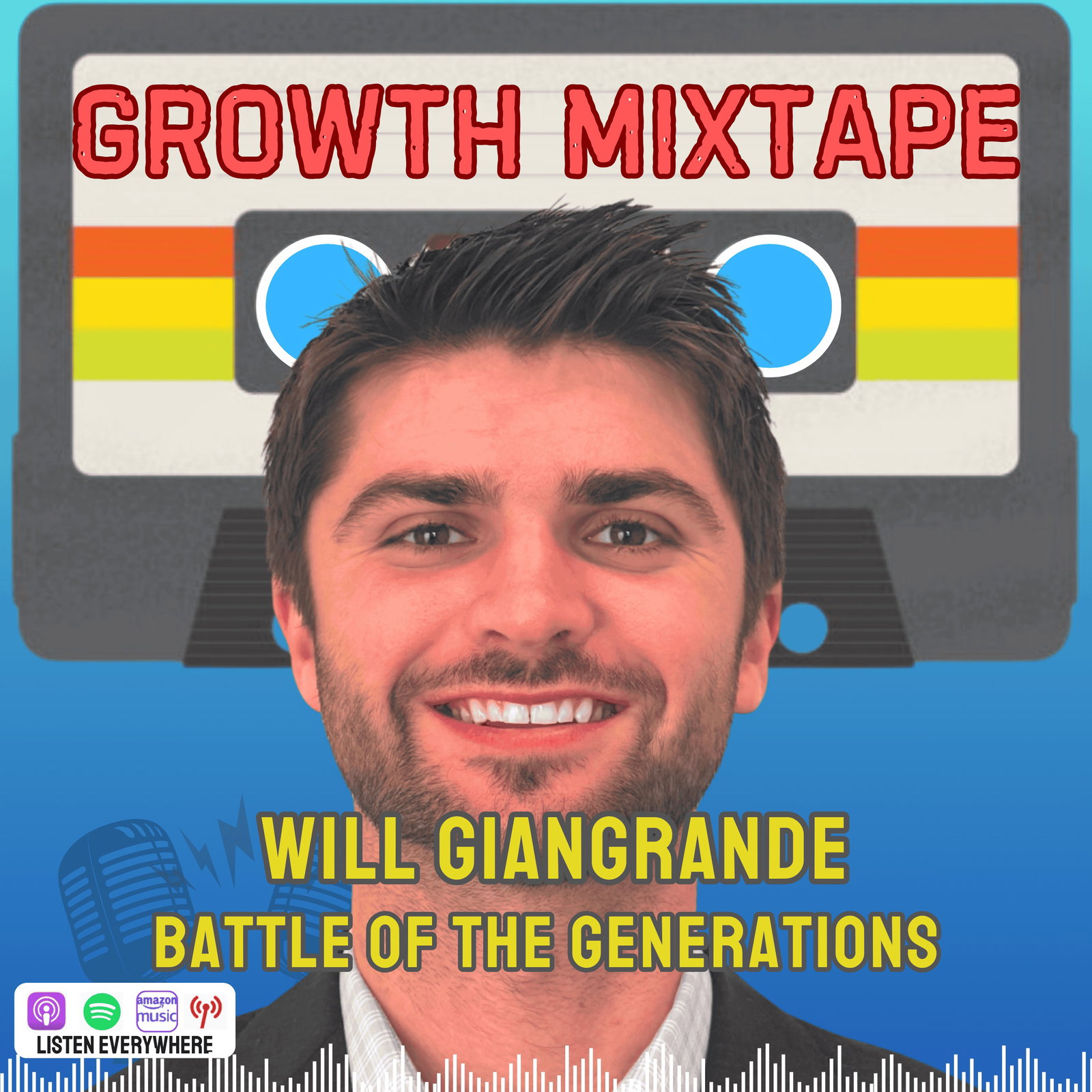
Today we talk to Will Giangrande, founder of The NextGen Playbook and someone who has made it his mission to help bridge the gap between generations in the workplace.
I met Will a little over a year ago, and despite being nearly the youngest person in the room, he struck me as an old soul. He's spent the last few years helping leaders better understand Gen Z, but what I loved most about this conversation is that he flips the usual script. Instead of a fifty-year-old HR professional explaining how to relate to younger workers, here's someone from inside that generation translating both directions — and refusing to point fingers about which generation has it figured out.
We covered everything from dating apps and long-distance relationships to remote work, feedback, work-life boundaries, purpose, AI, and why a 25-year-old might already be wrestling with questions previous generations didn't start asking until midlife.
More than anything, this conversation reminded me that most of the friction between generations comes from misunderstanding. We're all just products of the world we grew up in — and if we can stay curious and ask one more question, we usually find we have more in common than we think.
Please enjoy, Will Giangrande.
Key Takeaways
- Every generation has accused the one behind it of being lazy, entitled, and bound to ruin everything. Will literally collects these quotes and has audiences guess which era they're from — the complaints are ancient.
- "Gen Z" isn't one group. Smartphones and COVID created sub-generations inside the label: someone who got a phone at 15 forms relationships differently than someone five years older, and where you were during the pandemic (17 or 22) changed everything.
- Most workplace tension is a projection problem. We assume the only upbringing we ever had — the way we learned to communicate and build relationships — is the "normal" way, and judge everyone else against it.
- Wanting feedback isn't neediness. In a remote setting, the hallway moments and quick door-knocks vanish, so mentorship has to be scheduled and asked for. That makes it look constant and formal when it's really just become visible.
- The work-life boundary fight isn't about laziness either — it's about control over time, not fewer hours. The 9-to-5 is an industrial-era leftover, and younger workers are the first to feel empowered to push back on it. Most of us never felt we could.
- Your first job becomes the baseline. Whatever you experience first — remote or in-person, one set of norms or another — quietly becomes the standard you judge every job after it against.
- Purpose is arriving early. The questions about meaning and balance that used to trigger a midlife crisis at 45 are now showing up in people's twenties — and with longer lives and AI reshaping work, careers are becoming less linear. Reinvention and curiosity may matter more than sticking to one path.
- We make sweeping claims about millions of people from a sample size of five. Social media magnifies the differences between us; honest conversation tends to shrink them.
- The simplest way to bridge the divide: stay curious and ask one more question. You never know where it leads.
Connect with Bob Mathers
Website
LinkedIn
Instagram
The Restless Leader Newsletter on Substack: https://bobmathers.substack.com/
Links & Resources
NextGen Playbook Website: https://thenextgenplaybook.com/
Will Giangrande on LinkedIn: https://www.linkedin.com/in/will-gian/
The Next Gen Playbook on Instagram: https://www.instagram.com/thenextgenplaybook/
Will Giangrande on YouTube: https://www.youtube.com/@WillNavigates20s
Speaker 0
Look. The your twenties is just your time to work your ass off. You don't have kids. You don't have, responsibilities. You might not have a mortgage. Then now is the time to work eighty hours a week because that's what I did and that's the way it's supposed to be. Now you've got a generation going, why would I work for thirty years before looking for some purpose? You know, the old generation, you're all freaking alcoholics. You're all have got heart disease. You're all freaking miserable. You're all burnt out. Maybe they're on to something. Speaker 1
I know that if I'm doing something that I'm passionate about, my output, if I'm working forty to fifty hours a week as opposed to sixty or seventy hours, my output for that will probably be more effective and more efficient than if I'm doing something that I dislike for sixty to seventy hours a week. That's not to say that your first job needs to be something that you're really passionate about, because I think you learn a lot from those first jobs. I will say, though, there are moments I still struggle with this, and it's gnaws at me all the time. Like, every day, I'm asking myself the question, how many hours did I work? And I think it's just something that's been ingrained in our minds for a very long time. It's like I if I work five or six hours a day, but I have a very productive day, I'm still thinking, well, I could have worked seven or eight. And it's something that keeps going in my mind, like I should be doing this, I should be doing this. And I think we're shifting more to being efficiency focused. And I think part of that is because people are exploring those things that are they're passionate about. Speaker 0
Alright. Welcome to the Growth Mix Tape podcast, and I'm your host, Bob Mathers. And just a reminder, if you know someone that needs to hear this episode, please share it with them. And if you like what we're doing here, join my one hundred percent free Substack at substack dot bob mathers dot com or get the link in the show notes. Now today, I talked to Will Giangrande, founder of the Next Gen Playbook, who works with leaders and organizations to bridge the generational divide in the workplace. But we don't stop there. We talk about the bar scene and dating apps and just building relationships in general. But what makes this conversation so fun and unique is that Will is twenty four. He's an old soul and gave me a completely different lens through which to see the world my kids are growing up in and what it's like for them as they start their professional lives. But maybe the biggest for me is that this thing we call Gen z is actually made up of three or four cohorts with wildly different experiences because of the disruptions caused by smartphones, social media, COVID, and now AI. Boomers or millennials, we had TV or nine eleven as the defining moment in our formative years. Gen z had four of them in ten years. If you've got kids you're trying to figure out or if you work with people across generations that struggle to understand each other, this episode is for you. Please enjoy Will John Grande. Welcome, Will John Grande, to the podcast. This is gonna be awesome. Speaker 1
Thanks for having me, Bob. Excited to be here. Speaker 0
Yeah. It's interesting. The so I've been thinking a lot about these generational differences, and we're gonna dig into a lot of that in kind of the workplace, in lots of different areas. It's kind of been maybe top of mind for me because I've got two kids that are in their early twenties entering the workforce for the first time. And so I just feel like I'm paying a little bit more attention to this stuff time. That's what I think I'm most excited about. Speaker 1
Yeah. Me too. And I think it's always interesting. For me, whenever I do these conversations, you you mentioned the word, like, expert and things like that, but I feel as though I walk away from these conversations just having learned so much from the other side as well. So every time I do a facilitation or do a session, it's it's always like I there's so much more input that I have and more information from any of these conversations. So I'm excited to learn from you, just as much. Speaker 0
Yeah. Well, we'll see. But, yes, I love that. I love the spirit of that. How old are you? And I only ask because it seems relevant to Speaker 1
this conversation. That's fair. Twenty four. Almost twenty five. Almost twenty five. Speaker 0
So I've got a son that's just maybe a couple of years younger, than you. We met just around a year ago at this retreat, and I think a lot of us were talking about like, you were, I don't know, the youngest person there by what seems like thirty years. Maybe it wasn't quite that much. But I get I'm sure you get this all the time that you seem much older than twenty five. Speaker 1
Yeah. Yeah. I've done I've I've heard it before, and I feel like I I resonate with being more of an old soul as well. So I appreciate it. Speaker 0
Yeah. Well okay. So there's I got so many questions more than we'll ever get to, but I I wanted to ask about something that I've noticed again because it's been top of mind. We'll get to the workplace stuff and and what it's and, how work is different. So a quick story. When I went away to university, I was eighteen years old. And in between graduating, so that summer before I went away to school about an hour away, I had a girlfriend. It wasn't anything serious. It was kind of a summer fling. Probably should have ended it before I went away to school. I don't know. Maybe it was my safety net. I don't know. But we were still going out when I went away to school, and she stayed here. And, it didn't work out. We broke up around Thanksgiving, Canadian Thanksgiving, so middle of October. And I would say that that is the way it worked for ninety percent of the people I know. If you went away to school, if either you or your boyfriend or girlfriend went away to school, you were broken up by middle of October, Thanksgiving, maybe you'd survive till Christmas. I would say that's true of ninety percent of the people that I knew in that situation. And we can talk about I've got a theory about why that happens. It's not complicated. But I've noticed my kids and their friends, the same thing. They've got boyfriends and girlfriends. They go away to school. But ninety percent of them after four years of university and college are still together. So the so the the ratio has completely flipped. And I can tell you that never happened back in nineteen eighty eight when I went to school. Like, if you went to school with a specific other, it was not gonna work out. And I'm wondering I'm not asking you to speak for an entire generation necessarily, but I'm wondering what you make of that. Speaker 1
Yeah. And I've just been thinking about that a little bit recently. Because I I've definitely seen it for myself too where I've noticed people that have stayed in relationships, like and they were long distance for a very long time. I mean, I think one of the things that's interesting is just how connected we are now. And, like, when I hear about, like, my parents growing up, obviously, you could call people up and and see, but now there's FaceTime, and there's all these different ways to stay connected that, you know, again, I don't have the perfect answer for this, but I do think that there might be this sense of, like, being able to simulate being in person a little bit more and, you know, having more of those ways to stay connected now, that might lead to that desire to be you know, stay together throughout college. Speaker 0
Yeah. I actually hadn't thought of that because I think I guess when I think about it, you know, if you were, you know, high school sweethearts or whatever, you're probably well, you're connected, like, all the time. Even though you're not physically together, you could be FaceTiming or texting virtually any time of the day. So maybe being separated by an hour or two drive doesn't seem as significant as it did when all we had was basically telephones, like landlines. Speaker 1
Yeah. Yeah. No. Exactly. What was the thing that you were gonna say? Was that was that the the part that you were gonna say No. Regarding Speaker 0
I had a much more cynical view. So the reason that most of those relationships didn't work out is because somebody was cheating on the other person. So if you if I I went away to school, and my experience was similar to virtually everyone I went to school with. I had never been away from school. Basically, unlimited alcohol, complete freedom. So, yeah, it was just it was just mayhem. And what we what younger generations have that I didn't have was phones everywhere and cameras everywhere. And you went away to school, and there was no way to know for your what your girlfriend there's no way for your girlfriend or boyfriend to know anything what you were doing. You could be completely anonymous. You could reinvent yourself. And so my cynical view is, yeah, you just can't get away with anything anymore. Speaker 1
That's a good point. I didn't even consider that. Yeah. Yeah. That's that's interesting. Because it's it is something that, like, I didn't know that that was always the case. I, like, I I knew that long term relationships were definitely I I see it all the time now, but I didn't know that it was much more rare to have that, you know, for people such as yourself or my my dad's age. So it's interesting to hear. I'm curious to hear what are your thoughts on, what are your thoughts on dating apps? Speaker 0
Well, I've never been on one, so all I know is sort of their reputation. Speaker 1
But, like, just the concept of it, because I know that's something that's definitely come into into the equation, for Gen z particularly. Speaker 0
Yeah. It's I don't know about dating apps specifically, I guess. I do wonder, and this does get to some of the things that we'll probably touch on later, is that I wonder what it's like being in a bar nowadays, being twenty one years old and going to a bar. Like, if I go into a bar, am I just gonna see blue screens everywhere and a circle of, like, people talking but also having their phones? And are they texting people in the bar? It's it's like nobody is just where they are. There nobody's present. They always wanna be somewhere else. I don't know how that relates back to dating apps specifically because I really just don't I cannot imagine what that would be like. But but just how people gather and how people build relationships, how they communicate, obviously, a bar is is like a little subset of society in there. And I just don't know what that would be like because we didn't have screens, And we might kinda make eye contact with somebody across the bar, and we walk over and talk to them and buy them a drink. And I don't know if that I don't know how that happens today. Speaker 1
Yeah. And I feel as though it's interesting because I I've been reflecting on this as well. I think especially with dating apps, there is a sense and I've I've used them before. But there is a sense of, like, certainty. Meaning, if you're at a bar or if you're in public and you see someone, you're like, oh, they they they seem cool. They're interesting. There is a sense of, like, okay. There's all these things that are going on in your head. Like, are they seeing someone? Are they in a relationship? And that might dictate your decision whether to go up to them. There's also the fear element of, you know, not knowing what are they gonna think. Whereas if you have a dating app, there's much more certainty. You know that, like, everyone on that app is there for a reason Right. To meet someone, and I think it removes that sense of angst. And I think I don't know. I think that's it's just been interesting to watch that, and I feel like today, it's it's much more rare to go up to people. Maybe in bars, you might see it a little bit more often, but go up to people, because you have all those different options. So that's one of the things that I've noticed is just there is that sense of certainty in knowing, like, why everyone's on the platform. Speaker 0
I can see that. There's certain there's certainty in that way, but you're but you can be anybody online. Speaker 0
So you're like, okay. There's certainty about everybody's intention of being here. Whether any of the other stuff you put on this profile is true, I have no idea. Whereas at a bar, I oh, yeah. You really are five eight. You really do have a full head of hair. You really you know? So I don't know. Yeah. It's it's like you're trading certainty in one area for uncertainty in another. Speaker 1
Yeah. And and that's a good point because I feel as though especially when you're getting to know someone on text for the first time, like, it could be so easy to build up this idea of what the person's like, like, in person when you're texting them because texting is obviously way different than, you know, how you are in person. But I've noticed that with myself is sometimes I might have this idea of what this person is like. And then when I meet them finally in person, I'm like, oh, they're completely different than what I thought. So there is this sense that's not necessarily a bad thing, but there is this sense of what you're saying is it's there is like, it's like a double edged, side to it where it's there is certainty, but also uncertainty. So that is interesting because I know, like, when you bring up dating, that's I feel as though that's one of the biggest things with Gen z that I see dating apps as being kind of at the epicenter of, one of the unique features that we we've had. Speaker 0
I think this is really interesting because you've only grown up one way. I've only grown up one way. I think a lot of the things that we run into in the workplace or other conflicts we have just come from a lack of understanding of what it was really like. Like, what it's like to to communicate and build relationships and do all these things. And we're sort of projecting ourselves the only the only way the the only adolescence or the only young adulthood that we've ever had, we're projecting that onto another group of people saying, oh Yeah. You don't make any sense to me. And it's like, no. But if you grew up in my world, this would all make perfect sense to you. Right? So much of it is just trying to better understand what it was like as we both went through it. Oh, agreed. Hundred percent. The in terms of, the the gap, so the differences between the generations, I do feel like okay. Every generation for thousands of generations has been complaining that the generation behind it is fucked up, that they're don't still they're gonna ruin the world, that they're lazy, and that they they have it too easy, etcetera. Do you think that this generation, we actually have a point? Do you think that the pace of change means that, no. This real it really is a little bit different this time? Speaker 1
I like what you said about pace of change because there's been since the COVID nineteen pandemic, I feel as though there's just been so much more like, the change has been accelerating because we were coming out of place from knee. And I think we might have discussed this. It's interesting how quickly change come about when you're at a place where it needs to happen. Because if people just said during COVID, you know, okay. We're not going to go remote, then people just wouldn't really be able to work. And before that, you know, when we were talking, you know, when people were able to meet in person, remote was just a nice to have. And then once the COVID pandemic hit, it was a need to have because they they they just didn't have the other option. So I think it was interesting to see, like, how much can happen when you're coming from a place of need. And I've and it's interesting because you have people that are twenty eight years old, twenty nine years old who might have had a little bit of pre pandemic experience, and then you have someone that's twenty one or twenty two. And they didn't have that experience, and that's not that big of a gap. But you're seeing that there is a big gap. Like, for example, I, you know, I have a family member who is in sales, and they're a leader at a company and manages a team. And she is twenty six, and she gets frustrated with twenty one, twenty two year olds because they don't necessarily know how to dress in the workplace. They show up in hoodies. They show up, you know, just wearing pants that they probably shouldn't be wearing in a work environment. So it is really interesting to see, and I think there is every generation and you can go back and look at all the quotes from about different generations. It's pretty hilarious, actually, if you if you look at some of the quotes. Like, the me me me generation, millennials are, you know, lazy, entitled, whatever it might be. It's I've done presentations where I I just share all the quotes and have people try and guess which generation they're referring to. But I do think there is this added element of Gen z, you know, having this pandemic experiences that have this thrown another layer of this generational disconnect to it. So I think it it's it's definitely prevalent to all of them, but I think we all express it in different ways. Hopefully, that answered your question. Speaker 0
Well, it makes me realize something that I hadn't thought of, Will, is that we tend to group things into generations, and we even label them differently. But maybe because of the pandemic and be I would say pandemic and smartphones. Smartphones. There's almost, like, two subgenerations. The people that grew up with a smartphone on them from the time that they were, I don't know, fifteen years old. If you take them as a cohort, but you took another cohort of people that were even five years older who didn't get a smartphone until maybe their early twenties, I bet you'd see dramatic changes in communication and how they form relationships because those are the formative years where we kind of learn how to do those things. So it's kind of like you've got a cohort of, like, true smartphone or or digital native people, people that for whom that happened a little bit later, and then you've got a separate cohort for COVID. Like, where were you when COVID hit? Because if you were seventeen to twenty one, you are gonna look dramatically different than people either two years before you or two years after you. Speaker 1
Yeah. That's and I fell into that age group. Speaker 0
So a lot of the generalizations that we make about this younger generation is kind of a mishmash of different people with, like, dramatically different experiences. And I imagine too you'd have people that, like, it must happen all the time if you're talking about what is Gen z, by the way? How would you characterize Gen z? Speaker 1
Nineteen ninety seven to two thousand twelve. So, you know, anyone that's twenty nine and, and younger. Speaker 0
Okay. Yep. I imagine you talk to a lot of people maybe in their mid twenties or late twenties, like, don't group me in with these people. I'm not that doesn't describe me at all. Speaker 1
And one other thing too that I I don't think we recognize enough is also paying attention to, well, who what what were your parents, like, what generation are your parents part of? So for me, I know that I am heavily influenced by Gen x because my both my parents are Gen x. But let's say if I were to have older parents and they were baby boomers, maybe they were younger, they were on the younger side of baby boomers, or maybe if I had younger parents and they were millennials, I I do think that the people that raise you have an influence on the way that you see the world. You know, for example, my dad always stresses the importance of, like, writing handwritten letters or writing handwritten thank you notes. That's definitely had an influence on me. You know, I think the element of calling people up, obviously, I still text a good amount, but he talks about way if you're gonna have an important conversation, talk in person or have a phone call. So I do think a lot of times people look at the generations in isolation. But, you know, when when you when you notice that gen xers are might be saying stuff about gen z, we also have to recognize that we're kind of more connected than we think we Speaker 0
are. Yeah. That's interesting. What do you so you go in and talk to organizations, groups of people across generations. Right? You'll have everybody from, I guess, boomers to Gen z. First of all, how did you get how does a twenty four year old guy get involved in work like this? Because most of us just bitch about it, and we do our best to navigate through it. At what point did you say, no. This is actually a problem I wanna try to spend some time trying to figure out. Speaker 1
Yeah. I I mean, I think one of the things I always describe, and I alluded to it at the beginning, is I've always felt I've always enjoyed like, if I go over to my my friend's house, a lot of times I get just as excited to spend time with my friend's parents then, like like, if he says, oh, like, let's go get food and then we're not with the family. Like, I enjoy being around the family. I enjoy being around the parents, having conversations with them. So I've always noticed that I've gravitated towards having conversations with people who are further along than me. Whether it's learning from their experiences, just talking with them about you know, because I feel as though, you know, if I talk to people who are and I learn a lot from people my age. But if I'm talking to people who are further along in their life, I I feel as though they can provide insight that I might not have ever considered, and it can help save me time in other areas, where I might end up making mistakes. But also, it's just fun to talk with them. And now I completely forgot what the question was that you asked me. But I knew there was a direction. Remind me again what the question was. Speaker 0
Now I've because I was listening so closely. What what is the oh, how did you get interested in doing this? Speaker 1
Oh, yeah. Yeah. Yeah. So I saw it as a unique opportunity because I was a part of being a part of Gen z. And a lot of times with HR and learning and development specialists I mean, there probably are some that are in that are Gen z, but a lot of them might be millennials or Gen xers that are further along in their career. But I saw, okay. Well, I'm having a lot of conversations with people saying we don't understand gen z. We don't understand gen z. We're having a difficult time working with them. So I thought it was a unique angle to be a part of this generation trying to communicate about us to people that I feel like I can connect to, and vice versa. Feeling as though the more experienced generations can give insight to the younger people about what their expectations are. Because I sometimes I've been on the golf course, and I've and I'm not huge into golf, but I've I've said, oh, it's about helping, you know, organizations better under gen understand Gen z. And then they're like, well, what about understanding us? And then that's when I'm like, now it's I think I need to focus on that too is being able to have both sides understand each other better. So that's really where it started is just being a part of this generation and seeing it as a unique opportunity to represent us. Speaker 0
Yeah. And I do think that was what maybe compelled me to have this conversation and what kinda drew me to you, Will, when we first met is, I guess, I would have always expected, oh, I'm gonna go to some workshop with a fifty year old HR professional that's gonna tell tell us how to relate to the young younger generation. And the the fact that you flipped that seems like a really unique perspective to bring. Speaker 0
The you you mentioned a couple of things. One of the things that I've noticed too is that my kids are much more interested in being friends with me than I was with my parents. So and and, actually, I'm I'm ten years older. Like, there's a ten year gap, a bigger a bigger gap than than my dad and I, for example. So my dad was, like, twenty three when he when he had me, and I was thirty when I had my first kid. But we didn't want anything to do with our parents or our friends' parents. It was super awkward and cringy when our parents would come down and try to hang out with us when we were trying to have a few beers. And so that's the way that I've always approached it. I've always given my kids lots of space. Don't worry. Dad's not gonna get in your way. You guys do whatever you want. And I actually think that they and their friends actually enjoy hanging around the parents, and I did not see that coming. Do you have you noticed that too? Speaker 1
A hundred percent agree. A hundred percent agree. And I'm curious to hear what you think because I haven't given much thought as to why that might be the case, but I'm curious to hear what you think the reason is. But, I mean, for me, I definitely agree that, like, my dad and I, I feel like he's one of my closest closest friends. I mean, I have a lot of close friends, but, I definitely, like, we joke around. Like, I I I wanna spend time with him. I wanna hang out with him. Same thing with my mom. But I'm curious, like, if you were to reflect on that, what do you think the, how do you where do you where do you see that trend, or, like, how do you think that started? Speaker 0
Maybe it started because I do think and I don't know. I'm just thinking off the top of my head. Maybe we put a higher priority on spending more time with our kids as we got older. I mean, all all of us worked, but we were very present, very involved, you know, hockey dads and all that sort of thing. So may I don't know. Maybe that's not unique. I honestly think well, because my my my immediate reaction is, well, I'm just cool. Like, I'm just cooler than and we're all just cooler than our parents were. Speaker 0
And I wish that were true. I don't know that it is. I honestly think we just don't wanna grow up. So I think we wanna be we wanna hang around. We wanna do the same things that our parents do. I think we feel younger than we did. Maybe we take better care of ourselves than our parents did, and we're just maybe younger at heart. But why our kids are more interested in hanging around with us? Honestly, I have no idea. I'm just I'm just holding on for dear life because it might not last forever, but I just we're just loving it. Just weird to me. Speaker 1
I think it's gonna I think it's gonna just get more and more that way. I mean, I I know there were definitely times when I was in, you know, middle school or or early high school where I realized, like, there was a little bit of wanting to spend more time away from my parents. But I'd say since college, I've definitely noticed that that's been flipped. Speaker 0
Yeah. It's been amazing. Okay. Let's talk about I really like this idea of these sub generations within these giant groups that we tend to group things in. Because I sorry. I do like the the idea of these subgenerations within these large groupings because that's the way we've these larger groupings are the way we've always thought about things. So I'm curious when you go into organizations because I have a standard set of things that I think about younger people. I guess I might say they're they seem impatient with their careers. They seem have short attention spans. They're looking for work life balance in their twenties when you don't really deserve that until your fifties. I'm wondering what are the other things that you hear people from older generations say about younger generations and and what the younger generation's responses to that. Speaker 1
I think, desire for feedback all the time. Mhmm. Did you mention that one? Speaker 1
Or no. I think that's a really big one. And I think it's interesting because, you know, you've talked a little bit about the remote environment and how if you're working in a remote space, I think it definitely and I've had I've learned this through my conversations is it minimizes the amount of conversations where you can have those sound bite moments where you can go up to someone, knock on their door, ask them a quick question. Whereas now, if you're working in a remote environment, you have to schedule that time and you have to, you know, reach out to the person and say, can I have a call? And I think naturally, that's just gonna make it feel as though more formalized. It it feels different than just going up to someone and asking them a quick question. And I think if we're in this remote environment as Gen Z ers, and we're looking to schedule that time as a replacement for us just, you know, knocking on someone's door, I think we can be perceived as constantly looking at feedback when really it's about and this isn't for everyone because I think everyone exists on a scale. And I think that's another thing to keep in mind with the generations is that it's not a one size fits all. But it is interesting to see that idea come up. Like, Gen Zers are always wanting feedback. But I think it makes sense if we're in a place where we're just kind of working on our own. So that's one of the things that I think has come up. Mentorship is changing. I think you can definitely have mentors through a remote setting, but I just think it looks different. So that's one of the things that's come up. Speaker 0
Yeah. So what I think I'm hearing is that you it it feels like the younger generations are always looking for feedback or validation, but what's really happening is we're just trying we're give we're making it more visible. We're making it more formalized because it doesn't happen by accident like it used to. There used to be all kinds of, you know, those sound bite moments you talked about, little learning moments, feedback, mentorship. It all just kind of happened in the course of a normal work day when we were working shoulder to shoulder. And now when we want those things, we have to be intentional about going to ask for them, and it feels it's just making it more visible and more yeah. It's it's yeah. May maybe more visible is the best way to think about it. Speaker 1
Yeah. Yeah. And I think too I mean, I'm curious to hear your thoughts on this. Like, one of the things that's come up is just work life boundaries being blurred a little bit more, especially in a remote setting. So I've heard complaints about Gen z not really respecting that type of environment where they might be emailing or texting at times that aren't, you know, appropriate to be texting at or emailing at. So that's one of the things that's come up. So I don't know if you've heard anything about that as well, but I think especially with the remote hybrid setting and especially if you're doing your own thing, I think naturally, your work and your your work life and your home life is gonna be blurred a little bit. And that's that's just another observation that I've had of complaints about Gen z. Speaker 0
Well, I think that happened before remote work. Like, I think back about I'm I am really old enough to know that the first job I had, one of the first jobs out of university was when I got email for the first time. But I still had no way of accessing email from home. So as soon as you could get like, it was a Blackberry, I don't know how many years ago, or a mobile phone. The first time you could get messages on your phone, phone, that's when those lines really started getting blurred because you never really got a phone call at home about work before then. So yeah. So, certainly, people my age, they they've saw that progression. I've what I the interesting thing about what you said there, Will, is that I don't think that our generation ever felt empowered to say anything. My boss wants to email me or people wanna email me or text me at ten o'clock at night. I'm gonna answer it. I it's my job. It just feels like and maybe that's the pushback is that older generations feel like, yeah. I understand that you want boundaries, but you're twenty years old. You don't have real responsibilities yet, And this is the way it's always been, so those boundaries don't they've never mattered to me when I was twenty. I never felt empowered to do anything about it. And so that's just the way it is. And I think for the first time, you're seeing younger people go, no. This isn't okay. You're like, what do you talk what do you mean it's not okay? You're twenty five years old. Who do you you know? It's this is the way it's always been. Speaker 1
Yeah. That's a good that's a really good point too. I never considered that. Speaker 0
What do you think it is that makes people, Gen z, feel empowered to kinda push back and say, I'm not okay with this? Because that's not something I don't think I ever would Speaker 1
have done. I think there's there's so much access now to podcasts, to information where you're talking about things. And and correct me if I'm wrong because this is just my experience. So this might have been around for a long time, but I feel like there's so many more things around mental health, around workplace toxicity that's being shared. That's, you know, if you wanna find information on something, you can find it. And I think whenever someone's having difficulty within the workplace, I think it's that much easier to be able to look up those things and to watch a ten to fifteen minute podcast and then hear what they wanna hear and then they're thinking, wow, okay. So what this person is saying is that I am permitted to be able to bring this up with a manager. I'm permitted to, you know, share this because this this person's saying that this isn't the right way to be treated in the workplace. So I think there's so many more outlets for you to be validated and can give you more confidence in terms of approaching that manager because you're seeing it all over the place, these things that are being brought up and these topics that are being brought up. Speaker 0
Yeah. That's so interesting, Will. And I guess, you know, if I'm twenty five and I'm bringing this up to my manager, I'm gonna assume that my manager also thinks that this is a perfectly reasonable concern to have. And yet they grew up in a time where, no. Nobody nobody talked about this. I'm not like, you're experiencing resistance even a little bit of mild resistance with your manager because they've they don't really know how to deal with this. They're not expecting it. It's not the way that they were, they wake they wait the way they came up through their careers. And so that's the friction. Oh, older generations don't wanna talk about this. They expect me to be available whenever, and we get and that's maybe how that chasm starts to starts to widen. Speaker 1
Definitely. And I think too, it's just it the more I'm learning is just the more that those first workplace experiences definitely have an influence on us and how we view, like, what should be the there's so many moments where and this is just totally outside of what we're talking about where if I go to two events or three events and they're around the same thing or a simp they're they're a similar organization like Toastmasters. If you're familiar with Toastmasters, the speaking organization, like, if I go to one Toastmasters meeting and I go to that for a few weeks, I think, oh, okay. This is what this is the baseline. And then if I go to a different Toastmasters meeting and I see them doing it differently, I'm like, this is wrong and then the first version's right. Mhmm. But what if I went to that second Toastmasters meeting first and then I went to the first Toastmasters meeting second? I probably would have had the same feeling. So I think there's just so much of an emphasis, at least for me, of, like, being biased towards my first experiences that everything after that kind of looks like it's wrong. So that's just something that I've noticed as well, is I do think that the first experiences have an influence on you. But there are people that are probably more open minded than others about those. Speaker 1
Because, obviously, for you, you're, like, you're very open minded about, you know, understanding the other generations, but not everyone is that way. So Speaker 0
Yeah. That's super interesting. And I guess especially kinda going back to something that you said before, if your first experience is fully remote because it happened during COVID or it just happened a couple years earlier or later when your first experience was all in person, those that is sort of the the foundation, the baseline that you tend to measure, you know, not forever, but the next job or two against. Speaker 1
Agreed. Yep. Hundred percent. I'm curious for you, though. Like, let's like, question would be, like, what would you say you know, given all that we've talked about so far, if you were to grow up in a time, like, would you rather have grown up in this time because you have so much access to information, you have the the Internet, you have all these different resources, would you have rather grown up now, like, where your kids are? Or would do you prefer having grown up? And or just the question of, like, would you prefer that the Internet or social media exists or doesn't exist? Do you think we're better off without those things? I know that's kind of a two pronged question, but Speaker 0
No. I love that. That's a great question. I will answer it, but I before I do, I I'm sure you've asked that of people before. And I'm wondering what proportion of people say that they would rather have grown up in a different generation? Speaker 1
Honestly, I actually haven't asked this question as much as you probably would think. But from what I've seen is, like, a lot of times the Gen Xers will say, no. I would have rather I would have rather have grown up at this at this stage in the game. Or or sorry. I would have rather have grown up at my like, when I when I did grow up, not now. I would be interested to see I think there would be more Gen Zers saying that they would rather grow up in the eighties than Gen Xers saying that they would wanna grow up now. Because, like, for me and maybe this is different. I know like, I'm fascinated by what it would have been like growing up in the eighties or the nineties or seventies, eighties, nineties, whenever. So I think my answer would probably be, I would have preferred growing up at that stage. So I think it is interesting to reflect on. I could be completely wrong because I haven't done enough research. Maybe I need to do that a little bit more. But if I were to guess, I feel as though, you know, there are some people that probably would have, you know, enjoyed not having all of the social media and all of the, you know, the constant, you know, distractions and things like that. So. Speaker 0
Yeah. Before I give my answer, that's what I would have expected. I would have thought that more people my age would say no. I love growing up in the seventies and eighties. I wouldn't change that. And I do think that there would be more people your age that would say, yeah. I'd like that too. And I don't know why that is, but I can tell you, for example, if we take social media, I already struggle with it. I already struggle with being present. I don't even wanna tell you what my phone would say about screen time. And I'm a grown ass adult that should be able to establish boundaries and have a healthy relationship with technology. You put that in my hand at fifteen years old, I am a completely different person by the time I get to be fifty. I guarantee it. So that's just one example of no. I don't I don't need that much connectivity. I don't need a mainframe in my pocket all along. I think it would have completely changed the trajectory of my life. Speaker 1
Yeah. It's interesting. It's it's always interesting to hear what people have to say to this. It's it's like the such a big question. I I feel like I need to reflect even more on it too. Even though I kinda know my answer, it's, diving deeper into, like, why I think that way would be would be interesting. So I might need to do my three page morning journal like you do. My morning pages. Speaker 0
Yeah. That's right. Your morning pages. Well, and I also I'd also be curious whether whether that answer, like, the proportion of peep younger people that would say they'd rather grow up thirty years ago or vice versa, whether that would change. Like, if we asked our grandparents that, would it be the same? Like, no. Younger people are always wishing that they grew up in the olden days, and the older people are always fine with growing up in the generation that they did. I don't know. That would be interesting too. Speaker 1
Well so yeah. Would you would you have said were you ever interested in growing up in, like, your parents' age as opposed to to your age? Speaker 0
Yeah. I mean, that was Elvis and the Beatles and old cars. So maybe there is something about our our parents' generation does tend to get romanticized, probably in part because we're also always talking about how awesome it was in the good old days, and you don't know how good you guys have it and how much harder things were. Maybe it does tend to get romanticized. We like watching older movies. We like listening to older music. But I'm yeah. Maybe that's just a generational thing. If you plopped me down in nineteen sixty seven, I'd be like, holy shit. Get me out of here. This is like this is terrible. Speaker 1
That's true. That's great. Yeah. Speaker 0
Tell me about, tell me about these workshops that you do with in the workplace with with generations. And what surprised you most about that work as you've done it? Speaker 1
I would say the part that surprised me the most it's a good question. When younger adults display more of the qualities of those experienced employees and experienced employees display the qualities of the young like, I see that more and more again, and I think it's just a reminder to me that it's not a not a one size fits all. This generation's like this. It's not an equation. I think you I'm just seeing patterns of this is what this generation is typically like, but that doesn't mean it's always the case. Because I see people who are in their seventies, and they're very good with AI. And then I see people like myself who are in my twenties, and I'm I'm not great at AI. Like, there's I'm not great at AI. So it's interesting to see when the generations possess qualities of other generations and vice versa. I think that's one of the biggest things that's been interesting to me. And I did wanna speak a little bit to I'm curious to hear your thoughts on this because I think one of the other things along with it was, like, an awkward moment that you experienced or had in in workshops. And this wasn't particularly a workshop. This was a panel. But I remember getting a little bit of pushback on this. I think someone asked me about be like pursuing entrepreneurship. And one of the things I brought up was, like, I know that I can work four hours, and then if I wanna go to the gym and refresh for a few hours and then come back and work for another four hours or what whatever. Like, my day might not look like a nine to five. I might I might be working from eight to twelve, go to the gym, do an errand, and then come back at two thirty or three, and then I might work until seven or seven thirty at night. And I remember having a conversation with someone after that, and they completely disagreed with me. It was really interesting. I was they because they were more on the traditional nine to five, but they were hearing something completely different. Like, they were thinking, oh, take two to three hours to go hang out with friends, take two to three hours to just, you know, do whatever you want. But if you think about it, it would be the same amount of time that I'd be working. I just would be going a little bit later into the night. So I thought that that was really interesting, just hearing and awkward for me hearing about, you know, being looked at as as almost, like, lazy or not putting in the effort and then saying, like, if you're starting your own business, you need to be go go go go go. And I think also what you mentioned too is allowing space for boredom and allowing space for creativity is important. So I remember feeling a little agitated by that response because I just wanted to communicate, like, I'm not saying that you're working less. I'm just saying that if you're starting your own business or if you have your own business, it might look a little bit different. Now if I were working in an in a company and I said, let me take three hours to go to the gym, let me take some time to, you know, go to this appointment, then obviously, I think it makes more sense to look at that and say that's unrealistic. But I think it was just really that was a really good moment for me and a really good learning experience to see how people's whether it's them going down the traditional path, they might impose their experience when they were in the workforce, and then they hear three hour break in the middle of the day, and they're thinking, that's wrong. I'm right. So I think that was, like, one of the awkward moments that I've experienced when doing a panel. I'm curious to hear your thoughts on that because you have your own business, you know, what that looks like. Yeah. Speaker 0
Well, there's a couple of things that that makes me think of, Will. One is and I think there I was listening to a podcast recently with Brene Brown and Adam Grant, and they were talking about remote work and and, you know, back to work mandates, etcetera. And it does relate back to what you were just talking about. I don't think people have a problem with being in a certain place at a certain time for a being in a certain in one place for a certain time or a certain day of week. What they want is more control over how they spend their time. And if you need me to work eight hours, I'm gonna work eight hours. But it might be there might be a three hour block in the middle of the day. Now it's work dependent. If you're if one of your big responsibilities is to be responsive to customers and your customers are working during those work hours, then there's a real reason why you can't be that you've gotta be connected. Right? But if you're clear on what people need to do to be good at their job, then it shouldn't matter how much time that they take to do it, and you should empower them to do it whenever they want. And I think that that is something that the younger generation, again, feels more empowered to push back on. You know, you realize that this this workday comes from, like, the industrial revolution. Because before that, we were all farmers, and we just woke up when the sun got up, and we had a nap in the middle of the day, and then we might work till the sun went down. There's no, like, work from nine in the morning till five in the afternoon with, you know, regimented breaks and everything. And now that work is so fluid and can be done from anywhere, why do it just seems like a really antiquated notion that maybe we're finally having a generation that's willing to push back and say, if I if I have these things I need to do today or this week, why can't I do them from anywhere? And, yes, if you want me in the office for certain times be for team building, etcetera, that's awesome. But, surely, I should be able to do the rest of it on my own time. Speaker 1
Yeah. That makes that makes a hundred percent Speaker 0
sense. One of the things I was thinking about too, Will, is I think you just posted a, a YouTube video on Ikigai and helping people in their twenties understand, you know, find some purpose in their work, for example. And it did it made me realize that that is not something that that I ever considered until I was in my forties or fifties. And I think that's what led to basically what people used to call a midlife crisis, where people in their mid forties would, like, leave their well, do what my dad did, left his wife, bought a sports car, got a girlfriend, changed jobs, because you just you look down, oh my god. I'm running out of time to do all these things I wanted to do. And in your career perspective, it meant, what am I doing this for? And I talk to leaders all the time. They're like, oh my god. I got ten years left. What can I do with this time? But people in their twenties are having that conversation. And I do and it's easy, I guess, for us to look back, and I think the the knee jerk reaction is, look, that your twenties is just your time to work your ass off. You don't have kids. You don't have, responsibilities. You might not have a mortgage. Like, now is the time to work eighty hours a week cause that's what I did and that's the way it's supposed to be. And now you've got a generation going, why would I work for thirty years before looking for some purpose? You know, the old generation, you're all freaking alcoholics. You're all have got heart disease. You're all freaking miserable. You're all burnt out. And I'm thinking, yeah. Maybe they're on to something. Speaker 1
It's such an interesting point and I mean, I definitely thanks for watching the video, by the way. But I think in terms of the sixty or seventy, eighty hour work weeks, I know that if I'm doing something that I'm passionate about, my output if I'm working forty to fifty hours a week as opposed to sixty or seventy hours, my output for that will probably be more effective and more efficient than if I'm doing something that I dislike for sixty to seventy hours a week. And I think that's something that I continuously keep in mind. It's like when I when I was graduating from college, it's three years ago already, crazy, but when I was graduating from college, there was I was applying to all these jobs, but I wasn't necessarily passionate about it. And that's not to say that your first job needs to be something that you're really passionate about because I think you learn a lot from those first jobs. But I knew I wanted to, you know, find something that I was passionate about and that I was interested in because I knew that I would have more of that muscle for resilience. And I will say though, there are moments I still struggle with this and it's gnaws at me all the time. Like, every day, I'm asking myself the question, how many hours did I work? Like, I still struggle with that. And I think it's just something that's been ingrained in our minds for a very long time. It's like I if I work five or six hours a day, but I have a very productive day, I'm still thinking, well, I could have worked seven or eight. And it's something that keeps going in my mind, like, I should be doing this. I should be doing this. And I think we're shifting more to being efficiency focused. And I think part of that is because people are exploring those things that are they're passionate about. But I I noticed I'm at a continuous tug of war with, like, the mindset of, you know, working like, you should be working seventy to eighty hours a week, but then also wanting to explore something that I'm passionate about. And that doesn't mean that I can't do that when I'm working seventy to eighty hours a week. But I do notice that that's that's a big a big draw for people because I think they recognize, like, I'm going to be more resilient. I'm going to be more invested. And as a result, I'll probably get done in forty to fifty hours what I would in sixty to seventy if I were doing something I'm not passionate about versus what I am passionate about. Speaker 0
Yeah. And I like that a lot, Will. As I'm as you're talking about that, it does come back to this idea too. And I I had mentioned this to my kids. I probably mentioned it on the podcast before. That with AI, you or some of your friends or all of your friends will live to be a hundred. Some of you some of you might live to be a hundred and ten. You are gonna have five careers. Nobody goes and works in one place for thirty years anymore. So who's to say that it has to be your fourth career when you're forty when you finally find some purpose and meaning? Because you're gonna be constantly looking for something that you're curious about, something that you're interested in, maybe not forever, but you just wanna do it for five years. And I think that's gonna be a core competency of people that our generation just never really learned because we were kinda sold this idea that you went to school and you got a job and you worked in the same career for thirty years and you retired and you died. And it's like this process of reinvention and being curious and finding something else to do for the next five or ten years. Like, that's your job. Right? And you're not always gonna get it right. You're gonna end up spending five years doing something that you don't love sometimes, but it's not forever. Speaker 1
Yeah. And that's I mean, you're definitely, I feel as though I don't wanna put words in your mouth, but it seems as though that's been the case for you. It's like you redefined your career and where you wanted to go. And, you know, that might you know, five to ten years from now, that might look a little bit different, or there might be, you know, different things that you incorporate into your work. So I do think that that's it's such a good point because I I hundred percent agree, and that seems to be a common theme across people my age as well as they people are always asked the question, what do you wanna do for the rest of your life? That's incredibly intimidating. Yeah. Because things things change, and there's so much out there now. So, yeah. Great point. Speaker 0
Yeah. I also like this idea. You know, you talked before about everybody is on a continuum. Right? Like, I know I use AI ten times more than my kids use it. They're both out of college. They're in their trades. They have no need for it. They might use it, you know, jump into chat GBT every once in a while. I'm using it to reinvent my business. And and so you you talk about this continuum, and it strikes me that we're very good at making broad generalizations about populations of people based on an incredibly small sample size. You know, if you talk to even some of the executives that you work with and you ask them about what they think about the younger generation, they're probably basing that, what, on four or five people that they've worked with? I'm basing it based kind of on my kids and my and my friends' kids. And I think social media, maybe we could blame a little bit of it on that, but it's great at polarizing things, at magnifying the differences between us when reality is when you just get people talking about it, realize, oh, yeah. Not only are we more similar than we are different, but if you plopped me and instead of being born in nineteen seventy, I was born in two thousand and two like my son, I'd be exactly the same. Like, we're products of our environment. And if we can understand the environment that we grew in, then the behaviors that we see make perfect sense.
Speaker 1
Oh, yeah. Definitely. And that's typically why I always like to bring up the life events that shaped the generation. What would you say was was the life events that I mean, I know you mentioned that you might be similar if you were plopped into two thousand two, but what what were the life events that shaped your generation you think the most?
Speaker 0
Well, I'm trying to think about things in adolescence. I can't think of anything in adolescence, but certainly nine eleven with and it's funny. Sometimes I when I walk through the airport with my kids, I'll be like, you know what? We used to show up at the airport twenty minutes before our flight. We'd walk through. We'd walk through security. We'd get on. You could have food. You could have water bottles. We ate with metal knives and forks. There were people smoking in the back of the plane. Yeah. And it's just like it's crazy how much things have changed. And so that's just one example of how a singular event can affect an entire generation and change things forever that are impossible, really hard for younger generations to understand what that was like before that.
Speaker 1
Yeah. And I mean, that's that's one of the examples I always hear from my my parents is if you watch the movie Home Alone, you'll see on the airplane. The airplane even looks much different, you know, now versus back then. And there's all been all these changes that have been made. So that's definitely a common theme because I was born a month before that happened. Oh, interesting. You know, I was right around that time, but, didn't experience it like you did. But I've heard there's just been a lot of a lot of changes came about after that event.
Speaker 0
Yeah. And there's also obviously geopolitical factors like that. You know, the the air travel is just one small example. But what would you say are those defining moments in your generation or your life?
Speaker 1
I would say well, COVID. We talked about COVID, but I think I think social media, like Instagram, like, we we had that at such a young age. Sixth grade, seventh grade, like, just all of those different apps, I think, is, it's very like, it's it's you know, we talk about things existing on a continuum. It's, like, it's like you're you're very connected, and then you feel isolated from from social media. And I think that was a big one that's defined our generation. And, you know, you look at advertisements that we've been given since we were really young, like, online advertisements that we see that talk about mental health, work life balance, things like that. And it's no surprise that when we're looking at that information now, this isn't the exact this isn't the only reason that we have this mindset, but I think it's no surprise that the information that we consume has a little bit of an influence or a decent influence on us. But I know, like, sixth grade is when everyone was downloading Instagram and, you know, I think the mindset of always seeing, like, I don't go on Instagram anymore. I have a or not much anymore, but I never scroll on Instagram anymore because I always had this feeling of, okay, well, I'm comparing how I'm experiencing life on the inside to how other people might be experiencing life on the outside. And I think that's something that if we're not careful as a generation, it could be so easy to do. And being given that at sixth grade, seventh grade, eighth grade, when you're really like, everyone's trying to fit in, everyone's trying to be popular and cool. I think that had a really big influence on us, and it's continued throughout the rest of our lives. And, obviously, that's had an influence on other generations. But when we speak about, you know, defining moments, that that definitely was one of them.
Speaker 0
God, I love that. It inspires me to to do a bit of a timeline inspired by something that happened, you know, that we talked about early on the conversation about when, phones and social media and COVID and how we can break down these generations. Because of the pace of change, there are things that happened within those generations that really defined that really changed everything. And you even men you could even get down to, like, the like button on Facebook. Facebook was just a community until they added a like button, and then that started this validation and this need for people to put things up there that got a reaction and that started the dopamine. Before then, it was just, hey. All my friends and family get to see what I'm up to. And then the infinite scroll made all social media infinitely more addictive. So it's like, yeah, if you could map these things out, and then you could say, yeah. I was born right here. I got a phone right here a month before or I was born a month before nine eleven. I got Instagram in in the sixth grade. You'd be like, oh, yeah. It's it's so much more than just this generation of twenty five years. It's these super moments that on their own would even have a massive impact, but they've been kind of piled up right on top of one another.
Speaker 1
Oh, hundred percent. And I'm interested to see what it's like for more will be revealed, but with Gen Alpha and whoever comes after that, it's there'll be there'll be new things as well. So I I a hundred percent agree.
Speaker 0
You did ask me earlier, Will, whether I am hopeful. And I I have said this before. I really am hopeful. There's lots of reasons to be pessimistic. But I look at my kids and my my, kids' friends and the questions they're asking about work that's that means something to them, defining some balance. You know, it's interesting. We can in our work life, we can kinda bitch about younger generations and how they don't wanna work hard and sacrifice, but that's not what I want for my kids. For the people that mean something to me, I want them I don't want them to get to be fifty I don't want them to be fifty years old before they start thinking about these things. I I want them to be concerned about that and to be thinking about that now. And that does make me, I think, hopeful because I don't I don't think the way that we grow up is the only way that it's gotta work.
Speaker 1
Agreed. Agreed. And and, I I mean, I I do think there's is this desire and curiosity, and you talk a lot about curiosity. I think that's, I've noticed there seems to be a lot of young adults who are very curious, very interested. And I think, again, like, everything has a good side, and then everything has a but I think having all this access to information is a really good thing too because it allows us to be curious about different career paths and, you know, different ways of living, different job opportunities that we can pursue. And that's great to hear that you're having those conversations with people, people my age because I think it's it's important to get a better understanding even if you don't necessarily know what it is, at least moving in that direction because I'm still learning that myself too. So
Speaker 0
So for if people are listening to this, Will, and they are curious about the younger generations or older generations, like, what's the one thing they can do to sort of better understand the people that they're either working with or the people people in their lives?
Speaker 1
I mean, I think just opening up opportunities to have more of those those conversations where, you know, you might be passing someone in the office and just saying, oh, how's your day going? Maybe just asking one more question. Just asking you never know where one more question will take you, because sometimes that can just open up the conversation a little bit more. And I think there's so many moments throughout the day going back to that idea, like, allowing that time for that space, whether it's at a lunch break, just being able to ask a quick question to to someone who's of a different age, I think, is is really, really valuable. So I'd always I always recommend that as being, you know, a way to get a better sense and a better understanding of the other generations in the workplace.
Speaker 0
I love that. One more question. Yeah. And I do love that idea of curiosity. I think that is where it starts. And, god, there's just been so much about this conversation, Will, that I've loved. We sort of we're we're all over the place a little bit. I just feel like I could talk about this for another couple of hours. Me too. This has been I know we've skipped over a lot. I might this might genuinely be a conversation we need to continue in another episode.
Speaker 0
But it yeah. But in the meantime, if people are wanna learn more about you and the work that you do at the, at the Gen X playbook or next gen playbook. Sorry. No worries. The work that you do at the, Next Gen playbook, where can they find you? Where they where can they learn more?
Speaker 1
Yeah. So if you wanna visit my website and if you wanna include that in the notes or whatever, the next gen playbook dot com, feel free to follow me on LinkedIn, my Will John Grande. I definitely post a lot on there. But, yeah, I do a lot of work with, you know, again, helping bridge the gap between generations, whether it's through keynote sessions or doing consulting. And I've been, you know, restructuring it a little bit, which has been exciting. But, but, yeah, always happy to have conversations and talk a little bit more about the generations. So those are the best places to to reach me.
Speaker 0
This has been so good, Will. I know people are gonna love this. God. I've loved this conversation. I can't thank you enough.
Speaker 1
Yeah. Thank you so much, Bob, for having me. It was a pleasure.
Speaker 0
The Growth Mixtape podcast with Bob Mathers is produced by Bespoke Projects, music by Jemappelle Walter Cronkite. If you enjoyed this episode, please take a moment to follow and rate us. When you do this, it helps to raise our podcast profile so that more people can find us. If you wanna connect, you can find me on LinkedIn using the link in the show notes.