Today, we talk to John U. Bacon, bestselling author of The Gales of November: The Untold Story of the Edmund Fitzgerald.
This story gripped me in a way I didn’t expect. Like a lot of people, I knew the Gordon Lightfoot song — I’d sung it around campfires and strummed it on my guitar — but I had no idea how much more there was to the story until I picked up John's book.
He spent years talking to the families of the 29 men who were lost that night in 1975, and what he uncovered is not just a story of a shipwreck — it’s a story of sacrifice, silence, courage, and legacy.
We talk about the night the Fitzgerald went down, the myths and facts surrounding the wreck, the power of Gordon Lightfoot’s songwriting, and the heartbreaking and beautiful stories of the men on board. I learned a lot, felt even more, and I think you will too.
Please enjoy, John Bacon.
Key Takeaways
The Edmund Fitzgerald isn’t just a shipwreck — it’s a human story: John interviewed 14 families of the 29 crew members, many of whom had never spoken to a writer before. Their stories bring the tragedy to life in a deeply personal way.
The Gordon Lightfoot song changed everything: Without “The Wreck of the Edmund Fitzgerald,” this story might have been forgotten. Lightfoot’s first-ever performance of the song — captured by accident in the studio — is still the version we hear today.
The Great Lakes are more dangerous than the ocean: Local storms, sharp waves, and shallow shoals make the lakes uniquely treacherous. Sailors face 60-foot waves with just 11 feet of clearance from deck to water.
Shipping is essential — and invisible: The Fitzgerald and ships like it carried the raw materials that built North America’s cars, homes, and infrastructure. Yet most people know almost nothing about the lives of the sailors.
Heroism doesn’t always come with survival: The Arthur Anderson, the ship following the Fitzgerald, turned around and went back into the storm at the Coast Guard’s request — a nearly unthinkable act of courage.
A flawed map may have played a role: The Fitzgerald was likely using outdated charts with shoal locations that had shifted by more than a mile — potentially contributing to the ship’s damage and eventual sinking.
The tragedy led to lasting change: There hasn’t been a major Great Lakes shipwreck since the Fitzgerald. It changed safety standards and remains a powerful reminder of what’s at stake.
These men are not forgotten: From tattoos to scholarships to grandchildren who carry on their names, the legacy of the 29 lives lost lives on — through this book, through the song, and through the families who still feel the waves.
Connect with Bob Mathers
Website
LinkedIn
Instagram
The Restless Leader Newsletter on Substack: https://bobmathers.substack.com/
Links & Resources
John’s website: https://johnubacon.com/
Books by John: https://johnubacon.com/books/
John on LinkedIn: linkedin.com/in/john-u-bacon-6359302
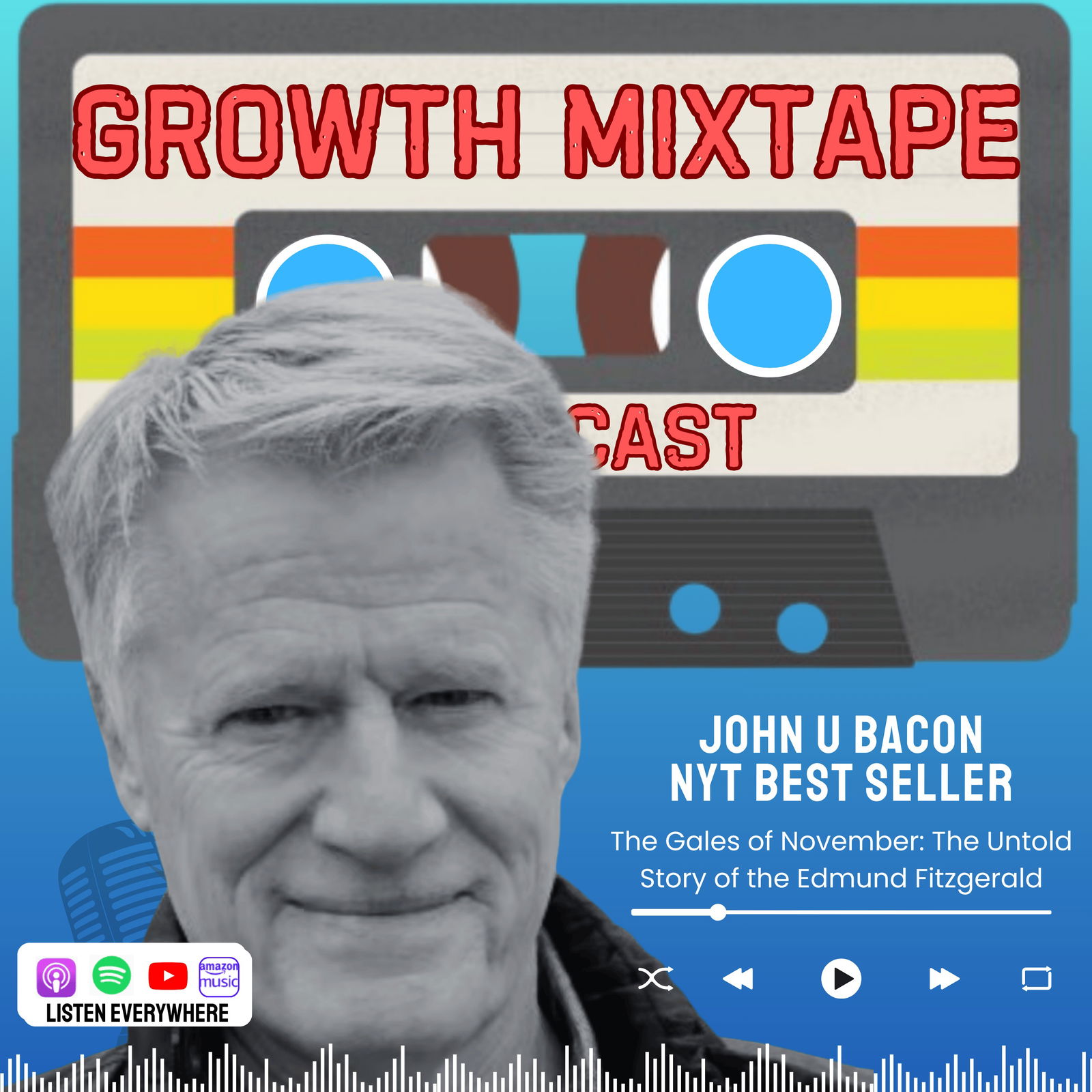
John
With these waves, you can have your bow stuck in a thirty foot wave, and then seven hundred feet later, that's how long these things are. You can have your stern stuck in another thirty foot wave with nothing supporting that ship in between. So it's gonna sag. Why is it gonna sag? Because it's carrying twenty six thousand tons of iron ore. Twenty six thousand tons of iron ore is the same as four thousand two hundred adult elephants. Then it does what's called hogging over the next wave, which is kinda the opposite, draping itself over that wave. Then it sags, then it hogs, then it sags, then it hogs. This happens ten thousand times a day during a storm. Take a paperclip. Bend it back and forth ten thousand times. What's gonna happen? Alright. That's what happens to these ships oftentimes. It does not happen on the ocean. It happens on the Great Lakes. So that's how you got six thousand shipwrecks, thirty thousand crew lost. That's one per day every day for a century. Bob
Legend lives on from the Chippewa down the big lake they call Gitche Gumee. The lake, it is said, never gives up her dead till the skies of November turn gloomy. A load of iron ore twenty six thousand tons more than the Edmund Fitzgerald weighed empty. The good ship and true was a bone to be chewed when the gales of November came early. BOb
Alright. Welcome to a very special episode of the Growth Mixtape Podcast, and and I'm your host, Bob Mathers. Today, I talked to John Bacon, author of the five time New York Times bestseller, The Gales in November, the untold story of the Edmund Fitzgerald. I can't even remember a time when I wasn't gripped by the story of the mighty Fitz. A seven hundred foot freighter loaded with iron ore that sank in the storm of the century in Lake Superior in nineteen seventy five. And if it sounds familiar, it's only because Gordon Lightfoot wrote what is still today the definitive song of nautical disaster. And that song alone is the reason that of the six thousand ships at the bottom of the Great Lakes, the Evan Fitzgerald is the only one people know by name. Now here's a fun story. I've been thinking lately about what makes a great podcast episode, and I've come down to two things. Is it interesting, and is it helpful? And I've been thinking about whether I should score each episode on a scale of one to five. How interesting is it, and how helpful is it? And my goal would be to have a five out of five on both of those categories every episode. I think I've come pretty close on a few of them. But I've also realized that sometimes you just need to do shit for the fun of it, and that's what this episode is. The story of the Edmund Fitzgerald has been a part of my life for as long as I can remember. My dad and I would talk about it out fishing on the Great Lakes. We'd listen to Gordon Lightfoot. It's part of the fabric of my life. But here's the thing. You might not learn a damn thing in this conversation. At least nothing that's gonna help you be a better person. But it also might be the most interesting episode I've ever done. So I don't know. Maybe there is a lesson. Maybe we just need to get more comfortable, give ourselves permission to chase our curiosity for no fucking reason. Not because it's gonna make us money or help us be a better person, be a better dad, a better partner. Not because it's helping us push us out of our comfort zone. We just need to do it because it's interesting, not having any idea where it might lead. And damn, maybe that's the most important lesson of all. Because it occurs to me that this episode might just be the reason I created this podcast in the first place. Please enjoy John Bacon. John Bacon, welcome to the show. I can't tell you how excited I am about this. I've had this date circled on my calendar for weeks. John
Well, you're very kind, Bob. And in fact, your enthusiasm got my wife's attention because, she said, this guy is really looking forward to talking to you. Check him out. It's a great website, great program. So we appreciate it, and, thanks for your invitation. BOb
Well, yeah. Yeah. I was scrolling through Instagram, and, of course, the fiftieth anniversary of the syncing of the Edmund Fitzgerald was maybe three weeks ago, and it'll be more weeks than that by the time people listen to this. But my feed was just filled with stories about it, and I I came across your book. And I don't think I've ever reached out to a guest faster than I've reached out to you. I'm like, holy shit. I didn't realize people were still writing about this fifty years later. I can't wait. And you were just so gracious, and, and here we are. So this is awesome. John
Well, I appreciate that. And then, also, it's always good for me to reach the Canadian side of things as well because, we're doing well in Canada as well. I'm actually half Canadian. My mom is Canadian, so I'm half Canadian bacon is the joke. But that joke is not very fun in Canada because you guys call it pee meals. So hey. BOb
Yeah. It's funny you mentioned Canada because in preparation for this, I've talked to I probably talked to twenty people. Any people from eighteen years old to seventy years old. Just curious, you know, what what do you think of when I mentioned the Edmund Fitzgerald? And I got lots of different reactions to it. One of the things though is that the Canadian everybody I talked to in Canada is shocked that it's not a Canadian story. Right? It's a Canadian ship with Canadian or sorry. It's American ship with American crewmen leaving American port, going to an American port. It just happens to have sunk in Canadian waters and be sung and have a very famous song written about it by a Canadian songwriter. John
Well, those are two pretty good Canadian things right there, of course, because let's be honest, without without the song, there is no book. I mean, how about this stat for you, Bob? Between eighteen seventy five and nineteen seventy five, there were six thousand commercial shipwrecks on the Great Lakes. And by that, I mean, not rowboats, but schooners and whatnot, tankers, you name it, all going down. Just crazy stuff. And we all know one, and the answer is because of Gordon Lightfoot's great song. So he got it right. And, crucially, it is in Canadian waters, the ship is today. And it was the Canadian government that approved the family's, wishes to have the site declared an international grave site, and that was very gracious of them. That's not an easy process either, it turns out. So that is crucial to keep the grifters and the ghouls away from the shipwreck today. BOb
Right. So that means that nobody's allowed to go down there without the consent of the Canadian government. And I think of the American government too. Is that true? John
Yeah. Kinda. But it's only legally. Right. The only only Canadians really matter in this one. And they've been very gracious about this. Countless meetings, by the way, the families would go to Ottawa or Toronto and have these, meetings, of course. And they've handled it very well. And since then, no one's been down since. So it has worked. BOb
So getting back to the book quickly, what is it? So the book is called The Gales of November, The Untold Story of the Edmund Fitzgerald. You've written a bunch of books. What makes you look at this story and believe that you had something new to offer after fifty years? John
That's a great question. Of of the fourteen previous books, by the way, one of them is called The Greatest Comeback about the Summit Series nineteen seventy two, published only in Canada, by the way, HarperCollins Canada. So how about that? That was a real treat. I grew up on the almost on the Canadian border in Anarbor, Michigan. So in seventy two, I was a third grader, running home from school with my friend Scott Childs, who's from, Owen Sound, Ontario, to turn on Channel nine out of Windsor. How about that? C k l w. We'd get CBC that way. And we're watching the games, of course, at two and a half at at three o'clock in the afternoon. So, anyway, so some Canadian roots there. Another book is on Surfers LA, actually. So I've got Alright. Few roots there. But this book, you're alright. I mean, behind me is a bookshelf full of, god, fifteen, twenty, or more, books written on the Emma Fitzgerald. Almost all of them are regionally produced. None of them are from New York, basically. And second of all, they're almost all focused on one thing. What what happened? What, how did it go down? So the who done it. For me, the untold part was getting to fourteen of the twenty nine families, of the crew members. There are twenty nine crew members on that ship that day. And they were they talked to an author for the first time, which was, very much flattering and an honor, but we we respected that. It got to six crewmen who had been on the ship, obviously, before it went down. Two from that season, actually, who knew the crew, knew the captain, knew the ship. So we got, basically as close as we can get to an eyewitness there. And finally, Rick Barthulli, the Arthur Andersen. That's the ship that was chasing the atmosphere that night. He is probably the last surviving member of the Anderson crew from that night, November tenth nineteen seventy five. That's as close as you can get to an eyewitness from that evening, what it's like to be in those ships at that point. So there's the untold part, I think. We also do get into new information untold part here is the people. That's what I wanted to get to. BOb
Yeah. I that struck me as I was going through it. I didn't realize that. It was a bit of a tribute to many of the stories that seem to have gotten lost for those twenty nine people, that right. Because, like you said, the dozens of books that have been written, I don't remember ever hearing any stories about the people that, you know, the twenty nine souls we lost that day. And so it's yeah. It's really beautiful. So much so, you know, when I was when we get to the point, the part, of course, where the the ship is sinking and even more so when you describe how the families are finding out, like, I was in tears, and I wasn't expecting that because I had just you know, you put us in in the in their homes, as they're finding out, I got I got the feeling that I knew all of them. Yeah. I was really emotional. I did not see that coming. John
The rule of thumb I have in these, hate to say it, disaster books is that you have to care about the people before the disaster happens. So you have to build up, who they are, explain who they are, get to know them, because by the time it happens, it's kinda too late. So that, I thought functioned well in Halifax and then hear the same thing. Get to know half the guys at least on the crew, before it all happens. And trust me when I tell you, I got choked up many times talking to these people. They're talking to for the first time about their fathers and uncles and cousins and boyfriends in some cases. And as one of them told me, you don't get over this. You get used to it. Mhmm. If you lose your your dad when you're a twelve year old girl, that's not gonna not sting when you're sixty two. In some ways, it makes it worse all the years you lost naturally. But you do learn how to handle it. That's undeniably true. BOb
Why does this story mean so much to you? I mean, part part of it is probably growing up in Michigan, but what was it about the story that compelled you to dig into it like this? John
You know what? I've done many, many of these interviews, and no one's ever asked me that. It's interesting. I grew up in Michigan. That's certainly part of it, and I grew up on the Great Lakes. I've been in all five of the Great Lakes. I've sailed the port here on the Mackinac race for a story. It's about a three day race. And for a year at the Detroit News, I traveled the state of Michigan to do, offbeat stories. Well, half of those end up on the Great Lakes. You can't avoid it. That that's where the the farms are are great. We need them. They tend not to produce, you know, fabulous stories. The water does. So I can't I can't spin that. But for me, it was, it was the people. It was the song, undeniably, that when you grew up as I did on the Great Lakes, that song is always in your in your head when you look look out across the lakes. And, honestly, it's just just fervent curiosity. Who were these guys? What were their jobs like? What's it like to be on the ship? What is shipping like? I really didn't know almost anything about it, sad to say. I asked my wife the summit series book took me about a year and a half, for example, talking to Bobby Orr and Bobby Clark and Ken Dryden and so on. And most of my books take me about a year, year and change. And this book took me about three and a half years. And I was asking my wife, why is this taking me so long? And she said, oh, that's easy. Because you didn't know anything. And I thought I did, but I didn't. I was just really very curious as to whether lives are like. What's it like on board? What's it like onshore? What's it like for the families when you're home and you're waiting nine months for your dad to get off a ship? That's gotta be pretty incredible. So and also shipping itself. I mean, I knew it was important. I grew up here and, but I had no idea how important. Shipping, by the way, is three times more efficient than trains and six times more efficient than trucks. Not six percent or sixty percent, but six hundred percent more efficient than trucks. So whatever you can put on a ship, you do. So So as a result, if you live in Canada or the United States or really almost anywhere in the world, the cement in your basement, the car in your driveway, and the food in your table comes from these ships. It's pretty amazing. BOb
Yeah. And, like, ninety five percent of the iron that was going into the cars in Detroit came from Minnesota or came from where the Edmund Fitzgerald and all those ships were starting from. John
Exactly right. It's called the John
Iron Range. Excuse me. And that's where they produce a lot of great hockey players, by the way. About a third of the Miracle on Ice hockey team comes from the Iron Range. These are tough dudes. And it goes across, Northern Wisconsin and Michigan's upper peninsula, which Canadians tend to know about. But, yeah, I mean, almost all the iron that we use, in the United States comes from this area and still does. So it's pretty amazing. Without this, by the way, we're cooked. Right. And to prove the point, during World War two, they put seven thousand soldiers in Sault Ste. Marie, Michigan at the Soo Locks because that is the bottleneck that covers the twenty one foot drop between Lake Superior and Lake Huron. And the arsenal of democracy you've probably heard about, that's where, we're building one b twenty four Liberator bomber per hour, every hour, twenty four hours a day, no shifts off for three years. That's Rosie the Riveter and all that. Well, that all that depends on the iron coming from Minnesota, Wisconsin, and Michigan down to Detroit, Cleveland, and so on. So that's why they put these troops there. That was the single most guarded point in all of North America during World War two. So if that fails, we're screwed. BOb
Yeah. We lose the war if they bomb the box. Yeah. BOb
So you mentioned the song. It's interesting. I would, I was thinking about well, I definitely wanna talk about the song a bit, but I'll leave it till later. But you're right. This book doesn't happen. This conversation doesn't happen. The one thing that is common among all those twenty people that I talked to in preparation for this, not only were the Canadians shocked that it wasn't a Canadian story, everyone says, oh, you mean the song. So so what did what did you learn about the song that was that was surprising you think people would wanna hear about? John
Well, quite a bit. First of all, in short, Gordon Lightfoot to me is one of the heroes of this story. So, again, six thousand shipwrecks, everyone knows one of them, and it's this one because of Gordon Lightfoot. He was an avid sailor and a very good one, by the way. He had done the part here on the Mackinac race. I think he might have won it. I have to check my records on that. That night he was doing the story on November tenth. Monday night, November tenth nineteen seventy five is the night that the ship went down. He was working on an Irish sea sea shanty he had learned when he was three and a half years old, his first musical memory. He had no words, of course, at this point. At ten o'clock at night, he goes down from his attic to his, little kitchen to, pour some coffee. And he thinks to himself at that time with the wind blowing in Toronto, and I pronounce that pronounce that the Canadian way, by the way. It's t r o n n o. Toronto, not Toronto. That's what Americans pronounce it. So I'm on you, Bob. I'm John
The the wind is whistling, and he says, man, it must be hell on Superior tonight. He already felt connected to these guys. That's why I think the song works. He took it seriously. He read almost every article he'd get on it. It's ninety seven percent accurate, the song is. And he went pains he went to pains for that. But he did not wanna record the song when he did. So, they get to the studio in March, in Toronto, and they've got five days to record eleven songs, and this is not one of them. He says it's not ready. He's not played it for anybody yet. So they finished the album, though, in three and a half days. They're very efficient, and they've got a day and a half left. And he tells the guys, hey. Congratulations. Good album. Thank you very much. This is the album Summertime Dreams. They are literally packing up their instruments. When the producer gets on the PA and says, why don't you try that song you've been screwing around with? And he says, it's not ready. It's not ready. And they say, look, man. I'm charging for five days whether you use five days or not. I'm here. The band's here. Why not try it? And he says, okay. I'll give it a go. He gets talked into it. He asked for the lights to come down. He's it's almost dark. He's getting in the mood. He's quiet for about a minute. And then Barry Keen, who still lives in Toronto, twenty four year old drummer back then, great help on this book, by the way. I kept on getting lucky that my sources were still around, still sharp, able to talk, and so so on. And Barry Keen was just phenomenal. He says, what do you want me to do? He's never heard the song. He has no idea if it even has drums. And Leifold says, I'll give you a nod when I want you to come in. And he said, okay. So Lightfoot goes for a minute and a half without nodding to Barry Keen. And Barry Keen thinks, well, he's forgotten all about me. This song is about to end. But nope. At one thirty four exactly, and I've timed this, by the way, He turns over to Barry Keen and gives him a nod, and Barry Keen comes in with what we now know to be the the storm. Just a a wonderful drum fill that you cannot hear the song without it. It's not a it's not a background part. It's front and center. And they keep on going along, and they finish in six minutes twenty eight seconds. Super long song. Three times longer than the average song. And they said, you know what? That wasn't half bad. Let's try it again. Let's record this one. They tried it again and again and again that day. Not as good. They tried it again the next day about five, ten times. Still not as good. And that's when the producer tells him, you know what? I recorded the first time you guys were screwing around with it. Let's try it. They played it back, and they all agreed that was the best version. So as Barry Keen tells me Barry Keen, by the way, is the most recorded musician in Canadian history. He's been on more than five hundred albums for crying out loud. So Shania Twain, Anne Murray, Bachman Turner Overdrive, you name it, he's been on it. And he said, you know what? A first take happens once in a blue moon. I can probably count on two hands the times I've seen that. This is not a first take. This was the first time we ever played the song. And how often does that happen? He goes, never ever never ever ever. And I said, okay. Why this one? He said, because this is not a song that you think your way through. This is your song you have to feel. And if you feel it most strongly, the listener's gonna pick up on that, and that's why we use the first one. And that's why to this day, the version you hear on the radio is the first time anybody ever played the song, which is incredible. BOb
Yeah. It's so rare that most of the time, it's not even recorded. Like you said, most most of the time, the engineer wouldn't even bother to record it because we're gonna we're gonna play this thing a few times before we press record. And you gotta believe that there's just it's almost almost like the weight of the responsibility that they all felt by telling this story kinda came through in that that they were just were not able to recapture in the twenty or thirty times they played it after that. John
Bob, you are good. Yeah. I mean, you're you're bringing a lot of feeling to this interview. I appreciate that, and that's exactly right. They felt it. And and and that's why we feel it now. The families, by the way, at first, most of them liked it right away. Some of a few were uncertain where he's coming from. Who's Gordon? I mean, they know who Gordon Lightfoot is, but why is he doing this? Is it exploiting and sewing? But then he got to know the families, brought him backstage, wherever they wherever he's playing for decades, he'd bring them backstage, know their names, keep in touch, on their deathbeds. They would he would he's the guy giving you a call, amazingly. And he set up two scholarships in their names at the Great Lakes Maritime Academy in Traverse City, Michigan. And a couple times, he had the word he had the lyrics wrong. He changed the lyrics in performance, not in the recording, but in performance. That's how dedicated he was to it. So they loved him, and they got to know him very well. And how about this? A very Canadian response as Barry Keen says in the book. They go on go on tours and say, why don't, you know, why don't you play Carefree Highway? Everyone likes that song. Oh, they all know that one. You know? I don't want them to think I'm just out to make money. It's like, what is a concert? A concert is where you play your favorite songs because they will pay you money for them. And he is very humble about it, very Canadian. He was very careful not to exploit the families or the song. When Jimmy Fallon, the night show host in LA, when he asked him to come on to do something silly about the MF Fitzgerald, it was a flat no. He just would not do it. So I think that the Canadian spirit that we're talking about here, which I'm familiar with, again, with the Canadian mom, is kinda throughout this thing. It's honest. It's sincere. It's pure. It is not about a dollar, and it was a very much an unexpected hit. They were on the, midnight concert show called the Midnight Special, on Friday nights, in in the US, and you guys probably got it too. And he's allowed to play six songs, off the album, and he only have only has eleven songs. And he did not play this one. And he's on Saturday Night Live after that, three or four songs. He does not play this one. It's too long. It's not commercial. It doesn't have a hook. It doesn't have a chorus. It doesn't have a guitar solo. Any of the things that are normally associated with a big hit, and it's six and a half minutes long for crying out loud. But it starts crawling up the charts bit by bit by bit. And finally, it's number two in the United States, number one in Canada. And it's number two in the United States behind Rod Stewart's. Tonight's the night. That's with his Swedish model girlfriend, Brit Eklund, cooing in the background. That kid's was the seventies. Trust me. And and this song, which is the which is just the exact opposite, is right there. And I'm sure it's played more now than Rod Stewart ever is anymore. So this song spiked again last month on Billboard, number one. It's still being played. BOb
I didn't know it was number two to tonight's the night. That is, you know, that's Rod Stewart's spread your wings and let me come inside. Like, that is the epitome of, like, seventies schmaltz disc kind of verging on disco cheese right there. John
That is exactly right. I'm I'm kinda surprised that line got through, but whatever. BOb
Okay. I've got so many questions about, you know, the storm and the ship, but first, there what I loved there's another song attached to this story, which I absolutely loved. Tell me a bit about Brandy. John
Brandy, you're a fine girl. What a good wife you'd be. But my life, my love, my lady is the sea. And if you know the seventies at all, you know that song. That was number one in nineteen seventy one by a guy named Elliot Lurie. And that was his only, you know, one hit wonder, but he's made a great career in LA, doing soundtracks actually for the movies that you we all watch. And he has a song, and it becomes a big hit. He he can't believe it. He's very shocked. He didn't think it was going to be. And all the sailors, by the way, this is the anthem to this day on the Great Lakes going to any sailor bar. This song, I guarantee, was on the jukebox. And I played it in a few of the great bars around the Great Lakes that these guys were in, and they love it. And as, John Hayes said, one of my sources, his best man, Tom Benson, was on the ship. Their classmates together at the Great Lakes Maritime Academy. He says that, that was that was our anthem, basically. That was who we were. So it was pretty cool. Now here's how it works. All the sailor bars on the Great Lakes, a few things in common. One, cheap beer. That's one thing. Two, a great jukebox, especially back then. Sixty five to seventy five, that's just incredible music, obviously, to me. Third thing is it's gotta be within walking distance of the dock because you walk up the street, not up the road, up the street. When I set up the road, my guys corrected me. So it's up the street, usually within a quarter mile. You don't have much time as the ship loads or unloads. If the old guys got there first, they're playing country music, Johnny Cash, Charlie Pride, and so on. The young guys got there first. It's The Rolling Stones and The Beatles and Motown and whatnot. But the one song they would agree on is Brandy, You're a Fine Girl. And they would literally sing in unison in the bars, when the song came on. Pretty cool. So my wife and I were debating. I knew I had to buy the rights for, the the MF Fitzgerald. There's no way I can it's the title of the book. The Gail's gonna remember. I mean okay. Well, I'm in on that one, and that comes out of the author's pocket, actually. We were debating, Brandy or Fine Girl, but I thought it's such an essential part of their lives, their stories. And it reflected them so well that I I got the rights to that too for this book. But fun fact, all the sailors I talked to said, man, that guy must be a sailor because he knows our life. He got it exactly right. And I interviewed Elliot Lurie for this book. And he says, I hate to tell you, the only ship I've ever been on was the Staten Island ferry. Yeah. BOb
Well, that what I loved about that part of the story, John, is that to me, that song is, again, just yacht rock schmaltz. I can't imagine these rugged sailors been at sea for days, drinking beer arm and arm whether they're nineteen years old or sixty years old, they're singing to this cheesy, one hit wonder. There's something just beautiful about that. John
I agree. I've I I don't think it's cheesy myself, but that's a matter of taste. Obviously, I love the song. But, but, yes, there's I mean and these guys, I would not describe stoic Midwesterner sailors as altogether romantic, but it is a romantic song. And it speaks to kind of their loneliness at sea. And and they lived it, of course. So, so that part the the music, I was shameless, I admit, in dropping songs left and right in this book, because it gets in your head. You kinda you kinda along. Few things establish an era like that, like the music in your head. And if you ever do a movie out of this thing, and that's possible, I guarantee you it will have one hell of a soundtrack. BOb
Yeah. Yeah. And the other thing that I hadn't realized either, you mentioned it earlier, nine months. So these these guys get on a ship in March, I guess, March to November. It's and there's no vacation. There's no there's no days off. There's no weekends. And they're either loading the ship at sea, so to speak, unloading the ship. Like, that's all they do for nine months. And so the ship comes in. They walk up the street to the bar. They basically drink as many beers as they can in the time that they have. They turn around. They get back on the ship for nine months. They're home for three months a year. John
That is exactly right. And I had no idea about this lifestyle. It's it's a as I said earlier, it's an industry we completely depend on, but it's almost entirely invisible to us. As one of my experts said, you know, we know the farmer, the fisherman, the factory worker, the miner, but nobody knows the sailor. I was wondering why is that. And I thought, well, there are only thirty guys in a ship. Now it's coed. Thirty people in a ship. There are only three hundred ships back then, now about a hundred ships. Well, that's nine thousand people spread out over, what? Eight states in the the gigantic province of Ontario. So they're they're not gonna meet them, chances are. And even if they're living next door, you're still not gonna meet them because that guy's on a ship nine months out of the year, just like you said. Now you have shifts and breaks and so on, union contracts. But back then, man, no anniversaries, graduations, birthdays, any of that. You're on a ship nine months straight, usually March till, January. So this ship was gonna be finished in November due to repairs. But think about that. That means, as one of my guys said, I've got three kids. I'm very close to them. I didn't teach any of them how to throw a baseball or ride a bike. And that's gotta break your heart on some level. And same guy, John Hayes, said that, nothing's better at the end of the season than to come home, put a fire in the fireplace, get my favorite drink, turn the game on, sit in my favorite chair, which is not moving for once, unlike a ship. And your kids run up to you and they give you a hug and they say, daddy, daddy. Then they say, you smell like a truck. He says, no. I smell like a paycheck. That's what it takes, kids. BOb
And they those twenty nine guys, they had been gone for nine months, and they were two days away, right, from coming home. John
Yep. So heartbreaking. John
This is not only gonna be the last run of the season, it turned out, and I was able to prove that. But the last run of Ernest Maceraire, the captain's career. He was about to retire before the end of this over the start of the season, he said to his wife, Neli, also sixty three in Toledo, Ohio, I promise you it's it's my last year. And five other guys made the same promise to their wives. Gonna be better husbands, better grandparents than they were parents. There's their chance. There's a payback they got for this very hard lifestyle is twenty or thirty years, being home, basically. And they're supposed to stop the week before, but they didn't. They added one more trip because McSortney needed the bonus to pay for his wife's medical care. She was probably with cancer. She was in twenty four hour care at that point, and she did live another twenty some years. But that was that was for her, so it makes it all the more heartbreaking. He was gonna retire. Guy guy named Eddie Bindon, forty seven years old. He was about to retire. His wife, Helen, in the Cleveland area. She'd be waiting at the dock just like, McSorthey's family's gonna be waiting at the dock. Pretty incredible. And then he the day before they leave, he goes to Duluth, Minnesota to buy his wife a two carat diamond ring for the twenty fifth anniversary. And instead of packing that in his double bag bob like you normally would, you're gonna see her in three days in Toledo. I mean, she's gonna be right there. He gives it to a friend of his in Duluth and with a love note wrapped around him and says, please send this to my wife. And only Eddie Binnen knows why he did that. Why would you do that? But sure enough, of course, the ship goes down, and three days later, she gets this ring in the mail. She wears it the rest of her life, and she never remarried. So these are the kind of stories that I kept on uncovering as I got to know these people better and better.
BOb
Hey. It's Bob, and I'm taking the growth mixtape on the road in a series of live podcast episodes. Imagine a podcast tailored specifically for your company recorded in front of a live audience that would be released as its own episode. These are thoughtful, emotional conversations that help teams who have lost their spark rediscover their curiosity and creativity so they can love work again. Sure. You could do a typical keynote or panel discussion, or you could give your team something they'll never forget. Book me at your next event at bob mathers dot c a. Now back to the show. Well, I wanna come back to a couple more of those stories later, John. There's a a few things that were kind of nightmare fuel as you go through, the account of what happened and the size of the storm. And so maybe if we could take us back there, what is it about the Great Lakes or even Lake Superior in particular that makes the storms and this storm just so incredibly powerful, because and you mentioned it earlier, all these books about, like, what happened, who's to blame. Right? We need somebody to hang this on. And, of course, it's like a plane crash, any number of things. There's no one thing that, is to blame. But just the unique characteristics of the storm and the lake in itself just make it like, you just paint a picture of what the the what the what the crew is up against.
John
Well, I appreciate that. And, listeners, be be known that Bob does his homework, man, because you clearly read it and read it very carefully. I was shocked by a lot of things when I did my research here. One, I know how big the Great Lakes were, but I didn't really know how big they were. Lake Superior is bigger than Ireland. That got my attention. And, of course, the five combined are bigger than all of New England in the United States plus the state of New York. That's how big this is, but Canadians probably know that. But I was also stunned to learn from experienced veteran commercial sailors. By that, I don't mean wind sailors, but the guys with the cargo. That the guys that sailed on the Atlantic versus the Great Lakes told me consistently and emphatically that the Great Lakes are more dangerous than the Atlantic. And I I had to hear it ten times and and read more before I actually believed it, but it's true. And the reason is saltwater is one reason. It takes our sharp pointy waves on the Great Lakes freshwater. On the ocean, the salt weighs down that point, kinda sands it off, and spreads out the, the waves as well. Furthermore, more importantly, you've got, the storms on the on the oceans are five hundred miles, a thousand miles away. So by the time the waves actually get to you, they're like smooth roller coasters, still dangerous, and still make you sick, of course, but not nearly as dangerous as the ones in the Great Lakes. The Great Lakes are produced by what's called locally occurring storms. And I asked one of my experts, what does that mean? He said, it's right over your damn head. And if you've been on Lake Ontario, of course, in Toronto, you can be fishing that morning, and by lunchtime, you're all looking for a shelter. It can get nasty fast. And that's the Great Lakes. So with these waves, you can have your bow stuck in a thirty foot wave. And then seven hundred feet later, that's how long these things are. You can have your stern stuck in another thirty foot wave with nothing supporting that ship in between. So it's gonna sag. Why is it gonna sag? Because it's carrying twenty six thousand tons of iron ore. Twenty six thousand tons of iron ore is the same as four thousand two hundred adult elephants. A crazy amount. The scale of all this is just mind blowing. They carried enough taconite, which is iron ore, on each run on the Emma Fitzgerald to build seven thousand cars per run, and they do this every five days. So that's how the big three automakers were cranking them out during this time. So what happens is, therefore, the ship sags in the middle when it's not supported between two waves. Then it does what's called hogging over the next wave, which is kinda the opposite, draping itself over that wave. Then it sags, then it hogs, then it sags, then it hogs. This happens ten thousand times a day during a storm. Take a paperclip. Bend it back and forth ten thousand times. What's gonna happen? Alright. That's what happens to these ships oftentimes. It does not happen on the ocean. It happens on the Great Lakes. So that's how you got six thousand shipwrecks, thirty thousand crew lost. That's one per day every day for a century. It's crazy numbers. So I already have a scary situation. It's always at its worst in November, the gales of November. Why? Because the water's warm and the air is cold, It's like hurricane season in Florida in September. The water wants to come up. Like, boiling water bubbles and steams away in your kitchen. Same phenomenon. The warm stuff wants to go where the cold stuff is. So that's a problem. On top of that, how about this one, Bob? The longer winter it takes to arrive, the nastier it shows up. And we all know about that here in the Great Lakes. So when it's seventy degrees in Duluth on Sunday, November ninth, that is not good news. It's like water behind a dam. The more water you have behind a dam, the worse it's gonna be when it finally breaks. The longer winter comes, the nasty it's gonna be, and you get two storms coming in. One is the Alberta Clipper from, of course, Alberta. I think you know where that is. Bringing cold dry winds, they're used to that. That's pretty common. One they were not used to is called the panhandle hooker, a term I did not have when I wrote the book. It's not what you think. It's from, it hooks around the panhandles of Oklahoma and Texas and comes on up with hot wet winds. Alright. And that contrast is gonna be bad. These two storms collide right in front of Whitefish Bay like a catcher guarding home plate. Whitefish Bay, by the way, is the drain of the bathtub that is Lake Superior. So you start in Duluth, and you end up in Whitefish Bay, and that's where all the trouble is, of course. And this storm is gonna block you from getting there. So all this is happening at once. It's the storm of the century. By the time, the ship gets down to where it needs to be, to get to Whitefish Bay, seventeen miles away from safety on a three hundred and, about a four hundred mile trip, basically. That's how close they were. As one of my experts said, the Edmund Fitzgerald and only the Edmund Fitzgerald, because the next ship was about an hour behind fifteen miles north, was in the exact wrong place at the exact wrong time. Hundred mile per hour winds, that's hurricane force anywhere in the world, sixty foot waves, and this thing only has eleven feet out of the water. So do that every four to eight seconds and you see the problem.
BOb
Yeah. Sixty foot waves. And you mentioned that eleven foot freeboard. So that's the distance when this thing is fully loaded, the distance between the water and the top of the deck. And these waves are I think you call it green water. Right? They're not just splashing over the ship. They're, like, swallowing the ship.
John
That's man, Bob, damn it. That's a good line. And if I had that line a year ago, I would've said swallowing the ship. It's what happens. The splashy waves, okay. Those are scary. Those are bad, but they're used to that. Green waves. Green water, that means you are basically underwater. And the light of the ship lights that water up, of course, makes it green. That is scary stuff. That means you're underwater. So you're underwater twenty, thirty feet every forty eight seconds. These things are these things are very well designed, and they it comes back up. It comes back up. It comes back up. But after some point around seven ten PM on November tenth, it did not come up. We know that.
BOb
So I wanted to ask you about that. That's a great segue. You've done all this research. I know you've read all those books behind you about the who done it. So the ship goes down right around seven ten or seven fifteen in the evening. So what's your best guess about what was happening at seven zero five?
John
That's a great question. Of course, like I said, the book here behind me, but we did advance the conversation in many ways here. One is that, the I'm gonna go first with John Tanner. John Tanner, one of my experts, he said that, when a big ship goes down, it is rarely one thing as you alluded to earlier, Bob. It's a a series of forces that combine nature, how the ship was built, other stuff. It all combined to send the ship down is really one thing. In this case, this was the storm of the century. We know that. There's one thing. Two, the ship was built, swapping out rivets for welds. It was considered innovative at the time. Welds are cheaper. They're faster to make. They're also lighter, one point two million pounds lighter. And what that allows you to do, therefore, is load one point two million more pound pounds of taconite, iron ore, each time you make a run. Well, that's fifty runs per year. That's sixty million extra pounds of taconite you're taking right there times every year you're out there, of course. So that is a huge profit you get by making a lighter, but welds are not as strong as rivets. It makes it far more flexible, far more bendy, which can be good to a point like a skyscraper in the wind, but you can bend too much. When you bend too much, you crack. So that's one aspect there. That night, as they're going down on the far end, his long radar is out, his short radar is out, the, lighthouse at Whitefish Point, the light is out. The radio beacon from that lighthouse is also out. That is a signal that goes out to captains to tell you where you are and where you're trying to go. So he's truly sailing blind. At that point, he might have gone over a little patch called Six Fathoms Shoal. It's attached to an island called Caribou Island. It's in Canada. I don't know why they call it Caribou Island. It's a nasty little swamp of flies and nastiness. Even the caribou have long left, Bob. They they swam across to Batchawana Bay or somewhere in Canada, but they're gone. But Six Fathom Shoal is right in front of it as you go down. I fathom is six feet. Six Fathoms, therefore, is thirty six feet. So you don't wanna be anywhere near this in a lake that's a thousand foot deep. So and in some places, it's only eleven feet deep and and just crazy. So he might have gone over that. If he did, because he didn't know where he was, basically, and they bottomed out, that would explain why they're taking in water. It would explain why they develop what's called a starboard list. That means you are leaning permanently to the right, and that gets worse over time, which means you can't steer nearly as well. It's much harder to steer. You're more vulnerable to getting pinned down by wave or even capsizing. You're like a three legged animal in the wild. You are now at the mercy of waves you don't control. So all this starts, starts adding up, by the way. And by the way, one more fun fact for you. The map they're using, they call them charts. We call them maps. The chart they're using is from a nineteen seventy three US geological survey, it says, on the map. Okay. Great. Then you look more closely, and it says, this is derived from the Canadian map. So you look at the Canadian map because it's their water, and it says nineteen, you know, nineteen seventy three geological survey. This data is derived from a survey from nineteen nineteen. So the data they had was fifty five years old, and it turns out Six Fathom Shoal had moved about a mile. So he had a lot of problems going in. If he hit then, that would probably explain all the problems they have afterwards. And we do know at seven ten, right around there, he's talking to, Bernie Cooper, the captain of the Arthur Andersen. And they are now talking about the various problems they're both having. And Bernie asked him, well, how are you making out with the problems with with your problems? And McSorney says, and I quote, we are holding our own. And those are the last words we know of from the MFS Gerald. And shortly thereafter, it went out of sight, off the radar, almost certainly sank at that time. We don't know exactly why, although I've got my theory certainly. But we do know that, when the end happened, it probably happened incredibly fast because McSorority, considered the greatest captain on the Great Lakes out of three hundred. He did not get out in SOS. The lifeboats were still secure. Only one crew we know of was wearing a life jacket. They did not think they're gonna go down at that moment. So that gives the families some solace that it was quick and fast at the end.
BOb
There, yeah, there is some comfort in in knowing that maybe these guys, I mean, you have to be a little bit crazy to do this for a living. So you have to be an optimist. You never really believe that a ship like the Edmund Fitzgerald is gonna get is gonna sink no matter how badly you're getting the shit kicked out of you for, you know, twelve or fifteen hours. So we take some comfort in thinking, yeah, maybe these guys didn't know what was happening. But then you talk about the winches and the cables and the fact that they might the ship might have been actually cracking in half during this. Can you talk a little bit about because that is nightmare fuel that you that these guys would actually know what was happening in the parallel that they were in.
John
That is undeniably true. And, again, you read it very carefully. A lot of more untold part. One, as far as the ship hitting in the six fathom shoal, a guy named Dick Race, the, all time best they said diving investigator on the Great Lakes, was hired by the company, although in order to quietly go out there a few months later, March of seventy six, to investigate the six fathom shoal and to see if there's any evidence of hitting. And he wrote a report. The report went to Cleveland where the company is based. And a guy I know, Peter Groh, a guy I met in this process. His job when the company went bankrupt in two thousand and four was to go through hundreds of bankers boxes, maybe thousands, of all their other ships. They had a lot of ships and a lot of documents, of course. And they found everything, pay scales, you know, crew and everything else on all the ships, except for three boxes, all on the Emma Fitzgerald. None of them signed out by anybody and all disappeared. I'm willing to bet this report is in that file somewhere. But anyway so that was in the report. I can't say because I've not seen it, and I've tried very hard to find it. But he did tell four people I know, experts now in this book, the same thing. And that is that I found the MF zero's red paint on the bottom of six fathom show, which is as close as we can get to proof. Is it a hundred percent? I can't call it that. But, boy, it's highly suggestive. I'll say that. Likewise, on the bottom, they've done a few dives before it was declared a gravesite in ninety five. And they found, at one point, there's a hundred and twenty feet of one inch thick steel cable pulled out, spooled out from one of the winches, one of the winches, winches. Sorry. And, and what does that mean? It's like, I I have no idea what that means. I'm not a sailor. Talking to Tom Weider, a captain of the Great Lakes, he said, these winches do not let out this cable by accident. And I've I've played around with these things in other ships, and he's right. There's there's, you know, lock, stock, and barrel. It does not roll for anything unless you intentionally unleash it. So somebody did that intentionally. Why would you have a hundred and twenty feet of cable out in that situation and you already on top of it? These deadheads, these, look like little, fire hydrants, basically, throughout the ship. They're for tying up when you're on the dock. You could take that cable and tie up the two halves of the ship and to keep it from splitting. That's what happened to the Bradley in nineteen fifty eight, the Morrell in nineteen sixty six. Like I said earlier, these ships can crack in half, and we have witnesses on this. So they might have been trying to tie the ship together when it was already cracking. And in fact, there's a recording of Ernest McSorority yelling at guys, don't let nobody on the deck. This guy's not a yellower or screamer. Why is anybody on the deck in thirty foot waves with ice and rain and the fence railings are off? This is extremely dangerous. In one wave, and you're gone, basically. That could be why. So that does suggest that these guys knew the ship was cracking beforehand, didn't think it was going to. And like you said, you hit another crucial point, confirmation bias. These guys have always made it, and therefore, you think you can't not make it. Until you're in a car accident, you never think you're gonna be in a car accident. You just can't believe that's gonna happen. So that's what these guys were dealing with. They they always made it, and therefore, we're gonna make it this time too.
BOb
Yeah. That just that image of crewmen being out in those conditions and the possibility of trying to put these cables and hold this ship together while it's cracking in half in fifty, sixty foot waves. Like, I wonder that's one of the that's one of the images that that is sort of burned into my brain. I'm wondering if you've got images that haunt you either with conversations or just as you put together the pieces of this puzzle?
John
The image I've got is the one of the the families almost all had nightmares about this after the fact. Mhmm. One, Deb Champeau. Her dad was Buck Champeau, one of the engineers on the ship, very good at what he did. She's the only child, definitely daddy's girl. She's a sixteen year old girl at the time. She'd always have nightmares of her dad in the water with his hand above the water looking for her, trying to find her, and she could not help him. Another one was Tom Walton. His uncle, Grant, Walton was on the ship. His dad had been in the ship before. He had been in the ship before as a porter, a sailing family. He always had nightmares. His, uncle must have been in the engine room at the time. It was his shift, four to eight. So if you're in that area and now you're going down, these are tight quarters usually. You're going down, the lights are out, and it's filling with frigid water very quickly, and you're gonna hit the bottom at thirty five miles per hour. He said I had nightmares about that for years because that almost certainly is how his life ended, basically. So those are the ones that stay with me, frankly, and what that must have been like. And you already mentioned one, the third one. If they were on deck, it would have been the guys I got to know the best, Bruce Hudson, Mark Thomas, his buddy. These guys are gonna go on a road trip in Bruce Hudson's Hot Shot, burgundy red, same color as the ship, really. Nineteen seventy two Dodge Challenger. This is the muscle car era. That that car is waiting for them in Toledo two days later. And they got money, man. These jobs paid quite well, like, three or four times what a teacher got paid even back then. They're gonna go for a month, to Colorado to get some Coors beer because back then, Bob, that was exotic. Now we know it is watered down Kool Aid, but anyway and got it. It's it's not Canadian beer, man. We know that. You know, go to LA, come back along Route sixty six. They had the whole thing planned out. Those would be the guys who'd be on deck, and that must have been utterly terrifying. The fence railing is down, might not help you anyway. So if you slip, you're going right across, and there's no saving you, at that point. Also, by the way, even if you had on a life jacket, you got about ten or fifteen minutes in those waters before, you die anyway, hypothermia and whatnot. So that those three images right there stay with me.
BOb
Yes. And one of the others that, really stuck with me too is because you take us back to the Monday night and these families, these husbands or sorry, these families and daughters and, wives and girlfriends.
John
Wives and sons and daughters. Yeah. There you go. Said.
BOb
The they're watching Monday night football. Right? Tell me about how they're finding out about the ship.
John
It's kinda funny about that. It's just a thing for CNN about the decade of sports in the seventies and what a big deal Monday night football was. It started in nineteen seventy, considered an oddity. Back then, you can only watch day games on Sunday pretty much. But, Monday night football took off, of course. It was such a big deal that every single person I talked to about Monday, November tenth nineteen seventy five was watching the Monday night football game as the Chiefs and the Cowboys, I think. They're watching this game, and that was the families at home in Duluth, in Mogwah, Wisconsin, in Toledo, Ohio, in Cleveland. The coastguards in Duluth, the coast the coasties were all there. They're one day off. They got in the day before. They had a day to themselves to eat pizza and drink beer and watch this game. Everybody was watching this game. And then this is where the company there aren't too many villains in the story, but the company is not a hero. They did not when the families started hearing this on channel ten from Dennis Anderson out of Duluth, channel eleven in Toledo, Ohio, they they got it on TV. Your neighbor will be watching TV and knock on the door and tell you that your dad's ship had just gone down. Imagine that. I mean, you're a twelve year old girl. Holy mackerel. This is crazy. So they all started calling the company, and the company did not answer a single call that night. They did not return any calls. They didn't call anybody themselves. So these people find out from TV. Ruth Hudson, she's one of my favorite people in the story. She passed away ten years ago. She was four foot nine, and she told you she was five foot five, and you believed her apparently. She's a little spark plug in Cleveland. Her only child, Bruce Hudson, is the dead cat I mentioned earlier with the muscle car and so on. She finds out while she's driving to her job at Bonnie Bell Cosmetics in Cleveland the next day on the radio that her son's ship is gone. Imagine that. I mean, that's just so cruel. So that's when they find out, but it's Monday Night Football that they all had in common. What was convenient about that for me as a writer is wherever they were in the country, they're all watching Monday Night Football. It's like the one thing that kinda connected all scenes at once. So that for me was a good device to use. But, yes. It was just horrible how they found out.
BOb
Yeah. That just imagine everybody sitting around the TV watching the Cowboys and Chiefs, you know, and maybe seeing that little ticker along the bottom of the screen or something. It was. Yeah. The Edmund Fitzgerald is missing. And it's and there's probably some disbelief again. There's gotta be some confirmation bias of these families too. It's like, oh, well, that's I mean, sure it's missing. It's radar is out. It's it's lost radio contact. I'm sure it'll be fine. Right? And slowly over the coming hours and and weeks or coming days, it becomes, you know, obvious what happened. Now just one last question that I not a last question, but one thing on this. Man, when I read that the Arthur Andersen, who was, as you said, just accompanying the ship, the Edmund Fitzgerald, and it gets to the safety of Whitefish Bay, and it turns around and goes back into this nightmare, just speaks to kind of the courage. And it was almost like it's not really a decision. Like, this is what sailors do. And they went back into the storm. This one that they probably just barely survived themselves and the courage that took to try to find, you know, in one in a million chance that they would find a survivor out there.
John
Exactly right. And, yes, you've honed in exactly the right themes. I am very reluctant to always to to ever criticize the coast guard. I know the Canadian has the Canadian version as well. For well more than a century, these guys have risked their own lives repeatedly, heroic rescues, the Bradley and Morrell. In both cases, they were they saved these a a few survivors each time. But that night, they were not ready. The two ships they had, search ships, were both, in dock and were not prepared to go out, so that was not great. As a result, when the Arthur Andersen, the last one to have contact with the Amethyst Gerald and it's a similar ship. It's seven hundred feet. It's carrying iron ore to Gary, Indiana to US Steel. It is not a search and rescue ship. It's a it's an iron ore carrier. The coast guard asked them to go back out in thirty foot waves, forty foot waves to find a ship by then you know is gone. You don't, this captain's not stupid. That ship's not missing. It's gone. You might find one or two guys in a raft clinging for dear life as happened with both Bradley and the Morrell. Thirty six hours out there in Lake Superior freezing. And when the coast guard finally sent them a rope in those cases, they were too weak to even grab the rope. That's how bad it was. But, these guys went back out, and Rick Bartholdi was on that ship, a guy I got to. And he said, they didn't tell us. They didn't have they they didn't ask for our permission. We just felt the ship turning around. We'd not even laid anchor at that point. You feel the ship turning around, and we know what we're doing. We know it's a bad idea. We know that not only is the Fitzgerald on the bottom, we might soon be on the bottom with us in it. He said, but we didn't hesitate because the sailors code. I said, what's that? You don't have to go. He said, we have to go out. We don't have to come back. You have to go do this because they would do it for us. And we talked to the guys in the raft who survived in fifty eight and sixty six. What kept you alive during that horrible night? And they said the idea that somewhere, somewhere, somehow, it'd be a coast guard guy or a guy in another ship willing to risk his own life to save mine, because you can't save my life without risking yours. And that's what kept them going, and that's why these guys went out. The slim chance of finding somebody in a raft perhaps, and they didn't. All twenty nine men are with the ship at the bottom five hundred and thirty feet down. But that, I was trying to find heroes, and there are heroes. Gordon Lightfoot's a hero. Those guys going back out and the William Clay Ford, the name for the grandson of Henry Ford. That ship went back out. Wilford Sykes and have been on two of these ships, that went back out. The Canadian ships went out, by the way, consistently. It's the salties that didn't go out, the ocean going ships, the, the European captains who always made fun of the Great Lakes until they're on them. Those guys did not go out. So the Canadians went out. The Americans went out. The, the European salties did not go out. And it's gotta be said also when I wrote the great Halifax explosion, Of course, this horrible disaster happens in Halifax, but strangers help strangers. And they came in from Moncton. They came in from New Brunswick, Toronto, Montreal, you name it, to help help help Boston too. And I think the reader needs that because after this horrible thing happens, you need to kinda rebound. In this case, I was wondering how do I twenty nine men go down, and that's it. There's no there's no rescuing. But then I thought, you know what? It's still heroic to go out in that situation and maybe even more heroic because you know it's a fool's mission, and you still did it anyway. So that to me is heroic even though it produced nothing but debris, basically. It's, it was still very noble for those guys to go out, and the Canadians did not hesitate.
BOb
Yeah. That was chilling. Yeah. That sailor's code, that is just a level of, you know, bravery and courage. It's just it's hard to fathom.
John
I don't know if I'd have it. Okay. I gotta be honest. I mean
BOb
I just I picture myself being in that ship. And, yeah, the sailors code and everything. But like you said, they're you're in this ship. You just barely survive. You're like, holy shit. We're actually gonna make it. And then you feel the ship. You kind of you feel it turning around. And if you're all looking at each other going, you know what's happening, you're like, okay. I guess,
John
you know. You know what? That's exactly it. You got into Wayfair Bay, and for everybody in that ship, that was the greatest storm of your life and the greatest storm you'd ever see. And you got home. You're there. You're you're you're safe. You're gonna make it. It's still nasty out there, but you're you're gonna be okay. And now we gotta we just we just saved our lives. Now we gotta put our lives back on the table and throw the dice again. For again, for a mission that's not gonna produce probably any survivors. So you you got it exactly right.
BOb
So maybe one last question on this, John, is, you know, you've written books about, like you said, football and hockey, other disasters. Do you ever think about what lessons we can take away from this that, you know, common themes that you've hit on from the from the from the rink, from the hockey field, even the boardroom and the leadership kind of books you've written about?
John
Well, back to the other books. I should have took this up for your readers. That's Peter Mihavic, by the way, scoring his famous, short handed goal in nineteen seventy two, game two in Toronto against the Soviets for the, Summit Series naturally. Painted by Mary Steele Geer, by the way, a friend of mine in Toronto who's a great painter. But, anyway, so the these other books, it always boils down to leadership. In this case, McSrawdie was a great leader, great captain. The guys liked him so much. He was not a tyrant like so many captains at that time. Kinda like hockey coaches or bosses. Fifty years ago, Bob, you could get away with a lot of things you cannot get away with now. And the other captains would throw hot coffee on you and, all kinds of crazy stuff. He would not do any of that. So they followed him from ship to ship to ship as he was promoted. And they loved him so much, respected him so much. I wonder if they were not willing to push back on certain ideas. They're going full blast when they're going full speed on the way down the down the last leg. On the Anderson, they're supposed to go full speed, but he was not nearly as beloved, Bernie Cooper, by the engine crew. And they slowed the ship down against his wishes, risking their own jobs. So they had found out you could be put up on charges even for openly defying a captain's orders, but they did. And as Rick Barthuli said, that might have saved our life. It probably did, because when you're going too fast on top of everything else, that can be an issue. So leadership matters, and being too beloved can be a problem, actually. You have to have a situation where people can push back. Harry Sindon in the nineteen seventy two summit series, he had assistant coaches who could say, Ferguson, John Ferguson, the all Montreal Canadian great, I don't agree with this, and he'd listen. And you have to have that in leadership positions, especially during a crisis.
BOb
Yeah. Wow. That's amazing. I hadn't even thought of that. I'm gonna be reflecting on that, John. I just want in closing I mean, I can't tell you how much I've enjoyed this. When I when I first read the book, I had I had folded over the corners of the pages where I came across something. I'm like, oh, I wanna ask John about that. And so when I went back in preparation for this interview, I had forty two pages marked, which was which is probably six hours of questions. I will
John
get that done. More than ten percent. Yeah.
BOb
They're paid exactly. But I and and so I we've hit on we've hit on so many of the, the things that I wanna talk about. And I think we've I'd like to think we've given some a voice to so many of the crewmen that were on that ship. And, obviously, I really encourage people to get the book. I you know, the the song The Wreck of the Edmund Fitzgerald by Gordon Lightfoot, I you know, you can see the guitars behind me. I've played that around campfires as long as I can remember. And it's but it's kind so hundreds of times. And it's kind of fallen out of my usual rotation until I sort of been immersing myself back into this world. And so I picked up my guitar last week, and I'm like, oh, yeah. I haven't I had to look at the lyrics because like you said, it's got, like, eight verses or something, and I and I had to go through it. But I for the first time ever, every time I got to the line and later that night when its lights went out of sight came the wreck of the Evans Fitzgerald. I couldn't get through it without, like, tearing up. And that's the first time in hundreds of times playing the song that it's been that emotional, and it's because of because your book has just brought to life the stories of the people that were on that ship and all their families. And, god, I just I just don't know how to thank you for that.
John
Well, I appreciate that, and thank you. That's what's kind of the goal really is to make them humans. Not just that's a number, but each individual, you know them now. You know that they had they're they had bright futures ahead of them. Whether you're gonna retire with your wife and your grandkids and so on or you're gonna go on this cool trip. The one story I can't resist telling here at the end, Bruce Hudson, the guy going for the road trip, he finds out in September that his girlfriend, Cindy Reynolds, is pregnant, and he's gotta think fast naturally. He finds out on a payphone at one of the sailor bars in Minnesota. And he says, okay. Don't worry about it. We're gonna move in together. We'll raise a child ourselves. You know, I've got good money. We'll be okay. So she was obviously deeply relieved to hear that. And then she says, you know what? Go on your road trip anyway. It's only November. It only takes a month. The the baby's not due until June, so go ahead. So at that point, he thinks she's the right girl. Yeah. Then, of course, the ship goes down, and Ruth Hudson has lost her only child on it. I cannot imagine the the void that creates, of course, the incredible grief. And then she finds out six months later, Cindy Reynolds, whom she knew, the girlfriend, guess what? You're gonna be a grandmother. And so she's a grandmother that spring, Heather. I've met Heather, who's now, of course, just one year shy of fifty. We know that from the math. Heather has four children, and the oldest of the four children, Austin, looks just like Bruce Hudson. And as aunt Ruth, told, told her, niece, Pam Wittig, she said, I love all four of the same, of course, but I do play favorites in Austin's hit. And there you go. So these stories, I mean, there is a there's a resurrection aspect to it, I guess. And they do live on thanks to, Gordon Levitt's song. They're not forgotten. And this last year certainly proved that. And the last thing I'll leave you with is, Heidi Wilhelm was twelve when it happened. She lost her father. She's six of seven kids. The company paid out as little as they could. In this case, one year salary, basically, which you have seven kids. Are you kidding me? But, anyway, but they they grinded their way through. They became very close to other families that whom they didn't know at all beforehand because they all live in different places, Duluth, Toledo, Cleveland, and so on. They came very close, and she said these people at this table this is three years ago at Wythege Point, where Gordon Lightfoot visited many times, by the way. That's how good a guy he was. She said, these people are not like family. They are family. Who else would know what I've been through, what it's like to be in this very odd situation? And then she says my daughter Sarah was born on the twenty third anniversary of the sinking, November tenth nineteen ninety eight, with her grandfather on it, a grandfather she'd never meet naturally. And then on her twenty first birthday, on November tenth twenty nineteen, she got a tattoo. And Sarah says I'm sorry. Heidi says to her daughter, Sarah, Sarah, show John your tattoo. And she pulls up the left sleeve on her hoodie, and it says, we are holding our own. The last words, of course, from captain McSorley. And these families really are. And this last year has been very reassuring for them that they're not forgotten. The book is, five time New York Times bestseller. I think it's doing very well in Canada too. And the enthusiasm for it across North America has been more than we expected. And like you and the song, the song spiked again last month. It is somewhat reassuring to know these guys did not die in vain. There's not been a single Great Lakes shipwreck since then. How about that? This one accident like nine eleven, like Titanic really, woke up the industry, and the families take pride in that. So thank you for sharing this, Bob. Folks, you're loyal listeners. Bob does his homework. Bob, a real pleasure talking to you.
BOb
This has been amazing. And, yes, people can pick up pick up the, the Gales in November, your book on the Summit series, the Halifax Halifax Explosion, a bunch of other beauties. I can't wait to dig into the rest of them. This has just been the thrill of a lifetime, John. I can't thank you enough.
John
Bob, too kind. I'll come back on anytime. Thank you.
BOb
The Growth Mixtape podcast with Bob Mathers is produced by Bespoke Projects, music by Joe Mappel Walter Cronkite. If you enjoyed this episode, please take a moment to follow and rate us. When When you do this, it helps to raise our podcast profile so that more people can find us. If you wanna connect, you can find me on LinkedIn using the link in the show notes.